







Question: 10) You are a bioengineer working for Genentech, the first company to artificially engineer a human protein in a bacteria. Your task is to design
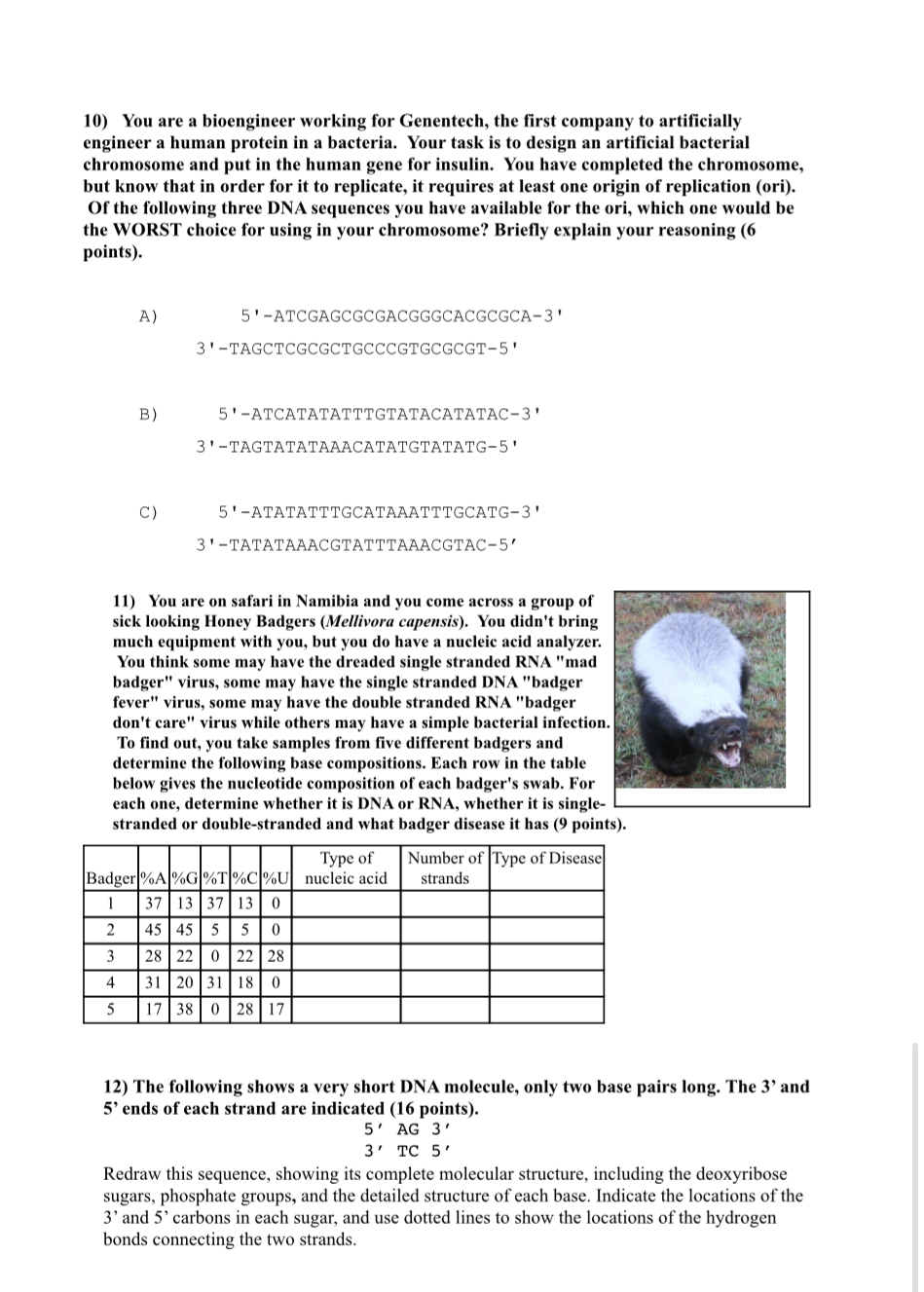
10) You are a bioengineer working for Genentech, the first company to artificially engineer a human protein in a bacteria. Your task is to design an artificial bacterial chromosome and put in the human gene for insulin. You have completed the chromosome, but know that in order for it to replicate, it requires at least one origin of replication (ori). Of the following three DNA sequences you have available for the ori, which one would be the WORST choice for using in your chromosome? Briefly explain your reasoning (6 points). A) 5 ' -ATCGAGCGCGACGGGCACGCGCA-3' 3' -TAGCTCGCGCTGCCCGTGCGCGT-5' B) 5' -ATCATATATTTGTATACATATAC-3' 3 ' -TAGTATATAAACATATGTATATG-5' C) 5 ' -ATATATTTGCATAAATTTGCATG-3 ' 3 ' -TATATAAACGTATTTAAACGTAC-5' 11) You are on safari in Namibia and you come across a group of sick looking Honey Badgers (Mellivora capensis). You didn't bring much equipment with you, but you do have a nucleic acid analyzer. You think some may have the dreaded single stranded RNA "mad badger" virus, some may have the single stranded DNA "badger fever" virus, some may have the double stranded RNA "badger don't care" virus while others may have a simple bacterial infection. To find out, you take samples from five different badgers and determine the following base compositions. Each row in the table below gives the nucleotide composition of each badger's swab. For each one, determine whether it is DNA or RNA, whether it is single- stranded or double-stranded and what badger disease it has (9 points). Type of Number of Type of Disease Badger %A %GT %CU nucleic acid strands 37 13 37 13 0 2 45 45 5 0 3 28 22 0 22 28 4 31 20 31 18 5 38 28 17 12) The following shows a very short DNA molecule, only two base pairs long. The 3' and 5' ends of each strand are indicated (16 points). 5' AG 3' 3' TC 5' Redraw this sequence, showing its complete molecular structure, including the deoxyribose sugars, phosphate groups, and the detailed structure of each base. Indicate the locations of the 3' and 5' carbons in each sugar, and use dotted lines to show the locations of the hydrogen bonds connecting the two strands
Step by Step Solution
There are 3 Steps involved in it

Get step-by-step solutions from verified subject matter experts
 Study Help