







Question: 101 PROBLEM 9.3A througe Issues involving Alternative L03 Depreciation Methods Smart Hardware purchased new shelving for its store on April 1, 2011. The shelving is
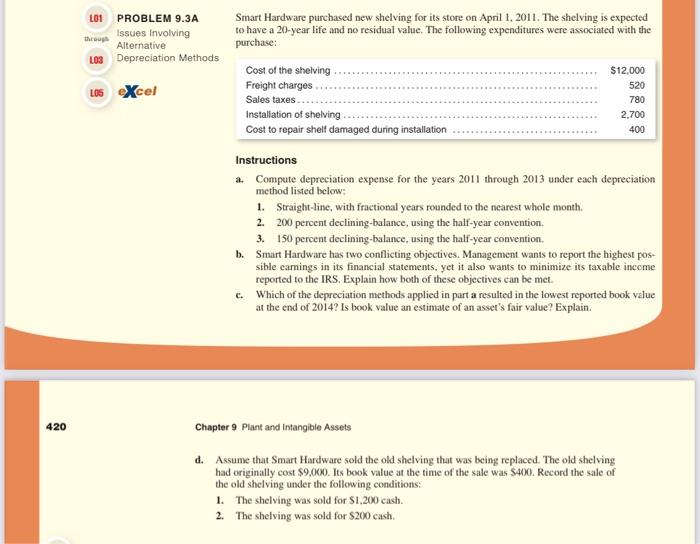
101 PROBLEM 9.3A througe Issues involving Alternative L03 Depreciation Methods Smart Hardware purchased new shelving for its store on April 1, 2011. The shelving is expected to have a 20-year life and no residual value. The following expenditures were associated with the purchase: LOS Xcel Cost of the shelving Freight charges Sales taxes. Installation of shelving Cost to repair shelf damaged during installation $12,000 520 780 2.700 400 Instructions a. Compute depreciation expense for the years 2011 through 2013 under each depreciation method listed below: 1. Straight-line, with fractional years rounded to the nearest whole month. 2. 200 percent declining-balance, using the half-year convention 3. 150 percent declining-balance, using the half-year convention b. Smart Hardware has two conflicting objectives. Management wants to report the highest pos- sible camings in its financial statements, yet it also wants to minimize its taxable inccme reported to the IRS. Explain how both of these objectives can be met. c. Which of the depreciation methods applied in part a resulted in the lowest reported book value at the end of 2014? Is book value an estimate of an asset's fair value? Explain. 420 Chapter 9 Plant and Intangible Assets d. Assume that Smart Hardware sold the old shelving that was being replaced. The old shelving had originally cost $9.000. Its book value at the time of the sale was $400. Record the sale of the old shelving under the following conditions: 1. The shelving was sold for $1.200 cash. 2. The shelving was sold for $200 cash
Step by Step Solution
There are 3 Steps involved in it

Get step-by-step solutions from verified subject matter experts
 Study Help