







Question: 10-2: Your company is evaluating two mutually exclusive projects that each have an initial outlay of $180,000. Free cash flows are scheduled in the table
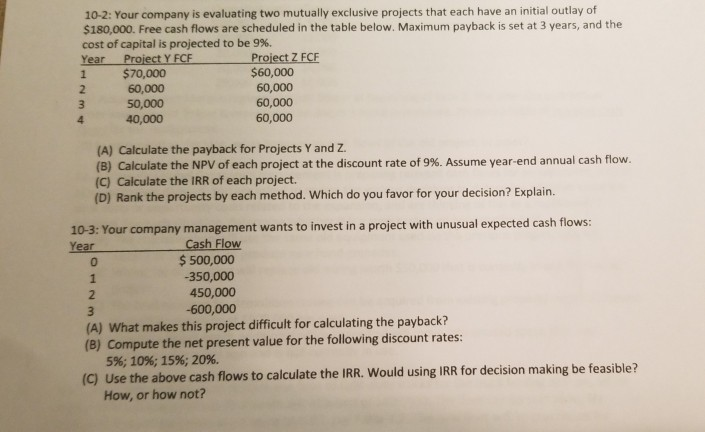
10-2: Your company is evaluating two mutually exclusive projects that each have an initial outlay of $180,000. Free cash flows are scheduled in the table below. Maximum payback is set at 3 years, and the cost of capital is projected to be 9%. Year Project Y FCF Project Z FCF 1 $70,000 $60,000 2 60,000 60,000 3 50,000 60,000 4 40,000 60,000 (A) Calculate the payback for Projects Y and Z. (B) Calculate the NPV of each project at the discount rate of 9%. Assume year-end annual cash flow. (C) Calculate the IRR of each project. (D) Rank the projects by each method. Which do you favor for your decision? Explain. 10-3: Your company management wants to invest in a project with unusual expected cash flows: Year Cash Flow 0 $ 500,000 1 -350,000 2 450,000 3 -600,000 (A) What makes this project difficult for calculating the payback? (B) Compute the net present value for the following discount rates: 5%; 10%; 15%; 20%. (C) Use the above cash flows to calculate the IRR. Would using IRR for decision making be feasible? How, or how not
Step by Step Solution
There are 3 Steps involved in it

Get step-by-step solutions from verified subject matter experts
 Study Help