







Question: 10A-Lab Report: Simple Harmonic Motion - Mass on a Spring Name: Data Sketch your graph of Position versus Time for Run #1: Enn Data
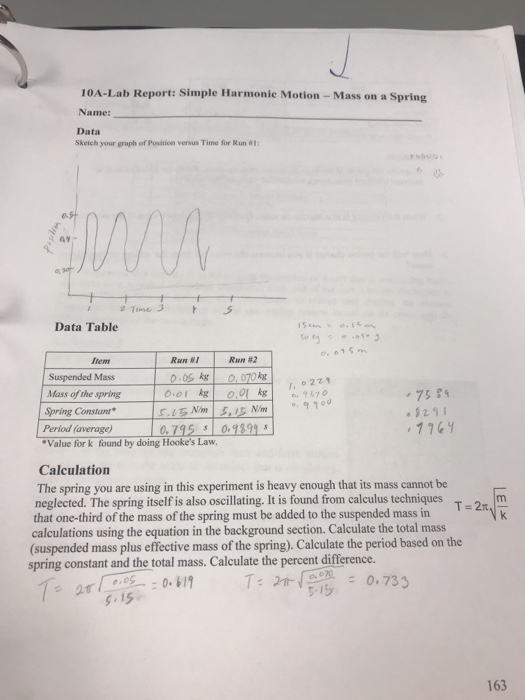
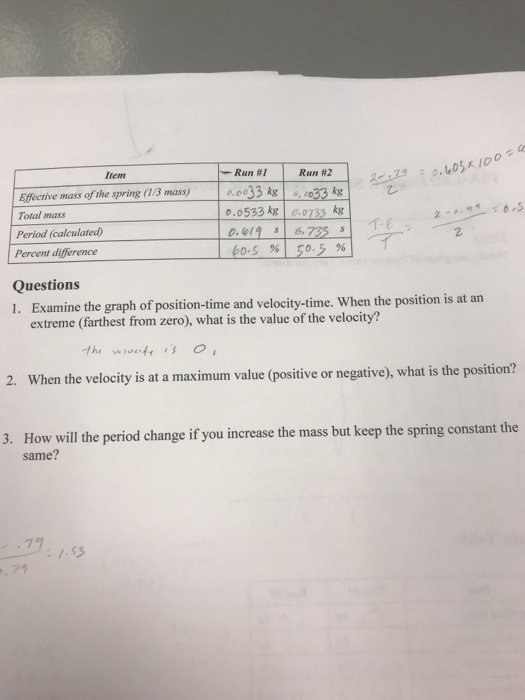
10A-Lab Report: Simple Harmonic Motion - Mass on a Spring Name: Data Sketch your graph of Position versus Time for Run #1: Enn Data Table 2 Time 3 r Item Run #1 Suspended Mass 0.05 kg Mass of the spring 0.01 kg Spring Constant 5.15 N/m Period (average) 0.795 *Value for k found by doing Hooke's Law. Run #2 0,070 kg 0.01 kg 5,15 N/m 0.9899 s T= 2010:05 = 0.619 5.15 15cm = 0.15m 50 kg.050 3 0.075m 1,0229 9570 0.9900 -75 89 .8291 7964 Calculation The spring you are using in this experiment is heavy enough that its mass cannot be neglected. The spring itself is also oscillating. It is found from calculus techniques that one-third of the mass of the spring must be added to the suspended mass in calculations using the equation in the background section. Calculate the total mass (suspended mass plus effective mass of the spring). Calculate the period based on the spring constant and the total mass. Calculate the percent difference. T = 22 = 0.733 5-15 T= 2 k 163 Item Effective mass of the spring (1/3 mass) Total mass Period (calculated) Percent difference -Run #1 Run #2 0.0033 kg, 0033 kg 0.0533 kg 0.0733 kg 0.419 s 6,733 60-5% 50.5% 2.79 2 10.405x100=60 -.79 1= 1.53 .79 2-0.94 2 Questions 1. Examine the graph of position-time and velocity-time. When the position is at an extreme (farthest from zero), what is the value of the velocity? = 6.5 the velveidy 13 0 2. When the velocity is at a maximum value (positive or negative), what is the position? 3. How will the peri change if you increase the mass but keep the spring constant the same?
Step by Step Solution
3.57 Rating (150 Votes )
There are 3 Steps involved in it
To answer your questions regarding the relationship between position velocity ... View full answer

Get step-by-step solutions from verified subject matter experts
 Study Help