







Question: 1.1 After reading the case study, explain how the motivational theory of Frederick Herzberg has been used by Wetherspoon pubs to ensure that their employees
1.1 After reading the case study, explain how the motivational theory of Frederick Herzberg has been used by Wetherspoon pubs to ensure that their employees offer the best customer service.......1.2.. After reading the above abstract on motivation give a futher discussion on your understand about the concept....1.3.. Provide a detailed discussion on the following early theories of motivation: (a) Self-determination theory......(b) Theory X and theory Y....(c) Two-factor theory....(d) McClelland theory of needs.
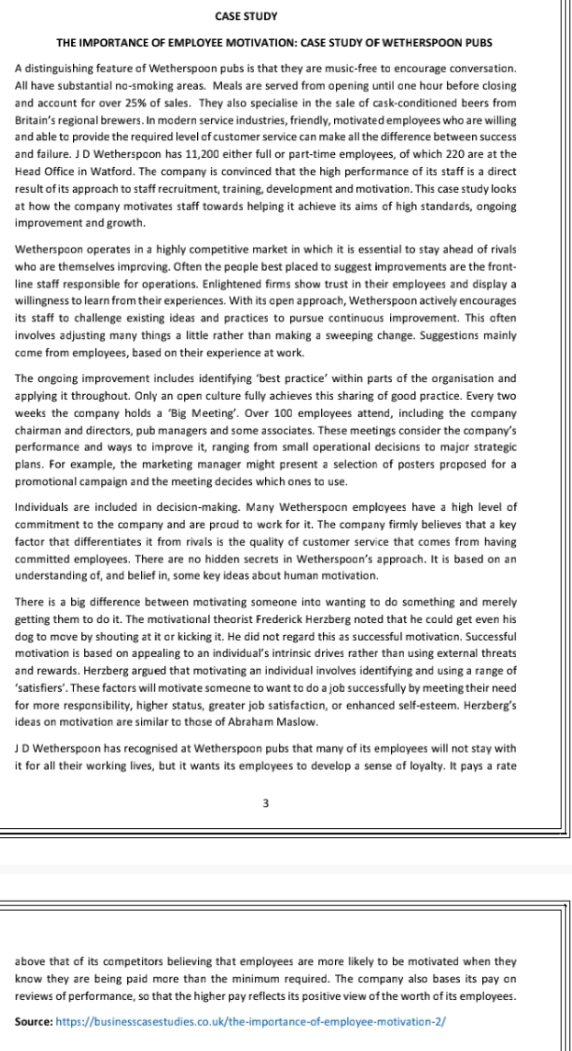
CASE STUDY THE IMPORTANCE OF EMPLOYEE MOTIVATION: CASE STUDY OF WETHERSPOON PUBS A distinguishing feature of Wetherspoon pubs is that they are music-free to encourage conversation. All have substantial no-smoking areas. Meals are served from opening until one hour before closing and account for over 25% of sales. They also specialise in the sale of cask-conditioned beers from Britain's regional brewers. In modern service industries, friendly, motivated employees who are willing and able to provide the required level of customer service can make all the difference between success and failure. J D Wetherspoon has 11,200 either full or part-time employees, of which 220 are at the Head Office in Watford. The company is convinced that the high performance of its staff is a direct result of its approach to staff recruitment, training, development and motivation. This case study looks at how the company motivates staff towards helping it achieve its aims of high standards, ongoing improvement and growth. Wetherspoon operates in a highly competitive market in which it is essential to stay ahead of rivals who are themselves improving. Often the people best placed to suggest improvements are the front- line staff responsible for operations. Enlightened firms show trust in their employees and display a willingness to learn from their experiences. With its open approach, Wetherspoon actively encourages its staff to challenge existing ideas and practices to pursue continuous improvement. This often involves adjusting many things a little rather than making a sweeping change. Suggestions mainly come from employees, based on their experience at work. The ongoing improvement includes identifying "best practice" within parts of the organisation and applying it throughout. Only an open culture fully achieves this sharing of good practice. Every two weeks the company holds a "Big Meeting'. Over 100 employees attend, including the company chairman and directors, pub managers and some associates. These meetings consider the company's performance and ways to improve it, ranging from small operational decisions to major strategic plans. For example, the marketing manager might present a selection of posters proposed for a promotional campaign and the meeting decides which ones to use. Individuals are included in decision-making. Many Wetherspoon employees have a high level of commitment to the company and are proud to work for it. The company firmly believes that a key factor that differentiates it from rivals is the quality of customer service that comes from having committed employees. There are no hidden secrets in Wetherspoon's approach. It is based on an understanding of, and belief in, some key ideas about human motivation. There is a big difference between motivating someone into wanting to do something and merely getting them to do it. The motivational theorist Frederick Herzberg noted that he could get even his dog to move by shouting at it or kicking it. He did not regard this as successful motivation. Successful motivation is based on appealing to an individual's intrinsic drives rather than using external threats and rewards. Herzberg argued that motivating an individual involves identifying and using a range of 'satisfiers'. These factors will motivate someone to want to do a job successfully by meeting their need for more responsibility, higher status, greater job satisfaction, or enhanced self-esteem. Herzberg's ideas on motivation are similar to those of Abraham Maslow. J D Wetherspoon has recognised at Wetherspoon pubs that many of its employees will not stay with it for all their working lives, but it wants its employees to develop a sense of loyalty. It pays a rate above that of its competitors believing that employees are more likely to be motivated when they know they are being paid more than the minimum required. The company also bases its pay on reviews of performance, so that the higher pay reflects its positive view of the worth of its employees. Source: https://businesscasestudies. co.uk/the-importance-of-employee-motivation-2/
Step by Step Solution
There are 3 Steps involved in it

Get step-by-step solutions from verified subject matter experts
 Study Help