







Question: 1-1 Basic Skills and Concepts Statistical Literacy and Critical Thinking 1. Online Medical Info USA Today posted this question on its website: How often do
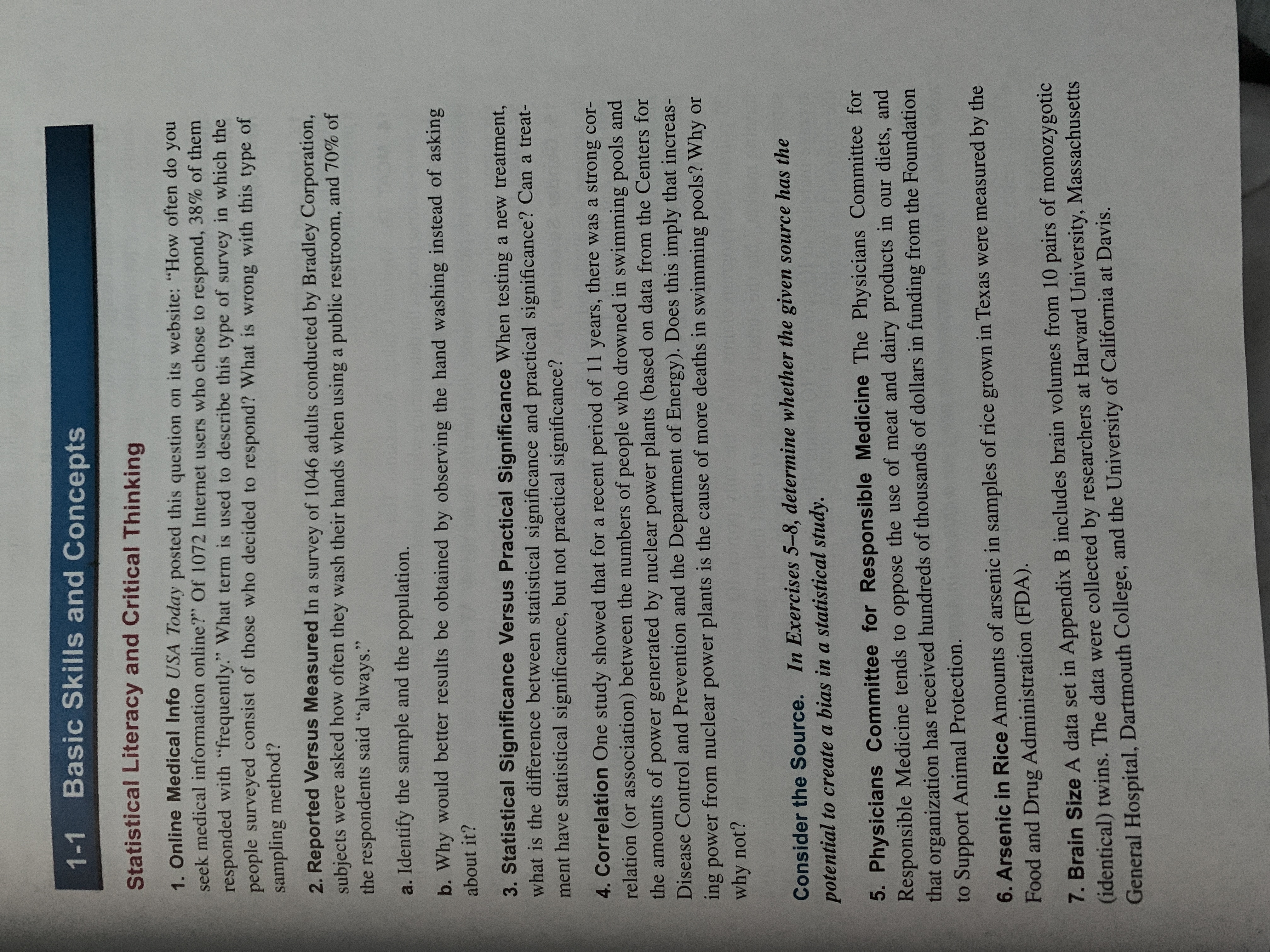
1-1 Basic Skills and Concepts Statistical Literacy and Critical Thinking 1. Online Medical Info USA Today posted this question on its website: "How often do you seek medical information online?" Of 1072 Internet users who chose to respond, 38% of them responded with "frequently." What term is used to describe this type of survey in which the people surveyed consist of those who decided to respond? What is wrong with this type of sampling method? 2. Reported Versus Measured In a survey of 1046 adults conducted by Bradley Corporation, subjects were asked how often they wash their hands when using a public restroom, and 70% of the respondents said "always." a. Identify the sample and the population. b. Why would better results be obtained by observing the hand washing instead of asking about it? 3. Statistical Significance Versus Practical Significance When testing a new treatment, what is the difference between statistical significance and practical significance? Can a treat- ment have statistical significance, but not practical significance? 4. Correlation One study showed that for a recent period of 1 1 years, there was a strong cor- relation (or association) between the numbers of people who drowned in swimming pools and the amounts of power generated by nuclear power plants (based on data from the Centers for Disease Control and Prevention and the Department of Energy). Does this imply that increase ing power from nuclear power plants is the cause of more deaths in swimming pools? Why or why not? Consider the Source. In Exercises 5-8, determine whether the given source has the potential to create a bias in a statistical study. 5. Physicians Committee for Responsible Medicine The Physicians Committee for Responsible Medicine tends to oppose the use of meat and dairy products in our diets, and that organization has received hundreds of thousands of dollars in funding from the Foundation to Support Animal Protection. 6. Arsenic in Rice Amounts of arsenic in samples of rice grown in Texas were measured by the Food and Drug Administration (FDA). 7. Brain Size A data set in Appendix B includes brain volumes from 10 pairs of monozygotic (identical) twins. The data were collected by researchers at Harvard University, Massachusetts General Hospital, Dartmouth College, and the University of California at Davis
Step by Step Solution
There are 3 Steps involved in it

Get step-by-step solutions from verified subject matter experts
 Study Help