







Question: 11. Consider a transmitter-receiver that encodes an 11-bit message using Hamming error correction. (30 total) a. Show that a system using 4 checek bits will
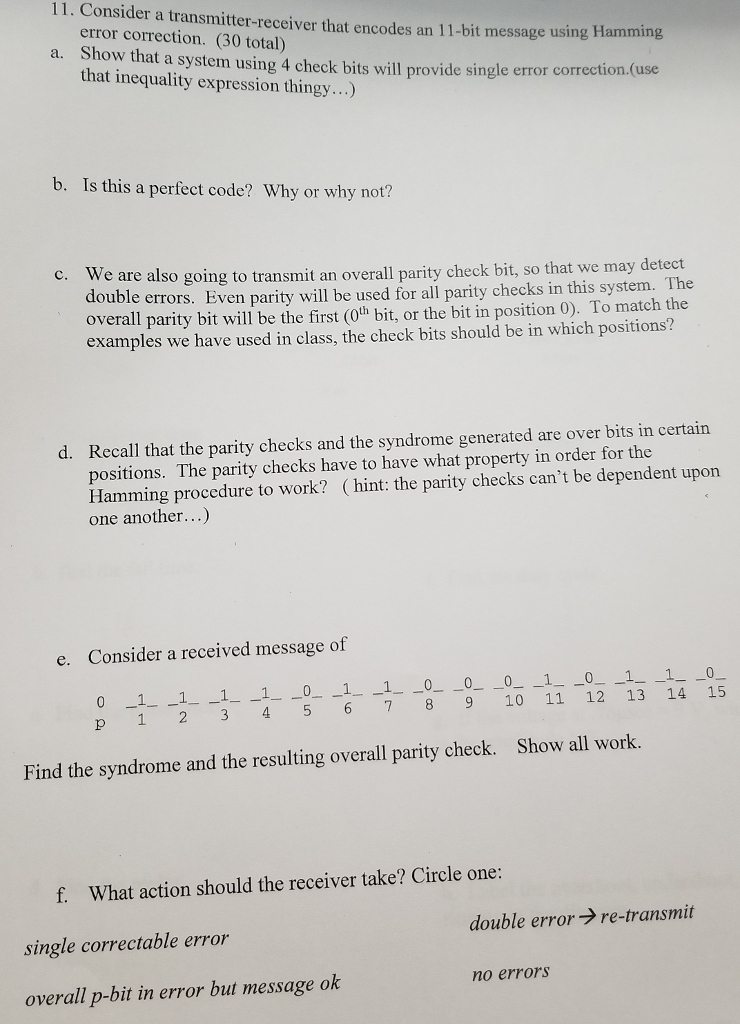
11. Consider a transmitter-receiver that encodes an 11-bit message using Hamming error correction. (30 total) a. Show that a system using 4 checek bits will provide single error correction (use that inequality expression thingy...) b. Is this a perfect code? Why or why not? c. W e are also going to transmit an overall parity check bit, so that we may detect ouble errors. Even parity will be used for all parity checks in this system. The overall parity bit will be the first (0th bit, or the bit in position 0). To match the examples we have used in class, the check bits should be in which positions? Recall that the parity checks and the syndrome generated are over bits in certain positions. The parity checks have to have what property in order for the Hamming procedure to work? (hint: the parity checks can't be dependent upon one another...) d. Consider a received message of e. p 1 2 3 45 6 7 89 10 11 12 13 14 15 Show all work. Find the syndrome and the resulting overall parity check. f. What action should the receiver take? Circle one: single correctable error overall p-bit in error but message ok double errorre-transmit no errors 11. Consider a transmitter-receiver that encodes an 11-bit message using Hamming error correction. (30 total) a. Show that a system using 4 checek bits will provide single error correction (use that inequality expression thingy...) b. Is this a perfect code? Why or why not? c. W e are also going to transmit an overall parity check bit, so that we may detect ouble errors. Even parity will be used for all parity checks in this system. The overall parity bit will be the first (0th bit, or the bit in position 0). To match the examples we have used in class, the check bits should be in which positions? Recall that the parity checks and the syndrome generated are over bits in certain positions. The parity checks have to have what property in order for the Hamming procedure to work? (hint: the parity checks can't be dependent upon one another...) d. Consider a received message of e. p 1 2 3 45 6 7 89 10 11 12 13 14 15 Show all work. Find the syndrome and the resulting overall parity check. f. What action should the receiver take? Circle one: single correctable error overall p-bit in error but message ok double errorre-transmit no errors
Step by Step Solution
There are 3 Steps involved in it

Get step-by-step solutions from verified subject matter experts
 Study Help