







Question: #11 For one binomial experiment, n 1 = 75 binomial trials produced r 1 =60 successes. For a second independent binomial experiment, n 2 =
#11
For one binomial experiment,n1= 75
binomial trials producedr1=60
successes. For a second independent binomial experiment,n2= 100
binomial trials producedr2=85
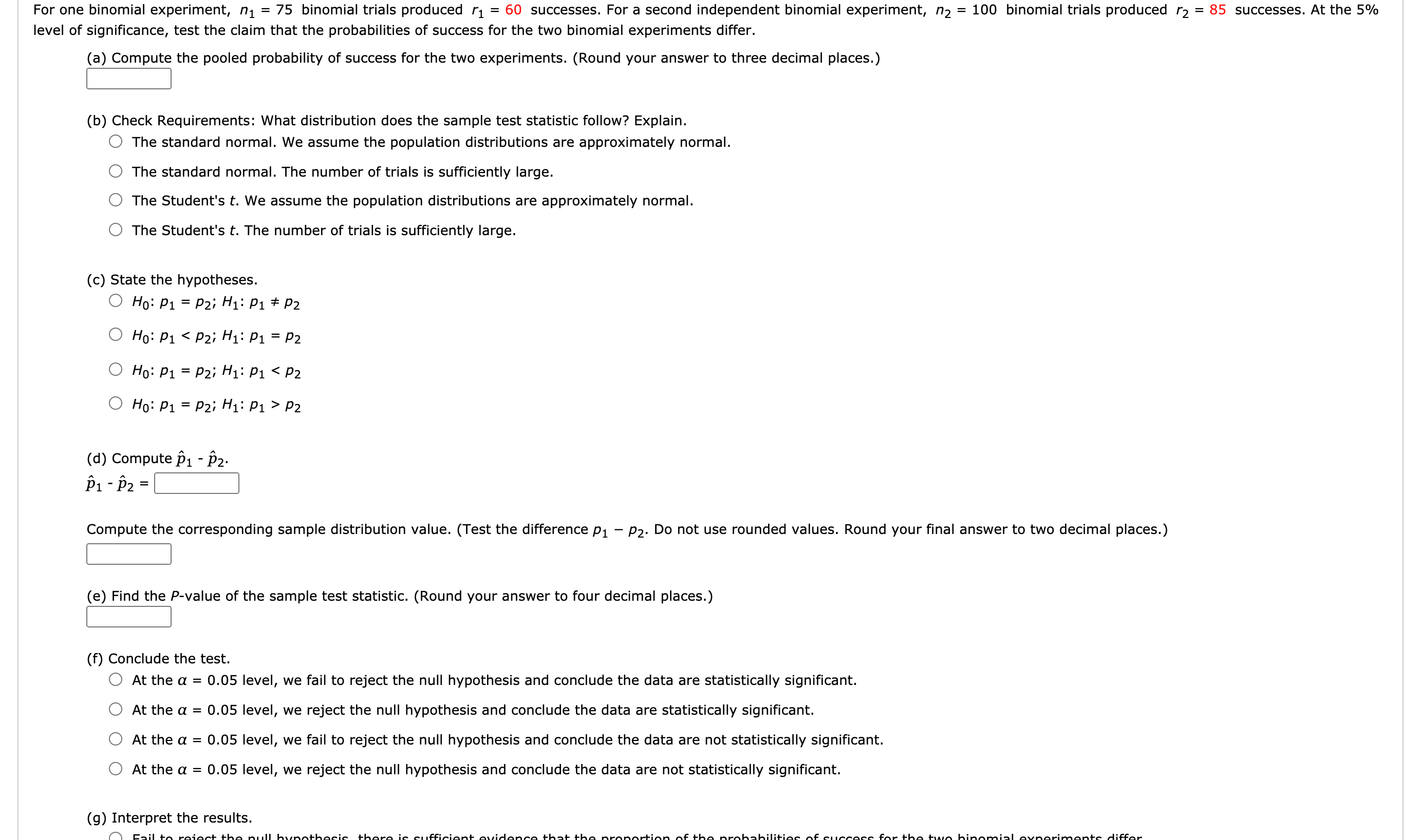
successes.At the 5% level of significance, test the claim that the probabilities of success for the two binomial experiments differ.
(a) Compute the pooled probability of success for the two experiments. (Round your answer to three decimal places.)
(b) Check Requirements: What distribution does the sample test statistic follow? Explain.
The standard normal. We assume the population distributions are approximately normal.
The standard normal. The number of trials is sufficiently large.
The Student'st. We assume the population distributions are approximately normal.
The Student'st. The number of trials is sufficiently large.
(c) State the hypotheses.
H0:p1=p2;H1:p1?p2
H0:p1p2;H1:p1=p2
H0:p1=p2;H1:p1p2
H0:p1=p2;H1:p1>p2
(d) Computep?1-p?2.
p?1-p?2=
Compute the corresponding sample distribution value. (Test the differencep1?p2. Do not use rounded values. Round your final answer to two decimal places.)
(e) Find theP-value of the sample test statistic. (Round your answer to four decimal places.)
(f) Conclude the test.
At the?= 0.05 level, we fail to reject the null hypothesis and conclude the data are statistically significant.
At the?= 0.05 level, we reject the null hypothesis and conclude the data are statistically significant.
At the?= 0.05 level, we fail to reject the null hypothesis and conclude the data are not statistically significant.
At the?= 0.05 level, we reject the null hypothesis and conclude the data are not statistically significant.
(g) Interpret the results.
Fail to reject the null hypothesis, there is sufficient evidence that the proportion of the probabilities of success for the two binomial experiments differ.
Fail to reject the null hypothesis, there is insufficient evidence that the probabilities of success for the two binomial experiments differ.
Reject the null hypothesis, there is insufficient evidence that the proportion of the probabilities of success for the two binomial experiments differ.
Reject the null hypothesis, there is sufficient evidence that the proportion of the probabilities of success for the two binomial experiments differ.

For one binomial experiment, n1 = 75 binomial trials produced 1 = 60 successes. For a second independent binomial experiment, n2 = 100 binomial trials produced /2 = 85 successes. At the 5% level of significance, test the claim that the probabilities of success for the two binomial experiments differ. (a) Compute the pooled probability of success for the two experiments. (Round your answer to three decimal places.) (b) Check Requirements: What distribution does the sample test statistic follow? Explain. The standard normal. We assume the population distributions are approximately normal. The standard normal. The number of trials is sufficiently large. The Student's t. We assume the population distributions are approximately normal. O The Student's t. The number of trials is sufficiently large. (c) State the hypotheses. O Ho: P1 = P2; H1 : P1 * P2 O Ho: P1 P2 (d) Compute p1 - P2. P1 - P2 = Compute the corresponding sample distribution value. (Test the difference p1 - P2. Do not use rounded values. Round your final answer to two decimal places.) (e) Find the P-value of the sample test statistic. (Round your answer to four decimal places.) (f) Conclude the test. O At the a = 0.05 level, we fail to reject the null hypothesis and conclude the data are statistically significant. At the a = 0.05 level, we reject the null hypothesis and conclude the data are statistically significant. O At the a = 0.05 level, we fail to reject the null hypothesis and conclude the data are not statistically significant. O At the a = 0.05 level, we reject the null hypothesis and conclude the data are not statistically significant. (g) Interpret the results.(9) Interpret the results. O Fail to reject the null hypothesis, there is sufficient evidence that the proportion of the probabilities of success for the two binomial experiments differ. Fail to reject the null hypothesis, there is insufficient evidence that the probabilities of success for the two binomial experiments differ. Reject the null hypothesis, there is insufficient evidence that the proportion of the probabilities of success for the two binomial experiments differ. O Reject the null hypothesis, there is sufficient evidence that the proportion of the probabilities of success for the two binomial experiments differ
Step by Step Solution
There are 3 Steps involved in it

Get step-by-step solutions from verified subject matter experts
 Study Help