







Question: 1.1. How many isomers would you expect for a complex with an empirical formula corresponding to Pt(NH3)2Cl2 ? 1.2. What dn configurations should be assigned
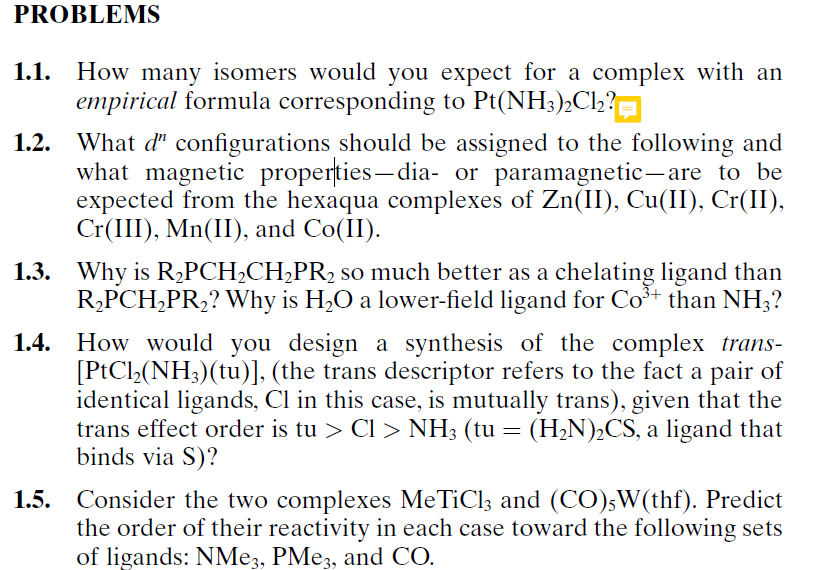
1.1. How many isomers would you expect for a complex with an empirical formula corresponding to Pt(NH3)2Cl2 ? 1.2. What dn configurations should be assigned to the following and what magnetic properties-dia- or paramagnetic-are to be expected from the hexaqua complexes of Zn(II),Cu(II),Cr(II), Cr (III), Mn(II), and Co(II). 1.3. Why is R2PCH2CH2PR2 so much better as a chelating ligand than R2PCH2PR2 ? Why is H2O a lower-field ligand for Co3+ than NH3 ? 1.4. How would you design a synthesis of the complex trans[PtCl2(NH3)(tu)], (the trans descriptor refers to the fact a pair of identical ligands, Cl in this case, is mutually trans), given that the trans effect order is tu>Cl>NH3(tu=(H2N)2CS, a ligand that binds via S) ? 1.5. Consider the two complexes MeTiCl3 and (CO)5W( thf ). Predict the order of their reactivity in each case toward the following sets of ligands: NMe3,PMe3, and CO
Step by Step Solution
There are 3 Steps involved in it

Get step-by-step solutions from verified subject matter experts
 Study Help