







Question: 11. If a.function.is.integrable.then.it must be.differentiable. ...1 12.> The fact. that.f.is.an.integrable.function.implies.that.there. always. exists.a.differentiable.function, .F(x), such.that.F'(x)=.f(x). 1 13.> If functions.f, and.g are.differentiable, and .have.a.maximum. distance between the
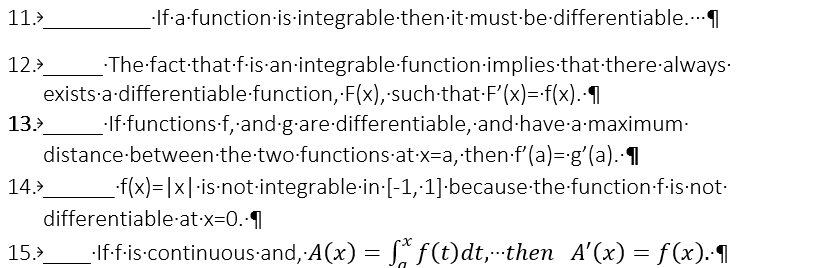
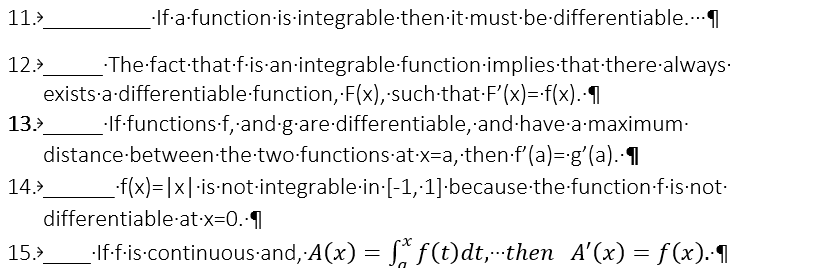
11. If a.function.is.integrable.then.it must be.differentiable. ...1 12.> The fact. that.f.is.an.integrable.function.implies.that.there. always. exists.a.differentiable.function, .F(x), such.that.F'(x)=.f(x). 1 13.> If functions.f, and.g are.differentiable, and .have.a.maximum. distance between the two.functions.at.x=a, then.f'(a)= g'(a). 1 14.> .f(x)=|x| .is.not.integrable.in.[-1, .1].because.the. function.f.is.not. differentiable at.x=0. .1 15.> If.f.is.continuous.and, A(x) = [ f(t)dt,..then A'(x) =f(x).1
Step by Step Solution
There are 3 Steps involved in it
1 Expert Approved Answer
Step: 1 Unlock

Question Has Been Solved by an Expert!
Get step-by-step solutions from verified subject matter experts
Step: 2 Unlock
Step: 3 Unlock
 Study Help