





Question: 11. In the simple queueing model of Example 11.6 suppose that the waiting line can be at most K individuals (including the one in service).

11. In the simple queueing model of Example 11.6
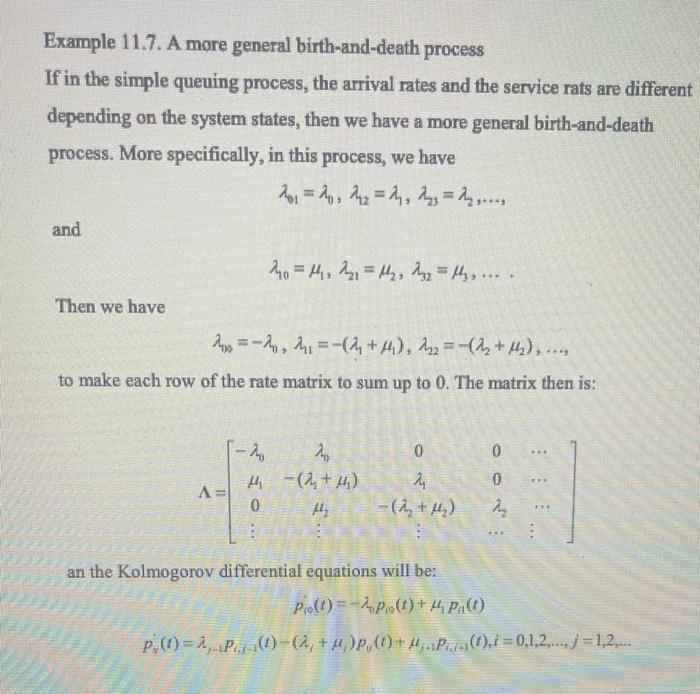
11. In the simple queueing model of Example 11.6 suppose that the waiting line can be at most K individuals (including the one in service). Write the Kolmogorov Forward Equations and determine A. Example 11.7. A more general birth-and-death process If in the simple queuing process, the arrival rates and the service rats are different depending on the system states, then we have a more general birth-and-death process. More specifically, in this process, we have 2012, 22 =2 y = ... and 20 = 4,2 = 12, 132 = My, ... . Then we have 100 = 2,2=-(2 + 4), 12 =-(+1), ..., to make each row of the rate matrix to sum up to 0. The matrix then is: 0 0 2 (1+4) 0 A= 24 - (2+) 0 2 an the Kolmogorov differential equations will be Pield) = -2.po(t) + H, Pat) p.(0) = 1.-P.:-(1)-(a,+ l)p, (+ 4P(0,1 =0,1,2,..., j = 1,2,... 11. In the simple queueing model of Example 11.6 suppose that the waiting line can be at most K individuals (including the one in service). Write the Kolmogorov Forward Equations and determine A. Example 11.7. A more general birth-and-death process If in the simple queuing process, the arrival rates and the service rats are different depending on the system states, then we have a more general birth-and-death process. More specifically, in this process, we have 2012, 22 =2 y = ... and 20 = 4,2 = 12, 132 = My, ... . Then we have 100 = 2,2=-(2 + 4), 12 =-(+1), ..., to make each row of the rate matrix to sum up to 0. The matrix then is: 0 0 2 (1+4) 0 A= 24 - (2+) 0 2 an the Kolmogorov differential equations will be Pield) = -2.po(t) + H, Pat) p.(0) = 1.-P.:-(1)-(a,+ l)p, (+ 4P(0,1 =0,1,2,..., j = 1,2

Step by Step Solution

There are 3 Steps involved in it

1 Expert Approved Answer
Step: 1 Unlock blur-text-image

Question Has Been Solved by an Expert!

Get step-by-step solutions from verified subject matter experts

Step: 2 Unlock
Step: 3 Unlock

Students Have Also Explored These Related General Management Questions!