







Question: (11%) Problem 8: A sphere ofmass m : 4.5 kg can move across a horizontal, frictionless surface. Attached to the sphere is an ideal spring
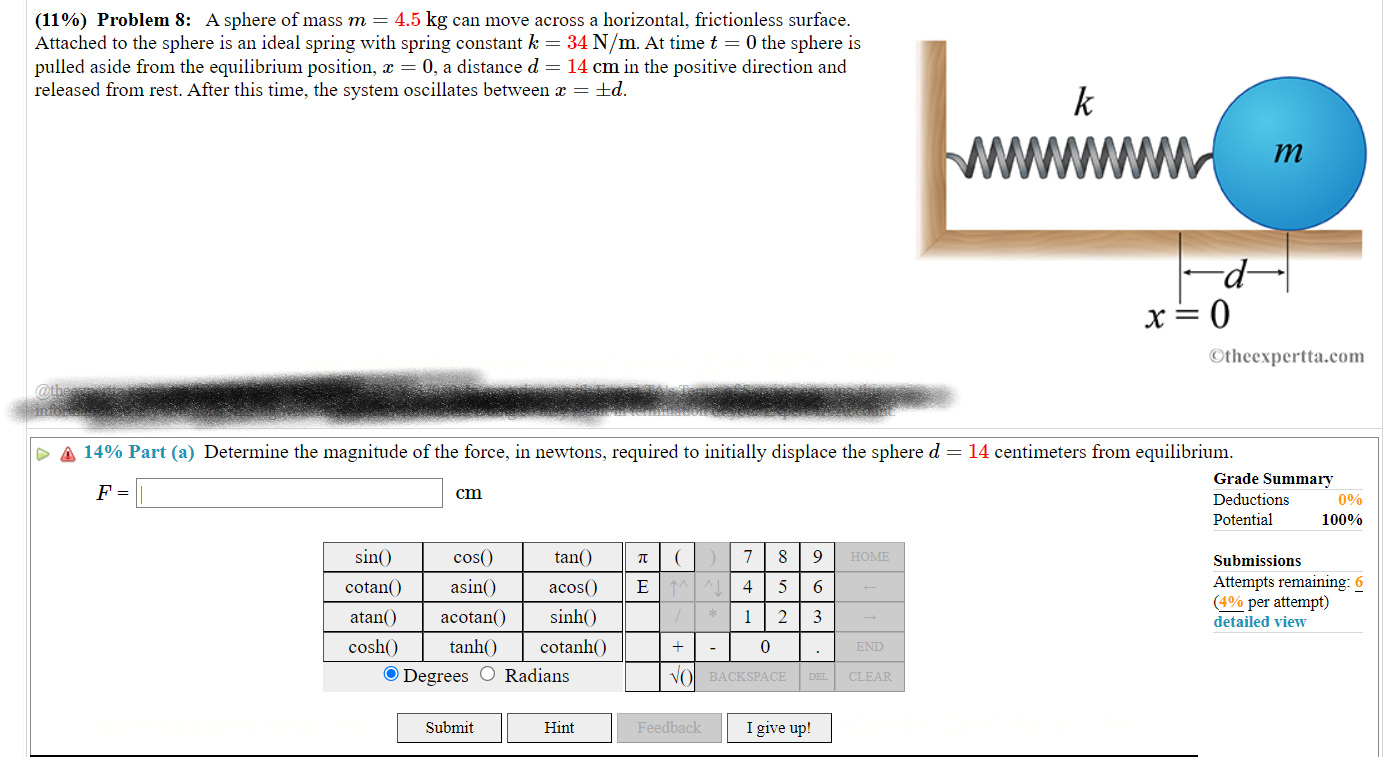

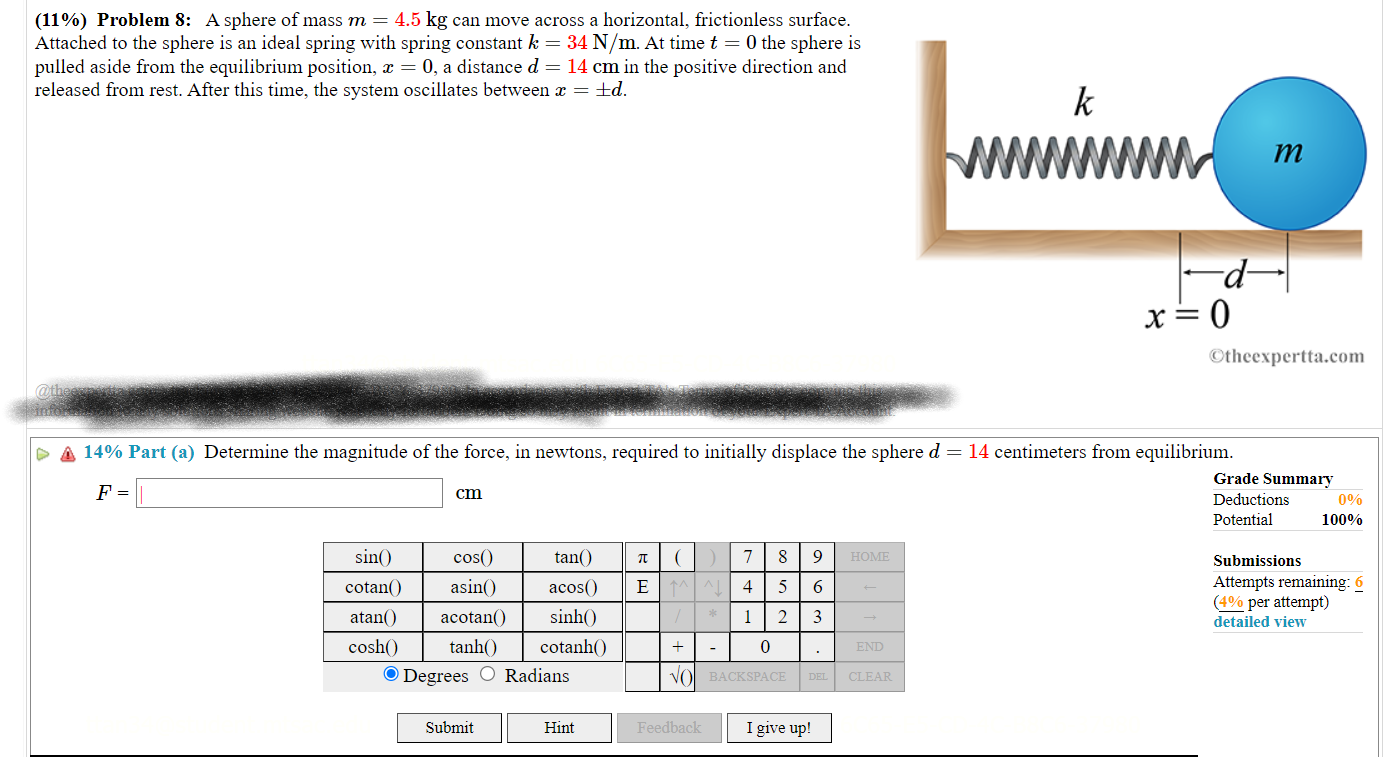

(11%) Problem 8: A sphere ofmass m : 4.5 kg can move across a horizontal, frictionless surface. Attached to the sphere is an ideal spring with spring constant k = 34 N/m. At time t = 0 the sphere is pulled aside from the equilibrium position, a: = D, a distance d = 14 cm in the positive direction and released from rest. After this time, the system oscillates between .7: : :d. tit hcmpur'ttaxmn L' - 14% Part (3) Determine the magnitude of the force, in newtons. required to initially displace the sphere d = 14 centimeters from equilibrium. Grade Summary F = l CID Deductions 0% Potential 100% Submissions Attempts remaining: g ( per attempt) detailed View tanhO Degrees O Radians Submit Him Feedback I Igive up! & 14% Part (L) What is the sphere's distance from equilibrium. in meters. at time t = 1 second? a 14% Part (c) Determine the frequency= in hertz. with which the springimass system oscillates after being released. & 14% Part ((1) Calculate the maximum speed, in meters per second, attained by the sphere. & 14% Part (9) At what point in the motion does the sphere reach maximum speed? a 14% Part (I) Calculate the magnitude of the maximum acceleration. in meters per second squared. experienced by the sphere. a 14% Part (g) At what point[s] in the motion does the sphere experience maximum acceleration? Select all that apply
Step by Step Solution
There are 3 Steps involved in it

Get step-by-step solutions from verified subject matter experts
 Study Help