







Question: (11) The Factorization Theorem can be used to find a sufficient statistic. (12) If T is a sufficient statistic, then T2 is also a sufficient
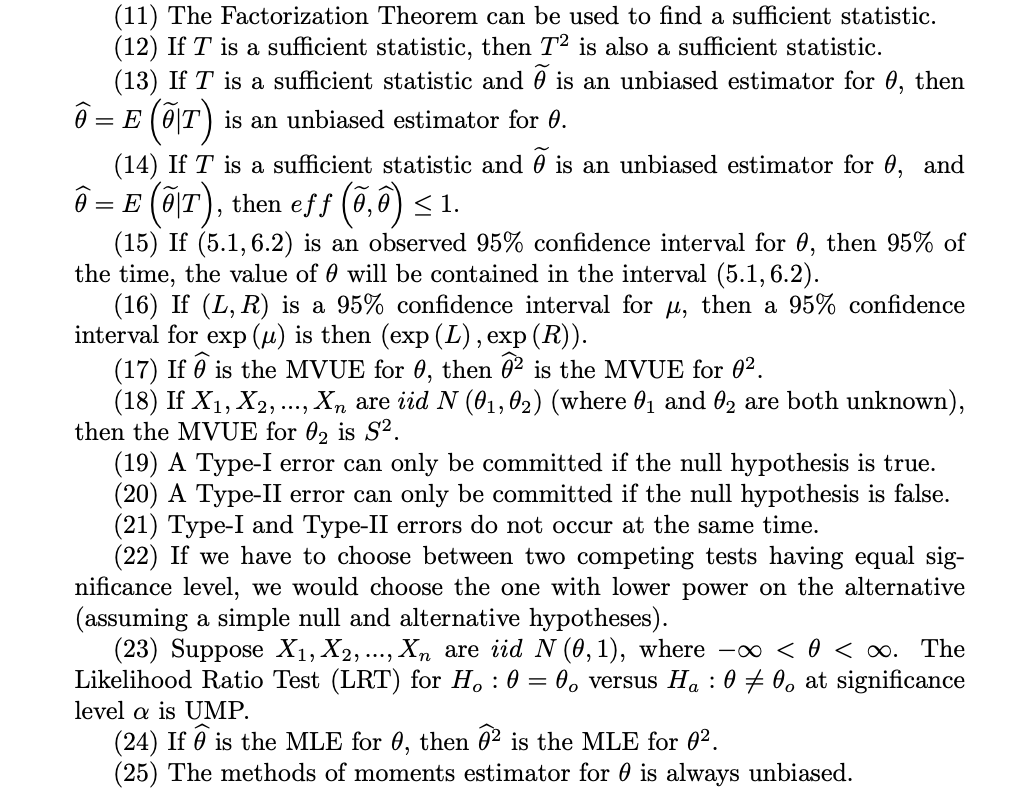
(11) The Factorization Theorem can be used to find a sufficient statistic. (12) If T is a sufficient statistic, then T2 is also a sufficient statistic. (13) If T is a sufficient statistic and 0 is an unbiased estimator for 0, then 0 = E O|T is an unbiased estimator for 0. (14) If T is a sufficient statistic and 0 is an unbiased estimator for 0, and 0 = EO T) , then eff (0, 0) 51. (15) If (5.1, 6.2) is an observed 95% confidence interval for 0, then 95% of the time, the value of 0 will be contained in the interval (5.1, 6.2). (16) If (L, R) is a 95% confidence interval for , then a 95% confidence interval for exp (u) is then (exp (L) , exp (R)). (17) If 0 is the MVUE for 0, then 02 is the MVUE for 02. (18) If X1, X2, ..., Xn are iid N (01, 02) (where 01 and 02 are both unknown), then the MVUE for 02 is $2. (19) A Type-I error can only be committed if the null hypothesis is true. (20) A Type-II error can only be committed if the null hypothesis is false. (21) Type-I and Type-II errors do not occur at the same time. (22) If we have to choose between two competing tests having equal sig- nificance level, we would choose the one with lower power on the alternative (assuming a simple null and alternative hypotheses). (23) Suppose X1, X2, ..., Xn are iid N (0, 1), where -co
Step by Step Solution
There are 3 Steps involved in it

Get step-by-step solutions from verified subject matter experts
 Study Help