



Question: (1-1) This notion helps you to factor the common factor of the additive elements, and you have (1-2) but the amount money you have the
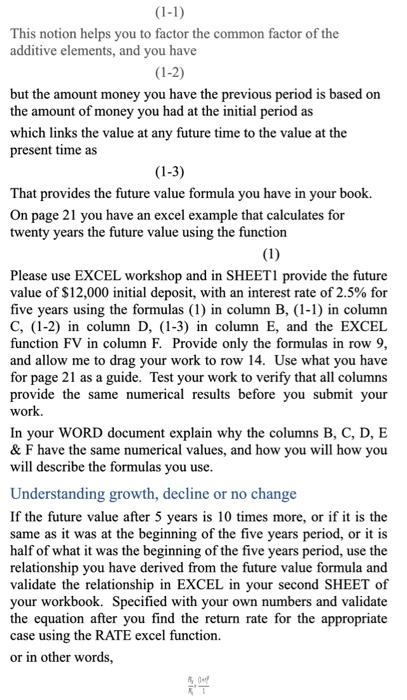
(1-1) This notion helps you to factor the common factor of the additive elements, and you have (1-2) but the amount money you have the previous period is based on the amount of money you had at the initial period as which links the value at any future time to the value at the present time as (1-3) That provides the future value formula you have in your book. On page 21 you have an excel example that calculates for twenty years the future value using the function (1) Please use EXCEL workshop and in SHEET1 provide the future value of $12,000 initial deposit, with an interest rate of 2.5% for five years using the formulas (1) in column B, (1-1) in column C, (1-2) in column D, (1-3) in column E, and the EXCEL function FV in column F. Provide only the formulas in row 9, and allow me to drag your work to row 14. Use what you have for page 21 as a guide. Test your work to verify that all columns provide the same numerical results before you submit your work. In your WORD document explain why the columns B, C, D, E & F have the same numerical values, and how you will how you will describe the formulas you use. Understanding growth, decline or no change If the future value after 5 years is 10 times more, or if it is the same as it was at the beginning of the five years period, or it is half of what it was the beginning of the five years period, use the relationship you have derived from the future value formula and validate the relationship in EXCEL in your second SHEET of your workbook. Specified with your own numbers and validate the equation after you find the return rate for the appropriate case using the RATE excel function. or in other words, 0 (1-1) This notion helps you to factor the common factor of the additive elements, and you have (1-2) but the amount money you have the previous period is based on the amount of money you had at the initial period as which links the value at any future time to the value at the present time as (1-3) That provides the future value formula you have in your book. On page 21 you have an excel example that calculates for twenty years the future value using the function (1) Please use EXCEL workshop and in SHEET1 provide the future value of $12,000 initial deposit, with an interest rate of 2.5% for five years using the formulas (1) in column B, (1-1) in column C, (1-2) in column D, (1-3) in column E, and the EXCEL function FV in column F. Provide only the formulas in row 9, and allow me to drag your work to row 14. Use what you have for page 21 as a guide. Test your work to verify that all columns provide the same numerical results before you submit your work. In your WORD document explain why the columns B, C, D, E & F have the same numerical values, and how you will how you will describe the formulas you use. Understanding growth, decline or no change If the future value after 5 years is 10 times more, or if it is the same as it was at the beginning of the five years period, or it is half of what it was the beginning of the five years period, use the relationship you have derived from the future value formula and validate the relationship in EXCEL in your second SHEET of your workbook. Specified with your own numbers and validate the equation after you find the return rate for the appropriate case using the RATE excel function. or in other words, 0
Step by Step Solution
There are 3 Steps involved in it

Get step-by-step solutions from verified subject matter experts