







Question: 1.10 desirable. we replaced a cylindrical problem with a linear approximation. The 1.10. In Example 1.2 we for this flow, taking the cylindrical character into
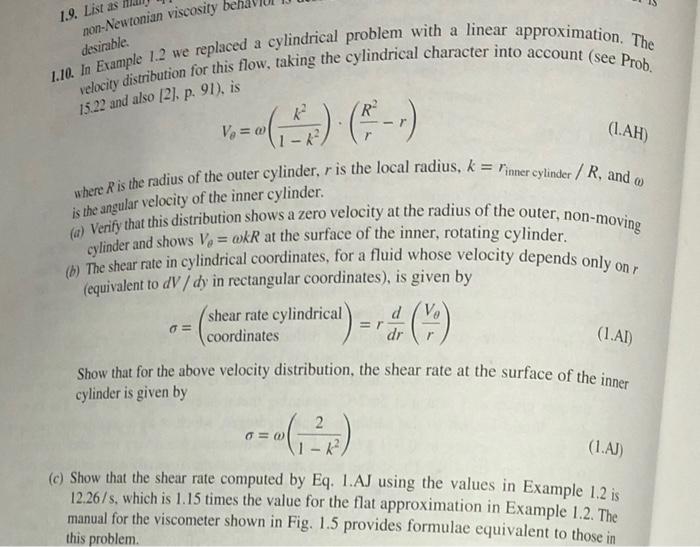
desirable. we replaced a cylindrical problem with a linear approximation. The 1.10. In Example 1.2 we for this flow, taking the cylindrical character into account (see Prob. velocity distribution [2], p, 91), is 15.22andalso[2].V=(1k2k2)(rR2r) where R is the radius of the outer cylinder, r is the local radius, k=rinnercylinder/R, and is the angular velocity of the inner cylinder. (a) Verify that this distribution shows a zero velocity at the radius of the outer, non-moving cylinder and shows V=kR at the surface of the inner, rotating cylinder. (b) The shear rate in cylindrical coordinates, for a fluid whose velocity depends only on r (equivalent to dV/dy in rectangular coordinates), is given by =(shearratecylindricalcoordinates)=rdrd(rV) Show that for the above velocity distribution, the shear rate at the surface of the inner cylinder is given by =(1k22) (c) Show that the shear rate computed by Eq. 1.AJ using the values in Example 1.2 is 12.26/s, which is 1.15 times the value for the flat approximation in Example 1.2. The manual for the viscometer shown in Fig. 1.5 provides formulae equivalent to those in this problem. desirable. we replaced a cylindrical problem with a linear approximation. The 1.10. In Example 1.2 we for this flow, taking the cylindrical character into account (see Prob. velocity distribution [2], p, 91), is 15.22andalso[2].V=(1k2k2)(rR2r) where R is the radius of the outer cylinder, r is the local radius, k=rinnercylinder/R, and is the angular velocity of the inner cylinder. (a) Verify that this distribution shows a zero velocity at the radius of the outer, non-moving cylinder and shows V=kR at the surface of the inner, rotating cylinder. (b) The shear rate in cylindrical coordinates, for a fluid whose velocity depends only on r (equivalent to dV/dy in rectangular coordinates), is given by =(shearratecylindricalcoordinates)=rdrd(rV) Show that for the above velocity distribution, the shear rate at the surface of the inner cylinder is given by =(1k22) (c) Show that the shear rate computed by Eq. 1.AJ using the values in Example 1.2 is 12.26/s, which is 1.15 times the value for the flat approximation in Example 1.2. The manual for the viscometer shown in Fig. 1.5 provides formulae equivalent to those in this
Step by Step Solution
There are 3 Steps involved in it

Get step-by-step solutions from verified subject matter experts
 Study Help