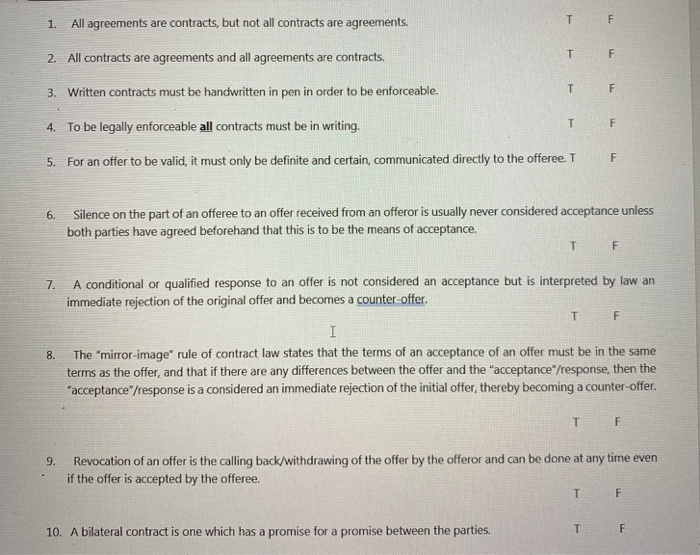
Question: 1-10 only true or false answer needed. better picture 1. All agreements are contracts, but not all contracts are agreements. T F 2. All contracts

1-10 only true or false answer needed. 1-10 only true or false answer needed. better
better picture 1-10 only true or false answer needed. better
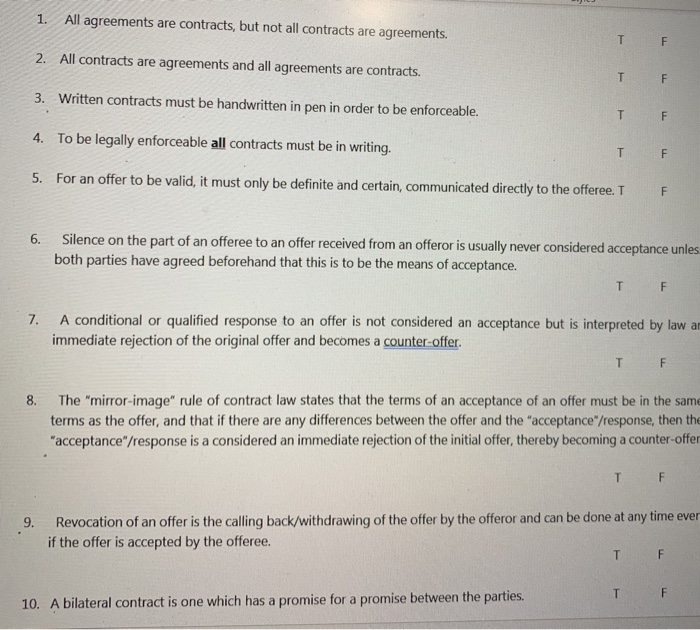
1. All agreements are contracts, but not all contracts are agreements. T F 2. All contracts are agreements and all agreements are contracts. T F 3. Written contracts must be handwritten in pen in order to be enforceable. T UL 4. To be legally enforceable all contracts must be in writing. TF 5. For an offer to be valid, it must only be definite and certain, communicated directly to the offeree. T F 6. Silence on the part of an offeree to an offer received from an offeror is usually never considered acceptance unles both parties have agreed beforehand that this is to be the means of acceptance. F T 7. A conditional or qualified response to an offer is not considered an acceptance but is interpreted by law an immediate rejection of the original offer and becomes a counter-offer. T 8. The "mirror-image" rule of contract law states that the terms of an acceptance of an offer must be in the same terms as the offer, and that if there are any differences between the offer and the acceptance"/response, then the "acceptance"/response is a considered an immediate rejection of the initial offer, thereby becoming a counter-offer T F 9. Revocation of an offer is the calling back/withdrawing of the offer by the offeror and can be done at any time ever if the offer is accepted by the offeree. TF T F 10. A bilateral contract is one which has a promise for a promise between the parties. 1. All agreements are contracts, but not all contracts are agreements. T F 2. All contracts are agreements and all agreements are contracts. T F 3. Written contracts must be handwritten in pen in order to be enforceable. T F 4. To be legally enforceable all contracts must be in writing. F F 5. For an offer to be valid, it must only be definite and certain, communicated directly to the offeree. T 6. Silence on the part of an offeree to an offer received from an offeror is usually never considered acceptance unless both parties have agreed beforehand that this is to be the means of acceptance. T F 7. A conditional or qualified response to an offer is not considered an acceptance but is interpreted by law an immediate rejection of the original offer and becomes a counter-offer. TF I The "mirror-image" rule of contract law states that the terms of an acceptance of an offer must be in the same terms as the offer, and that if there are any differences between the offer and the "acceptance"/response, then the acceptance"/response is a considered an immediate rejection of the initial offer, thereby becoming a counter-offer. 8. T F 9. Revocation of an offer is the calling back/withdrawing of the offer by the offeror and can be done at any time even if the offer is accepted by the offeree. T F 10. A bilateral contract is one which has a promise for a promise between the parties. T F

Step by Step Solution

There are 3 Steps involved in it

1 Expert Approved Answer
Step: 1 Unlock blur-text-image

Question Has Been Solved by an Expert!

Get step-by-step solutions from verified subject matter experts

Step: 2 Unlock
Step: 3 Unlock

Students Have Also Explored These Related General Management Questions!