





Question: 1.2 A part requires five (5) machining operations, each to be performed with a special tool. The time needed to complete each operation (including tool
1.2 A part requires five (5) machining

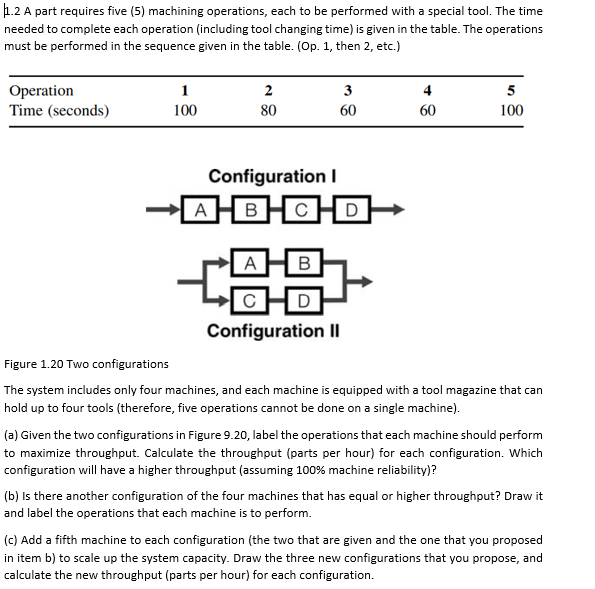
1.2 A part requires five (5) machining operations, each to be performed with a special tool. The time needed to complete each operation (including tool changing time) is given in the table. The operations must be performed in the sequence given in the table. (Op. 1, then 2, etc.) Figure 1.20 Two configurations The system includes only four machines, and each machine is equipped with a tool magazine that can hold up to four tools (therefore, five operations cannot be done on a single machine). (a) Given the two configurations in Figure 9.20, label the operations that each machine should perform to maximize throughput. Calculate the throughput (parts per hour) for each configuration. Which configuration will have a higher throughput (assuming 100% machine reliability)? (b) Is there another configuration of the four machines that has equal or higher throughput? Draw it and label the operations that each machine is to perform. (c) Add a fifth machine to each configuration (the two that are given and the one that you proposed in item b) to scale up the system capacity. Draw the three new configurations that you propose, and calculate the new throughput (parts per hour) for each configuration. 1.2 A part requires five (5) machining operations, each to be performed with a special tool. The time needed to complete each operation (including tool changing time) is given in the table. The operations must be performed in the sequence given in the table. (Op. 1, then 2, etc.) Figure 1.20 Two configurations The system includes only four machines, and each machine is equipped with a tool magazine that can hold up to four tools (therefore, five operations cannot be done on a single machine). (a) Given the two configurations in Figure 9.20, label the operations that each machine should perform to maximize throughput. Calculate the throughput (parts per hour) for each configuration. Which configuration will have a higher throughput (assuming 100% machine reliability)? (b) Is there another configuration of the four machines that has equal or higher throughput? Draw it and label the operations that each machine is to perform. (c) Add a fifth machine to each configuration (the two that are given and the one that you proposed in item b) to scale up the system capacity. Draw the three new configurations that you propose, and calculate the new throughput (parts per hour) for each configuration

Step by Step Solution

There are 3 Steps involved in it

1 Expert Approved Answer
Step: 1 Unlock blur-text-image

Question Has Been Solved by an Expert!

Get step-by-step solutions from verified subject matter experts

Step: 2 Unlock
Step: 3 Unlock

Students Have Also Explored These Related General Management Questions!