







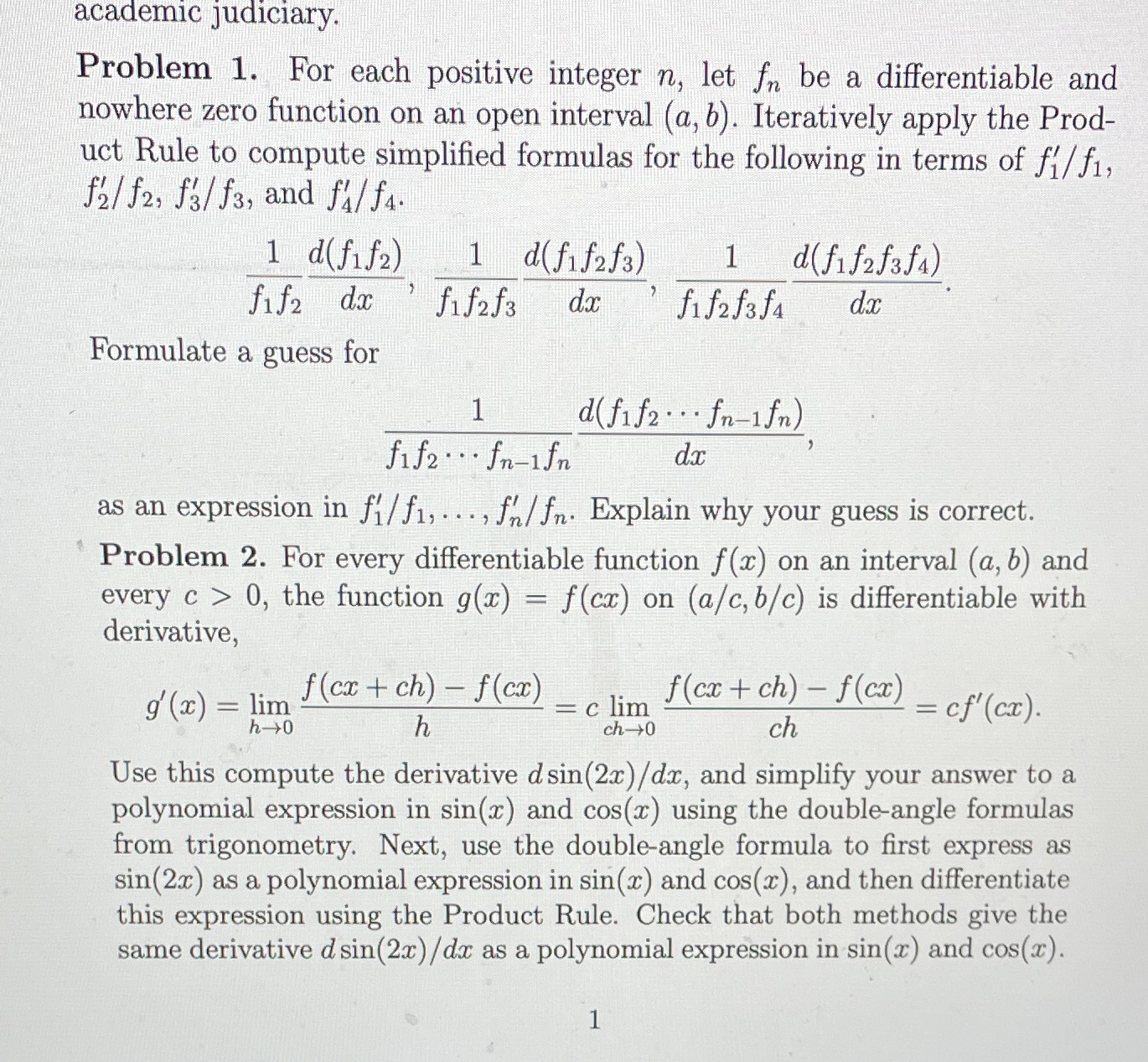
Question: #1,#2 academic judiciary. Problem 1. For each positive integer n, let In be a differentiable and nowhere zero function on an open interval (a, b).
#1,#2
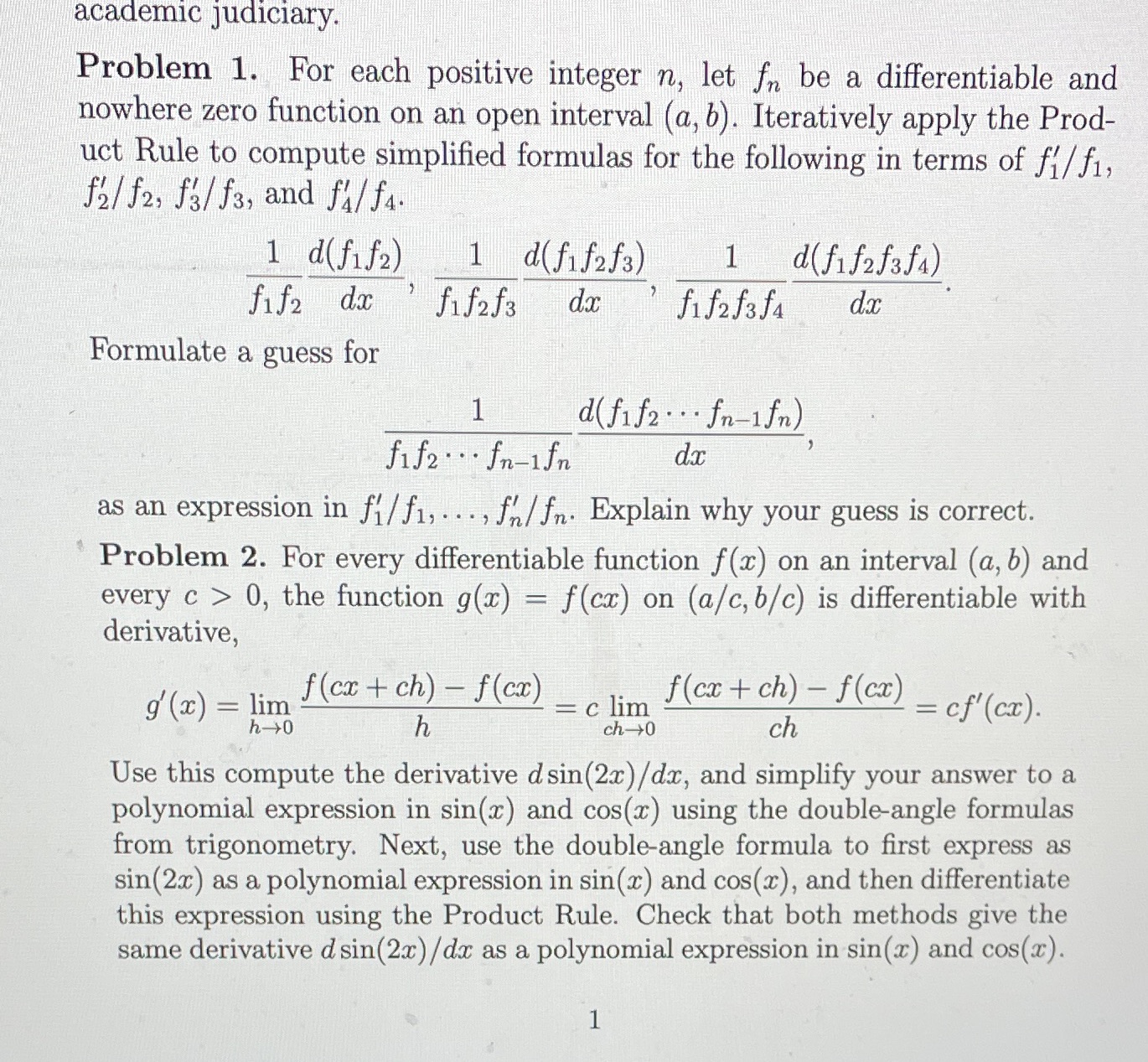
academic judiciary. Problem 1. For each positive integer n, let In be a differentiable and nowhere zero function on an open interval (a, b). Iteratively apply the Prod- uct Rule to compute simplified formulas for the following in terms of fi/ f1, f2/ f2, fa/ f3, and fi/ fa 1 d( f1.f2) 1 d(f1f2f3) d ( fifzfafa ) fifz dx ' fif2f3 dx fifzf3fa dx Formulate a guess for 1 d( f1f2 . . . fn-1fn) fif2 . . . fn-1in dx as an expression in fi/f1, ..., fh/ fn. Explain why your guess is correct. Problem 2. For every differentiable function f(x) on an interval (a, b) and every c > 0, the function g(x) = f(cx) on (a/c, b/c) is differentiable with derivative, g' (x) = lim f(ex + ch) - f(cx) = c lim f(cx + ch) - f(cx) = cf' (cx). h -+ 0 h ch -+0 ch Use this compute the derivative d sin(2x) /dx, and simplify your answer to a polynomial expression in sin(x) and cos(x) using the double-angle formulas from trigonometry. Next, use the double-angle formula to first express as sin(2x) as a polynomial expression in sin(r) and cos(x), and then differentiate this expression using the Product Rule. Check that both methods give the same derivative d sin(2x) /dx as a polynomial expression in sin(x) and cos(I)
Step by Step Solution
There are 3 Steps involved in it

Get step-by-step solutions from verified subject matter experts
 Study Help