





Question: 1.2 As the project manager for the BFIA project, demonstrate the strategies you would implement to effectively manage the key stakeholders identified in Question 1.1
1.2 As the project manager for the BFIA project, demonstrate the strategies you would implement to effectively manage the key stakeholders identified in Question 1.1

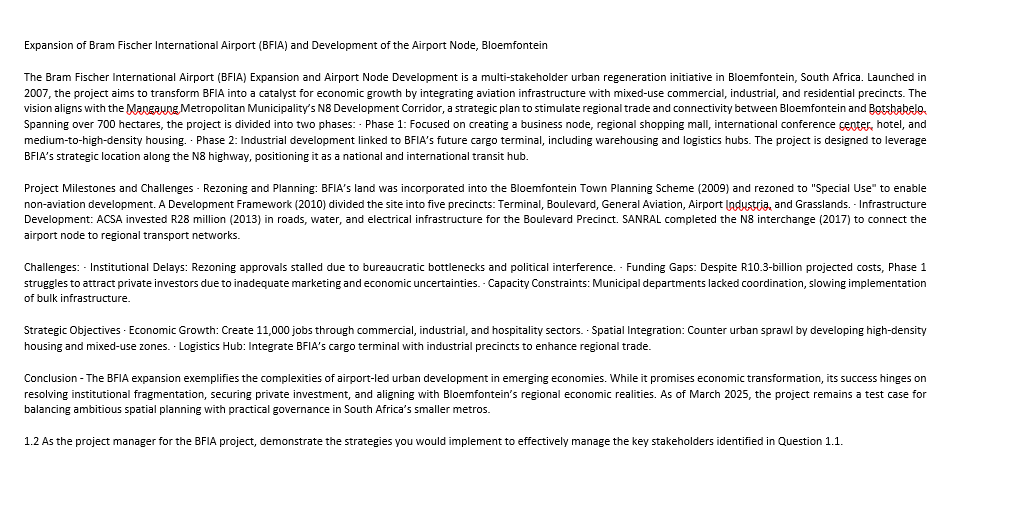
1.2 As the project manager for the BFIA project, Expansion of Bram Fischer International Airport (BFIA) and Development of the Airport Node, Bloemfontein The Bram Fischer International Airport (BFIA) Expansion and Airport Node Development is a multi-stakeholder urban regeneration initiative in Bloemfontein, South Africa. Launched in 2007, the project aims to transform BFIA into a catalyst for economic growth by integrating aviation infrastructure with mixed-use commercial, industrial, and residential precincts. The vision aligns with the Wangayung Metropolitan Municipality's N Development Corridor, a strategic plan to stimulate regional trade and connectivity between Bloemfontein and Botshabelo, Spanning over 700 hectares, the project is divided into two phases: - Phase 1: Focused on creating @ business node, regional shopping mall, international conference center, hotel, and medium-to-high-density housing. - Phase 2: Industrial development linked to BFIA's future cargo terminal, including warehousing and logistics hubs. The project is designed to leverage BFIA's strategic location along the N8 highway, positioning it as a national and international transit hub. Project Milestones and Challenges - Rezoning and Planning: BFIA's land was incorporated into the Bloemfontein Town Planning Scheme (2009) and rezoned to "Special Use" to enable non-aviation development. A Development Framework (2010) divided the site into five precincts: Terminal, Boulevard, General Aviation, Airport [ndustria, and Grasslands. - Infrastructure Development: ACSA invested R28 million (2013) in roads, water, and electrical infrastructure for the Boulevard Precinct. SANRAL completed the N interchange (2017) to connect the airport node to regional transport networks. Challenges: - Institutional Delays: Rezoning approvals stalled due to bureaucratic bottlenecks and political interference. - Funding Gaps: Despite R10.3-billion projected costs, Phase 1 Struggles to attract private investors due to inadequate marketing and economic uncertainties. - Capacity Constraints: Municipal departments lacked coordination, slowing implementation of bulk infrastructure. Strategic Objectives - Economic Growth: Create 11,000 jobs through commercial, industrial, and hospitality sectors. - Spatial Integration: Counter urban sprawl by developing high-density housing and mixed-use zones. - Logistics Hub: Integrate BFIA's cargo terminal with industrial precincts to enhance regional trade. Conclusion - The BFIA expansion exemplifies the complexities of airport-led urban development in emerging economies. While it promises economic transformation, its success hinges on resolving institutional fragmentation, securing private investment, and aligning with Bloemfontein's regional economic realities. As of March 2025, the project remains a test case for balancing ambitious spatial planning with practical governance in South Africa's smaller metros. 1.2 As the project manager for the BFIA project, demonstrate the strategies you would implement to effectively manage the key stakeholders identified in

Step by Step Solution

There are 3 Steps involved in it

1 Expert Approved Answer
Step: 1 Unlock blur-text-image

Question Has Been Solved by an Expert!

Get step-by-step solutions from verified subject matter experts

Step: 2 Unlock
Step: 3 Unlock

Students Have Also Explored These Related General Management Questions!