







Question: 12 CHAPTER 8: POPULATION, SAMPLES, And PROBABILITY Key Terms Population Any complete set of observations (or potential observations). Sampl - Any subset of observations from
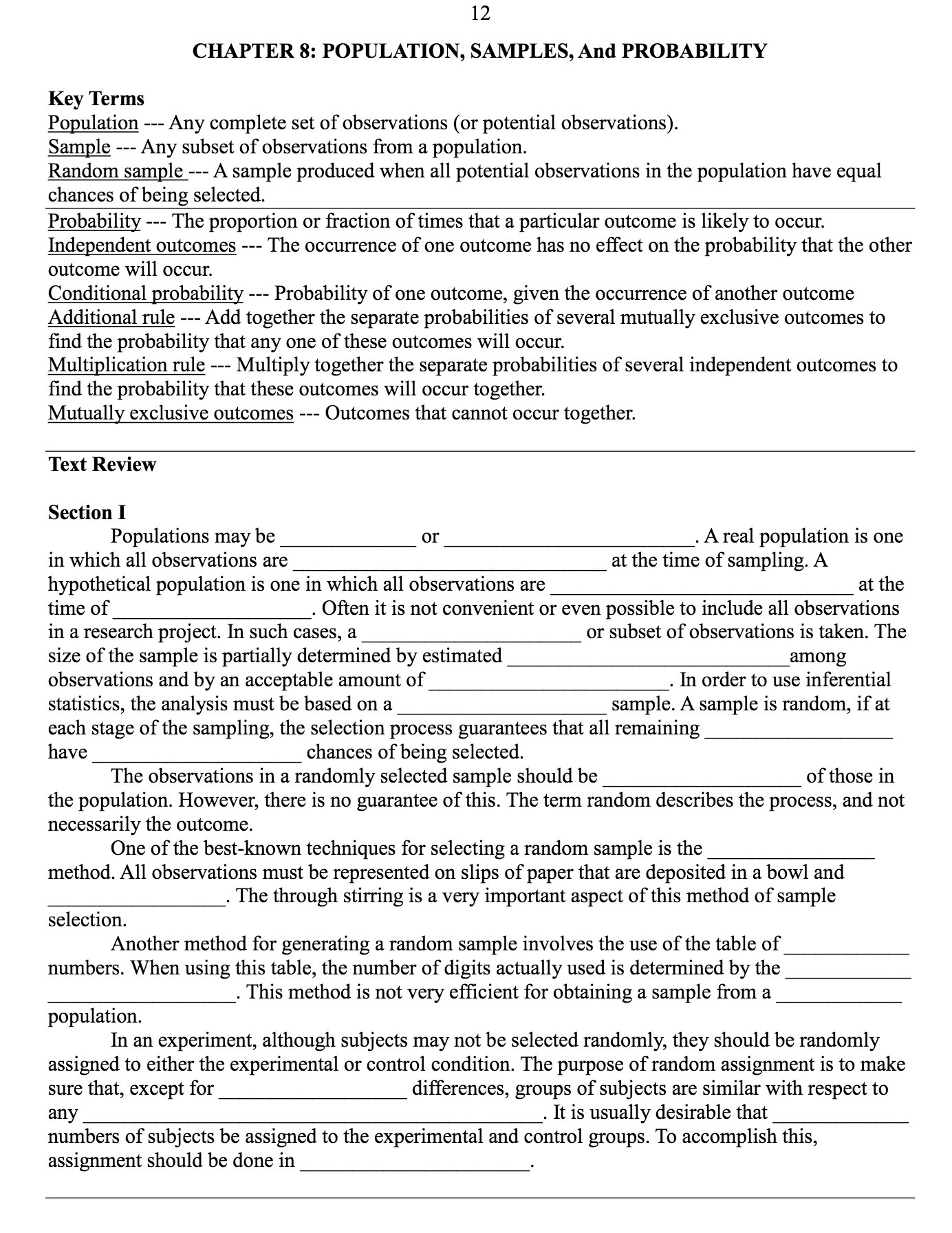
12 CHAPTER 8: POPULATION, SAMPLES, And PROBABILITY Key Terms Population Any complete set of observations (or potential observations). Sampl - Any subset of observations from a population. Random sampl ~- A sample produced when all potential observations in the population have equal chances of being selected. Probability --- The proportion or fraction of times that a particular outcome is likely to occur. Independent outcome ~- The occurrence of one outcome has no e'ect on the probability that the other outcome will occur. Conditional probabiligg ~~ Probability of one outcome, given the occurrence of another outcome Additional rule --- Add together the separate probabilities of several mutually exclusive outcomes to nd the probability that any one of these outcomes will occur. Multiplication rul Multiply together the separate probabilities of several independent outcomes to nd the probability that these outcomes will occur together. Mutually exclusive outcomes m Outcomes that cannot occur together. Text Review Section I Populations may be or . A real population is one in which all observations are at the time of sampling. A hypothetical population is one in which all observations are at the time of . Oen it is not convenient or even possible to include all observations in a research project. In such cases, a or subset of observations is taken. The size of the sample is partially determined by estimated among observations and by an acceptable amount of . In order to use inferential statistics, the analysis must be based on a sample. A sample is random, if at each stage of the sampling, the selection process guarantees that all remaining have chances of being selected. The observations in a randomly selected sample should be of those in the population. However, there is no guarantee of this. The term random describes the process, and not necessarily the outcome. One of the best-known techniques for selecting a random sample is the method. All observations must be represented on slips of paper that are deposited in a bowl and . The through stirring is a very important aspect of this method of sample selection. Another method for generating a random sample involves the use of the table of numbers. When using this table, the number of digits actually used is determined by the . This method is not very efcient for obtaining a sample om a population. In an experiment, although subjects may not be selected randomly, they should be randomly assigned to either the experimental or control condition. The purpose of random assignment is to make sure that, except for differences, groups of subjects are similar with respect to any . It is usually desirable that numbers of subjects be assigned to the experimental and control groups. To accomplish this, assignment should be done in
Step by Step Solution
There are 3 Steps involved in it

Get step-by-step solutions from verified subject matter experts
 Study Help