Question: 12. Develop Likert, semantic differential, and Stapel scales for measuring consumer preferences for hotel chains. 13. Develop a questionnaire for assessing consumer preferences for hotels
12. Develop Likert, semantic differential, and Stapel scales for measuring consumer preferences for hotel chains.
13. Develop a questionnaire for assessing consumer preferences for hotels when on vacation.
14. What sampling plan should be adopted for the survey of question 9?
 15. How should the sample size be determined for the survey of question 9?
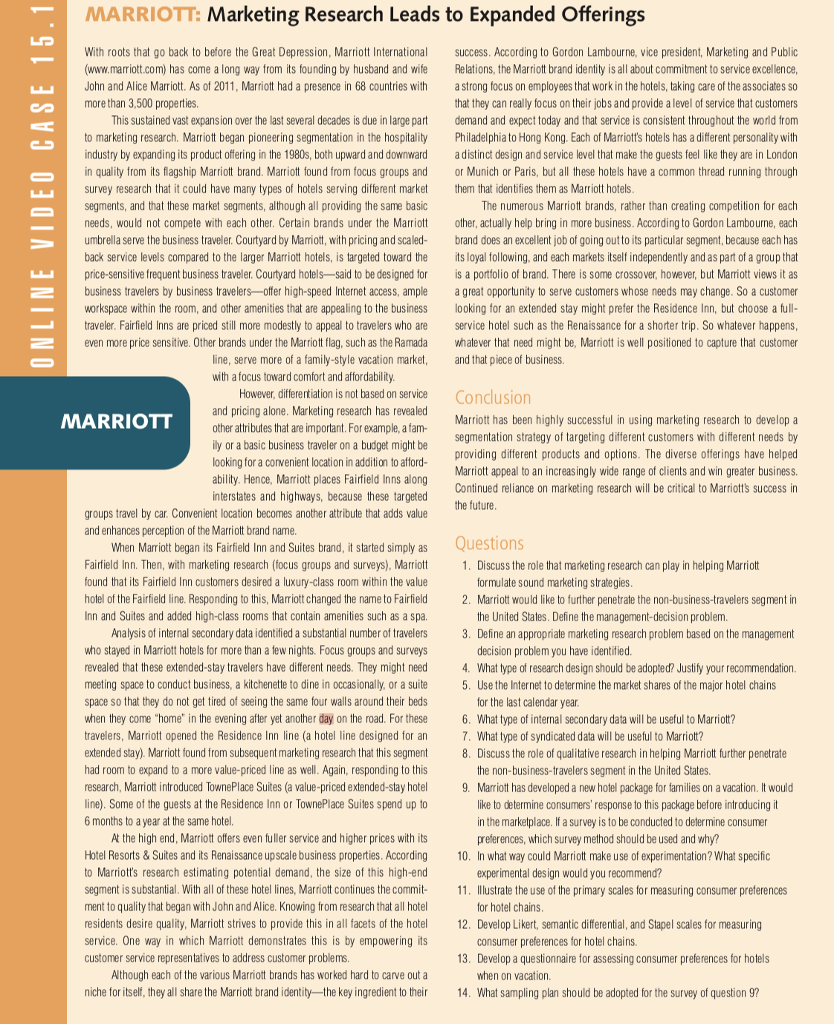
MARRIOTT: Marketing Research Leads to Expanded Offerings ONLINE VIDEO CASE 15.1 success. According to Gordon Lambourne, vice president, Marketing and Public Relations, the Marriott brand identity is all about commitment to service excellence, a strong focus on employees that work in the hotels, taking care of the associates so that they can really focus on their jobs and provide a level of service that customers demand and expect today and that service is consistent throughout the world from Philadelphia to Hong Kong. Each of Marriott's hotels has a different personality with a distinct design and service level that make the guests feel like they are in London or Munich or Paris, but all these hotels have a common thread running through them that identifies them as Marriott hotels The numerous Marriott brands, rather than creating competition for each other, actually help bring in more business. According to Gordon Lambourne, each brand does an excellent job of going out to its particular segment, because each has its loyal following, and each markets itself independently and as part of a group that is a portfolio of brand. There is some crossover, however, but Marriott views it as a great opportunity to serve customers whose needs may change. So a customer looking for an extended stay might prefer the Residence Inn, but choose a full- service hotel such as the Renaissance for a shorter trip. So whatever happens, whatever that need might be, Marriott is well positioned to capture that customer and that piece of business Conclusion Marriott has been highly successful in using marketing research to develop a segmentation strategy of targeting different customers with different needs by providing different products and options. The diverse offerings have helped Marriott appeal to an increasingly wide range of clients and win greater business. Continued reliance on marketing research will be critical to Marriott's success in the future. With roots that go back to before the Great Depression, Marriott International (www.marriott.com) has come a long way from its founding by husband and wife John and Alice Marriott. As of 2011, Marriott had a presence in 68 countries with more than 3,500 properties. This sustained vast expansion over the last several decades is due in large part to marketing research. Marriott began pioneering segmentation in the hospitality industry by expanding its product offering in the 1980s, both upward and downward in quality from its flagship Marriott brand. Marriott found from focus groups and survey research that it could have many types of hotels serving different market segments, and that these market segments, although all providing the same basic needs, would not compete with each other. Certain brands under the Marriott umbrella serve the business traveler. Courtyard by Marriott with pricing and scaled- back service levels compared to the larger Marriott hotels, is targeted toward the price-sensitive frequent business traveler. Courtyard hotelssaid to be designed for business travelers by business travelers offer high-speed Internet access, ample workspace within the room, and other amenities that are appealing to the business traveler. Fairfield Inns are priced still more modestly to appeal to travelers who are even more price sensitive. Other brands under the Marriott flag, such as the Ramada line, serve more of a family-style vacation market, with a focus toward comfort and affordability. However, differentiation is not based on service and pricing alone. Marketing research has revealed MARRIOTT other attributes that are important. For example, a fam- ily or a basic business traveler on a budget might be looking for a convenient location in addition to afford- ability. Hence, Marriott places Fairfield Inns along interstates and highways, because these targeted groups travel by car. Convenient location becomes another attribute that adds value and enhances perception of the Marriott brand name. When Marriott began its Fairfield Inn and Suites brand, it started simply as Fairfield Inn. Then, with marketing research (focus groups and surveys), Marriott found that its Fairfield Inn customers desired a luxury-class room within the value hotel of the Fairfield line. Responding to this, Marriott changed the name to Fairfield Inn and Suites and added high-class rooms that contain amenities such as a spa. Analysis of internal secondary data identified a substantial number of travelers who stayed in Marriott hotels for more than a few nights. Focus groups and surveys revealed that these extended-stay travelers have different needs. They might need meeting space to conduct business, a kitchenette to dine in occasionally, or a suite space so that they do not get tired of seeing the same four walls around their beds when they come "home" in the evening after yet another day on the road. For these travelers, Marriott opened the Residence Inn line (a hotel line designed for an extended stay). Marriott found from subsequent marketing research that this segment had room to expand to a more value-priced line as well. Again, responding to this research, Marriott introduced Towne Place Suites a value-priced extended-stay hotel line). Some of the guests at the Residence Inn or Towne Place Suites spend up to 6 months to a year at the same hotel. At the high end, Marriott offers even fuller service and higher prices with its Hotel Resorts & Suites and its Renaissance upscale business properties. According to Marriott's research estimating potential demand, the size of this high-end segment is substantial. With all of these hotel lines, Marriott continues the commit- ment to quality that began with John and Alice. Knowing from research that all hotel residents desire quality, Marriott strives to provide this in all facets of the hotel service. One way in which Marriott demonstrates this is by empowering its customer service representatives address customer problems Although each of the various Marriott brands has worked hard to carve out a niche for itself, they all share the Marriott brand identity the key ingredient to their Questions 1. Discuss the role that marketing research can play in helping Marriott formulate sound marketing strategies. 2. Marriott would like to further penetrate the non-business-travelers segment in the United States. Define the management decision problem. 3. Define an appropriate marketing research problem based on the management decision problem you have identitied. 4. What type of research design should be adopted? Justify your recommendation, 5. Use the Internet to determine the market shares of the major hotel chains for the last calendar year 6. What type of internal secondary data will be useful to Marriott? 7. What type of syndicated data will be useful to Marriott? 8. Discuss the role of qualitative research in helping Marriott further penetrate the non-business-travelers segment in the United States. 9. Marriott has developed a new hotel package for families on a vacation. It would like to determine consumers' response to this package before introducing it in the marketplace. If a survey is to be conducted to determine consumer preferences, which survey method should be used and why? 10. In what way could Marriott make use of experimentation? What specific experimental design would you recommend? 11. Ilustrate the use of the primary scales for measuring consumer preferences for hotel chains 12. Develop Likert, semantic differential, and Stapel scales for measuring consumer preferences for hotel chains 13. Develop a questionnaire for assessing consumer preferences for hotels when on vacation 14. What sampling plan should be adopted for the survey of question 9




