



Question: 1/2 Human-Powered Flight (15 points): Instead of a baseball, consider another possible flying object affected by a quadratic drag force, Olympic long jumper Bob Beamon.
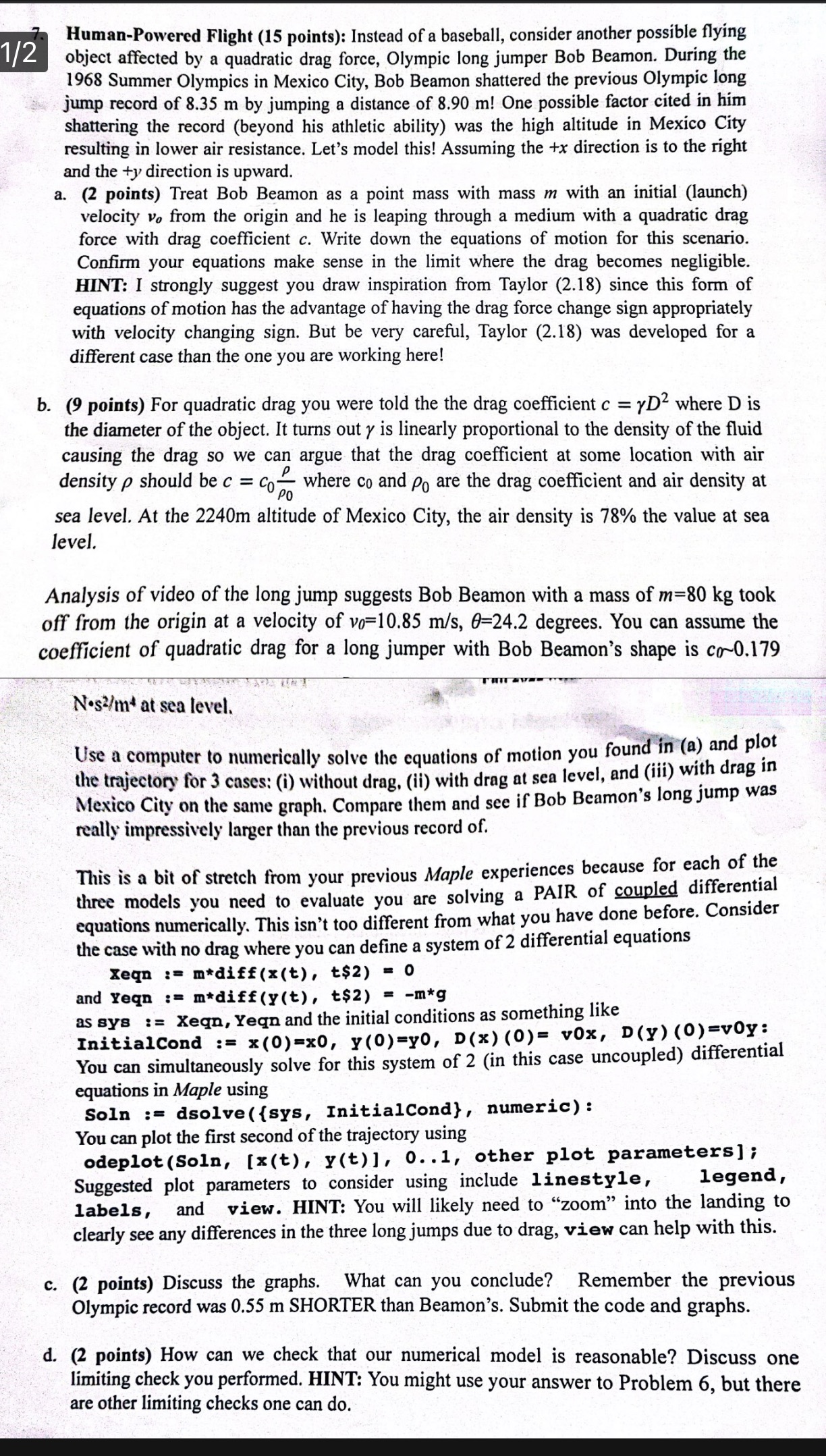
1/2 Human-Powered Flight (15 points): Instead of a baseball, consider another possible flying object affected by a quadratic drag force, Olympic long jumper Bob Beamon. During the 1968 Summer Olympics in Mexico City, Bob Beamon shattered the previous Olympic long jump record of 8.35 m by jumping a distance of 8.90 m! One possible factor cited in him shattering the record (beyond his athletic ability) was the high altitude in Mexico City resulting in lower air resistance. Let's model this! Assuming the +x direction is to the right and the +y direction is upward a. (2 points) Treat Bob Beamon as a point mass with mass m with an initial (launch) velocity vo from the origin and he is leaping through a medium with a quadratic drag force with drag coefficient c. Write down the equations of motion for this scenario. Confirm your equations make sense in the limit where the drag becomes negligible. HINT: I strongly suggest you draw inspiration from Taylor (2.18) since this form of equations of motion has the advantage of having the drag force change sign appropriately with velocity changing sign. But be very careful, Taylor (2.18) was developed for a different case than the one you are working here! b. (9 points) For quadratic drag you were told the the drag coefficient c = yD2 where D is the diameter of the object. It turns out y is linearly proportional to the density of the fluid causing the drag so we can argue that the drag coefficient at some location with air density p should be c = Co- where co and po are the drag coefficient and air density at sea level. At the 2240m altitude of Mexico City, the air density is 78% the value at sea level. Analysis of video of the long jump suggests Bob Beamon with a mass of m=80 kg took off from the origin at a velocity of vo=10.85 m/s, 0=24.2 degrees. You can assume the coefficient of quadratic drag for a long jumper with Bob Beamon's shape is co~0.179 N.s2/m* at sea level. Use a computer to numerically solve the equations of motion you found in (a) and plot the trajectory for 3 cases: (i) without drag, (ii) with drag at sea level, and (iii) with drag in Mexico City on the same graph. Compare them and see if Bob Beamon's long jump was really impressively larger than the previous record of. This is a bit of stretch from your previous Maple experiences because for each of the three models you need to evaluate you are solving a PAIR of coupled differential equations numerically. This isn't too different from what you have done before. Consider the case with no drag where you can define a system of 2 differential equations Xeqn := m*diff (x(t), t$2) = 0 and Yeqn := m*diff (y (t), t$2) = -m*g as sys := Xegn, Yean and the initial conditions as something like InitialCond := x(0)=x0, y(0)=y0, D(x) (0)= vox, D(y) (0)=vy: You can simultaneously solve for this system of 2 (in this case uncoupled) differential equations in Maple using Soln := dsolve ({sys, InitialCond), numeric) : You can plot the first second of the trajectory using odeplot (Soln, [x(t), y(t)], 0. .1, other plot parameters] ; Suggested plot parameters to consider using include linestyle, legend, labels, and view. HINT: You will likely need to "zoom" into the landing to clearly see any differences in the three long jumps due to drag, view can help with this. c. (2 points) Discuss the graphs. What can you conclude? Remember the previous Olympic record was 0.55 m SHORTER than Beamon's. Submit the code and graphs. d. (2 points) How can we check that our numerical model is reasonable? Discuss one limiting check you performed. HINT: You might use your answer to Problem 6, but there are other limiting checks one can do
Step by Step Solution
There are 3 Steps involved in it

Get step-by-step solutions from verified subject matter experts