





Question: 1.2 SIMPLE OPERATIONS ON SEQUENCES Project 1.5 Signal Smoothing A copy of Program P1_5 is given below. Q1.29 Answers: The signals generated by running Program
 1.2 SIMPLE OPERATIONS ON SEQUENCES Project 1.5 Signal Smoothing A copy

of Program P1_5 is given below. Q1.29 Answers: The signals generated by

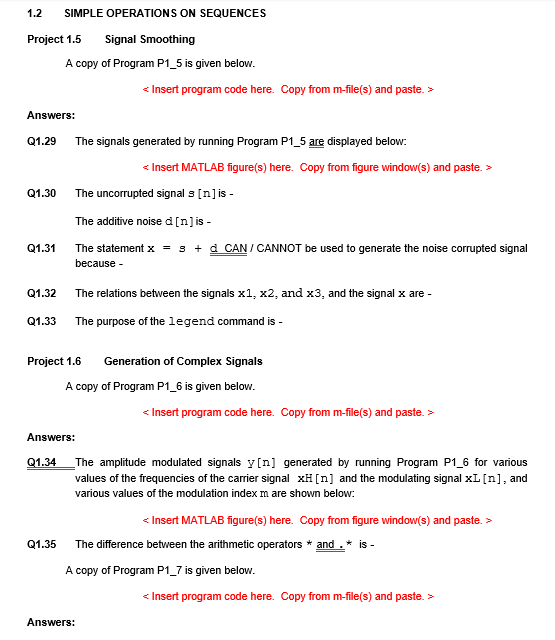
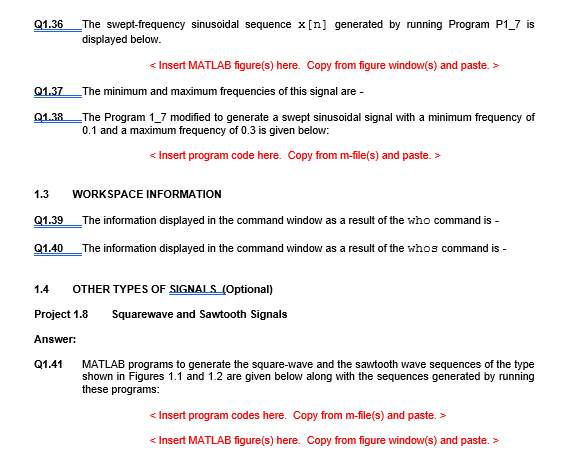
1.2 SIMPLE OPERATIONS ON SEQUENCES Project 1.5 Signal Smoothing A copy of Program P1_5 is given below. Q1.29 Answers: The signals generated by running Program P1_5 are displayed below: Q1.30 The uncorrupted signal s [n]is - The additive noise d[n]is - Q1.31 The statement x = 3 + d CAN / CANNOT be used to generate the noise corrupted signal because Q1.32 The relations between the signals x1, x2, and x3, and the signal x are - The purpose of the legend command is - Q1.33 Project 1.6 Generation of Complex Signals A copy of Program P1_6 is given below. Answers: Q1.34 The amplitude modulated signals y[n] generated by running Program P1_6 for various values of the frequencies of the carrier signal xH [n] and the modulating signal xL [n], and various values of the modulation index m are shown below: The difference between the arithmetic operators * and . * is - A copy of Program P1_7 is given below. Q1.35 Answers: Q1.36 01.37 The swept-frequency sinusoidal sequence x[n] generated by running Program P1_7 is displayed below. The minimum and maximum frequencies of this signal are- _The Program 1_7 modified to generate a swept sinusoidal signal with a minimum frequency of 0.1 and a maximum frequency of 0.3 is given below: 01.38 1.3 Q1.39 WORKSPACE INFORMATION The information displayed in the command window as a result of the who command is - The information displayed in the command window as a result of the whos command is Q1.40 1.4 OTHER TYPES OF SIGNALS (Optional) Project 1.8 Squarewave and Sawtooth Signals Answer: Q1.41 MATLAB programs to generate the square-wave and the sawtooth wave sequences of the type shown in Figures 1.1 and 1.2 are given below along with the sequences generated by running these programs: 1.2 SIMPLE OPERATIONS ON SEQUENCES Project 1.5 Signal Smoothing A copy of Program P1_5 is given below. Q1.29 Answers: The signals generated by running Program P1_5 are displayed below: Q1.30 The uncorrupted signal s [n]is - The additive noise d[n]is - Q1.31 The statement x = 3 + d CAN / CANNOT be used to generate the noise corrupted signal because Q1.32 The relations between the signals x1, x2, and x3, and the signal x are - The purpose of the legend command is - Q1.33 Project 1.6 Generation of Complex Signals A copy of Program P1_6 is given below. Answers: Q1.34 The amplitude modulated signals y[n] generated by running Program P1_6 for various values of the frequencies of the carrier signal xH [n] and the modulating signal xL [n], and various values of the modulation index m are shown below: The difference between the arithmetic operators * and . * is - A copy of Program P1_7 is given below. Q1.35 Answers: Q1.36 01.37 The swept-frequency sinusoidal sequence x[n] generated by running Program P1_7 is displayed below. The minimum and maximum frequencies of this signal are- _The Program 1_7 modified to generate a swept sinusoidal signal with a minimum frequency of 0.1 and a maximum frequency of 0.3 is given below: 01.38 1.3 Q1.39 WORKSPACE INFORMATION The information displayed in the command window as a result of the who command is - The information displayed in the command window as a result of the whos command is Q1.40 1.4 OTHER TYPES OF SIGNALS (Optional) Project 1.8 Squarewave and Sawtooth Signals Answer: Q1.41 MATLAB programs to generate the square-wave and the sawtooth wave sequences of the type shown in Figures 1.1 and 1.2 are given below along with the sequences generated by running these programs:

Step by Step Solution

There are 3 Steps involved in it

1 Expert Approved Answer
Step: 1 Unlock blur-text-image
Question Has Been Solved by an Expert!

Get step-by-step solutions from verified subject matter experts

Step: 2 Unlock
Step: 3 Unlock

Students Have Also Explored These Related Databases Questions!