







Question: 12:08 OO 33% FPUT-Model-P... a 4 : FPUT Model Consider a chain of particles that can interact via nonlinear nearest neighbors a-model -- +1+ x.(t)
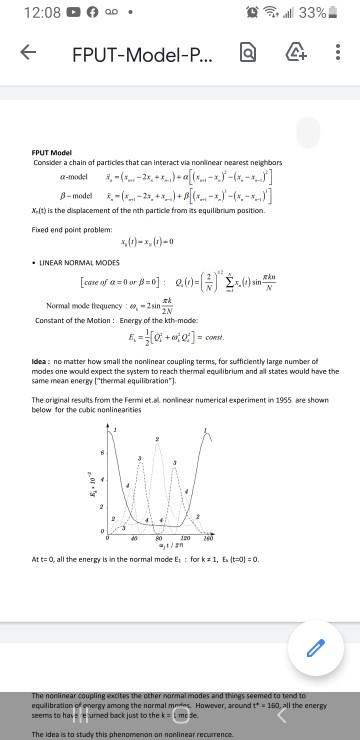
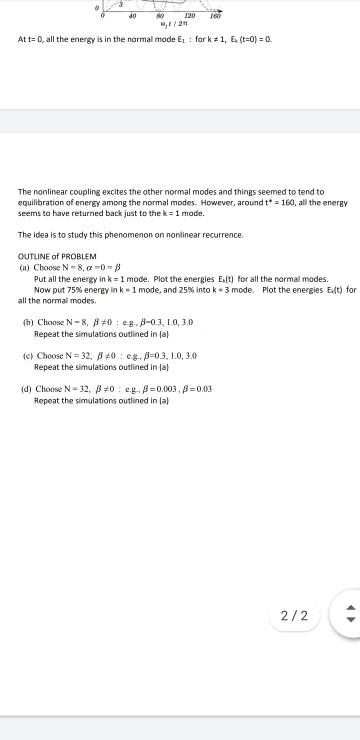
12:08 OO 33% FPUT-Model-P... a 4 : FPUT Model Consider a chain of particles that can interact via nonlinear nearest neighbors a-model -- +1+ x.(t) is the displacement of the nth particle from its equilibrium position Fixed end point problem LINEAR NORMAL MODES [core of a=0 wr 8=0] 06-) :) som kan Normal mode fequency, -21 2N 5. = }(0 +70+] = comst Constant of the Motion Energy of the kth mode Idea: no matter how small the nonlinear coupling terms, for sufficiently large number of modes one would expect the system to reach thermal equilibrium and all states would have the same mean energy "thermal equilibration), The original results from the Fermietal nonlinear numerical experiment in 1955 are shown below for the cubic nonlinearities ory M 40 20 / 260 At t=0, all the energy is in the normal mode for k= 1, Esto) = 0 The nonlinear coupling excites the other normal modes and things seemed to end to equilibration of energy among the normalmente. However, around t = 150, all the energy seems to have turned back just to the = mc de The idea is to study this phenomenon an nonlinear recurrence. 10 120 TER At t=0, all the energy is in the normal mode E1 : for k=1, E. (t=0) = 0. The nonlinear coupling excites the other normal modes and things seemed to tend to equilibration of energy among the normal modes. However, aroundt* = 160, all the energy seems to have returned back just to the k = 1 mode. The idea is to study this phenomenon on nonlinear recurrence OUTLINE of PROBLEM (a) Choose N-8,0-0-1 Put all the energy ink1 mode. Plot the energies Ext) for all the normal modes Now put 75% energy ink-1 mode, and 25% intok - 3 mode. Plot the energies Ext) for all the normal modes (h) Choose N-8, 8+0: eg..8-6.3, 10, 3.0 Repeat the simulations outlined in tal (c) Choose N= 32, 8+0: e... 3=0.3, 1.0, 3.0 Repeat the simulations outlined in (al (d) Choose N= 32, B +0. 4.8.3=0.003.8=0.03 Repeat the simulations outlined in lal 2/2 12:08 OO 33% FPUT-Model-P... a 4 : FPUT Model Consider a chain of particles that can interact via nonlinear nearest neighbors a-model -- +1+ x.(t) is the displacement of the nth particle from its equilibrium position Fixed end point problem LINEAR NORMAL MODES [core of a=0 wr 8=0] 06-) :) som kan Normal mode fequency, -21 2N 5. = }(0 +70+] = comst Constant of the Motion Energy of the kth mode Idea: no matter how small the nonlinear coupling terms, for sufficiently large number of modes one would expect the system to reach thermal equilibrium and all states would have the same mean energy "thermal equilibration), The original results from the Fermietal nonlinear numerical experiment in 1955 are shown below for the cubic nonlinearities ory M 40 20 / 260 At t=0, all the energy is in the normal mode for k= 1, Esto) = 0 The nonlinear coupling excites the other normal modes and things seemed to end to equilibration of energy among the normalmente. However, around t = 150, all the energy seems to have turned back just to the = mc de The idea is to study this phenomenon an nonlinear recurrence. 10 120 TER At t=0, all the energy is in the normal mode E1 : for k=1, E. (t=0) = 0. The nonlinear coupling excites the other normal modes and things seemed to tend to equilibration of energy among the normal modes. However, aroundt* = 160, all the energy seems to have returned back just to the k = 1 mode. The idea is to study this phenomenon on nonlinear recurrence OUTLINE of PROBLEM (a) Choose N-8,0-0-1 Put all the energy ink1 mode. Plot the energies Ext) for all the normal modes Now put 75% energy ink-1 mode, and 25% intok - 3 mode. Plot the energies Ext) for all the normal modes (h) Choose N-8, 8+0: eg..8-6.3, 10, 3.0 Repeat the simulations outlined in tal (c) Choose N= 32, 8+0: e... 3=0.3, 1.0, 3.0 Repeat the simulations outlined in (al (d) Choose N= 32, B +0. 4.8.3=0.003.8=0.03 Repeat the simulations outlined in lal 2/2
Step by Step Solution
There are 3 Steps involved in it

Get step-by-step solutions from verified subject matter experts
 Study Help