







Question: 12.2 QUESTION 12 During a thunderstorm, strong air currents inside clouds rub ice crystals against each other. This results in a separation of charge and
12.2
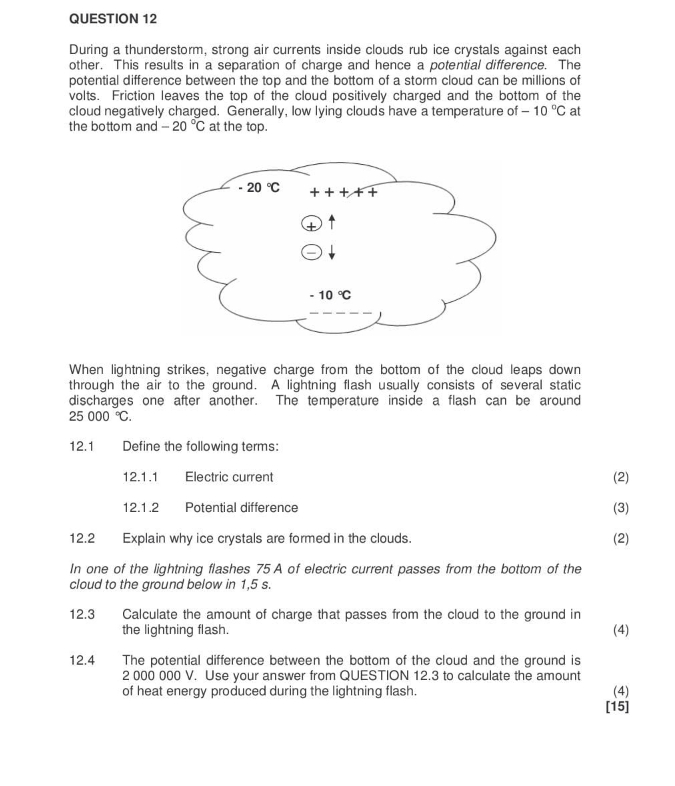
QUESTION 12 During a thunderstorm, strong air currents inside clouds rub ice crystals against each other. This results in a separation of charge and hence a potential difference. The potential difference between the top and the bottom of a storm cloud can be millions of volts. Friction leaves the top of the cloud positively charged and the bottom of the cloud negatively charged. Generally, low lying clouds have a temperature of - 10 "C at the bottom and - 20 "C at the top. - 20 .C + + +#+ - 10 C When lightning strikes, negative charge from the bottom of the cloud leaps down through the air to the ground. A lightning flash usually consists of several static discharges one after another. The temperature inside a flash can be around 25 000 C. 12.1 Define the following terms: 12.1.1 Electric current (2) 12.1.2 Potential difference (3) 12.2 Explain why ice crystals are formed in the clouds. (2) In one of the lightning flashes 75 A of electric current passes from the bottom of the cloud to the ground below in 1,5 s. 12.3 Calculate the amount of charge that passes from the cloud to the ground in the lightning flash. (4) 12.4 The potential difference between the bottom of the cloud and the ground is 2 000 000 V. Use your answer from QUESTION 12.3 to calculate the amount of heat energy produced during the lightning flash. (4) [15]
Step by Step Solution
There are 3 Steps involved in it

Get step-by-step solutions from verified subject matter experts
 Study Help