



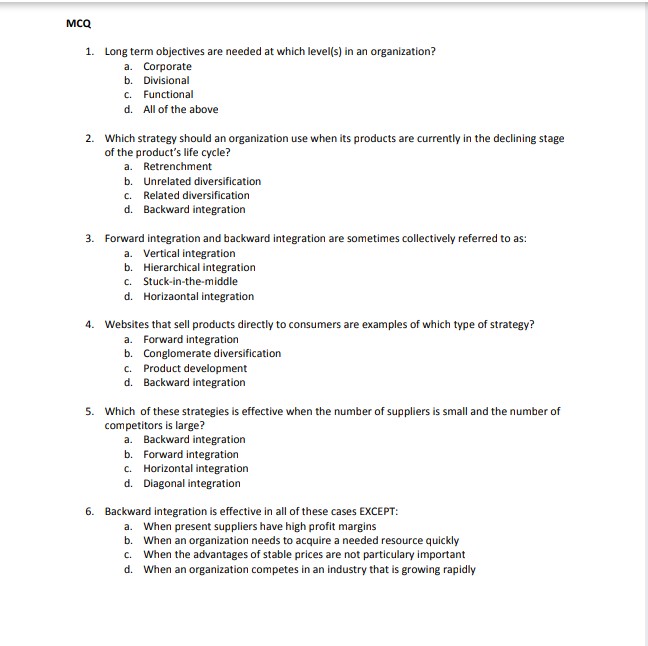
Question: 1-25 MCQ 26-40 T/F MCQ 1. Long term objectives are needed at which level(s) in an organization? a. Corporate b. Divisional C. Functional d. All
1-25 MCQ
26-40 T/F
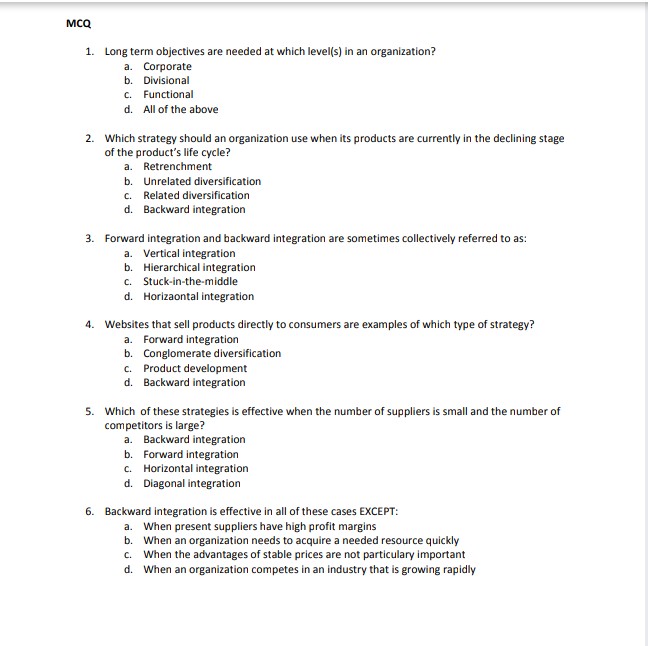
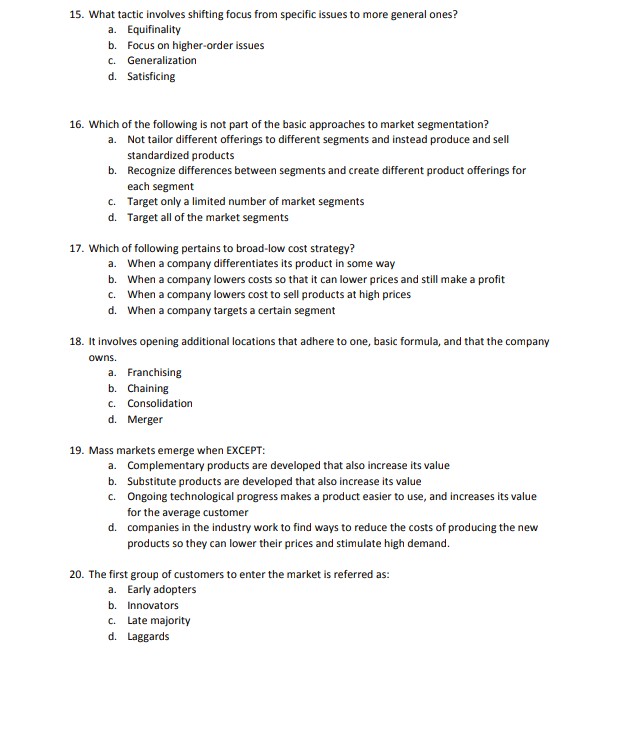
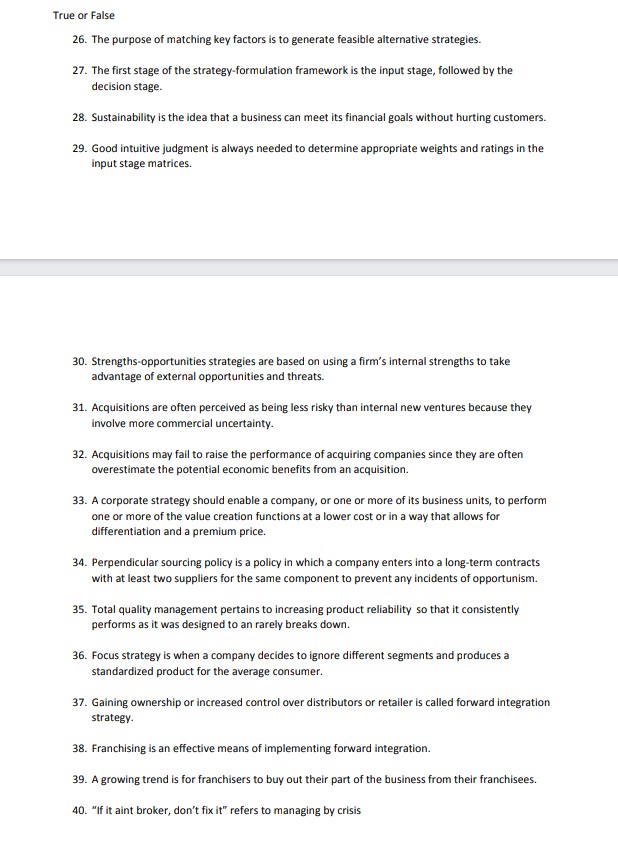
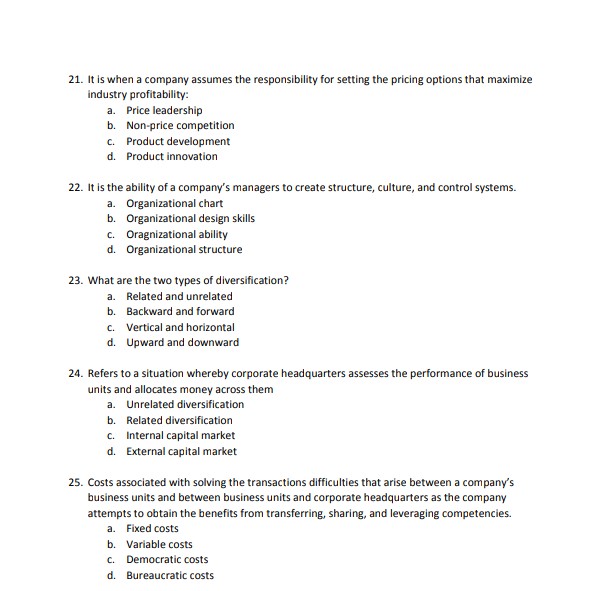
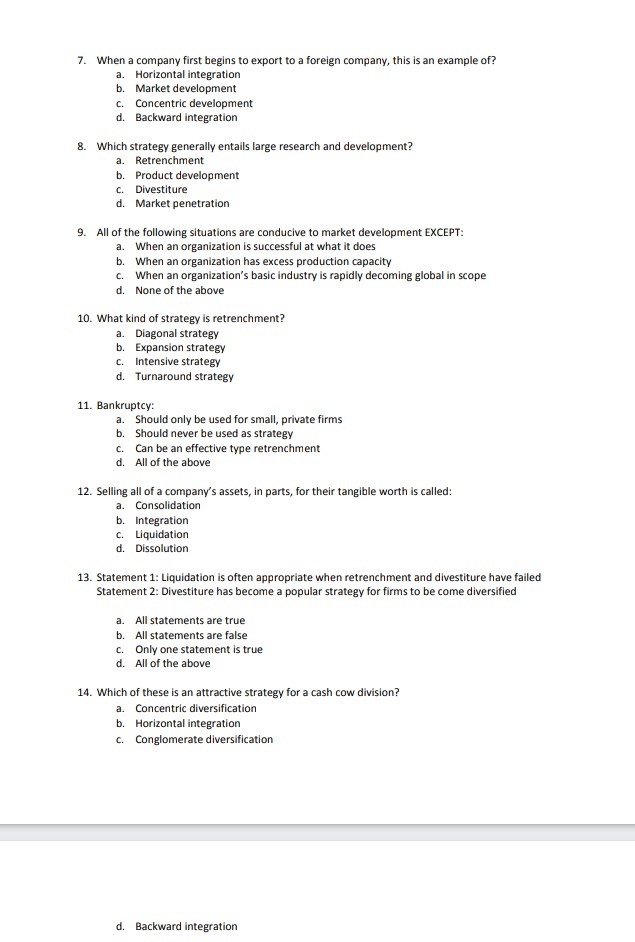
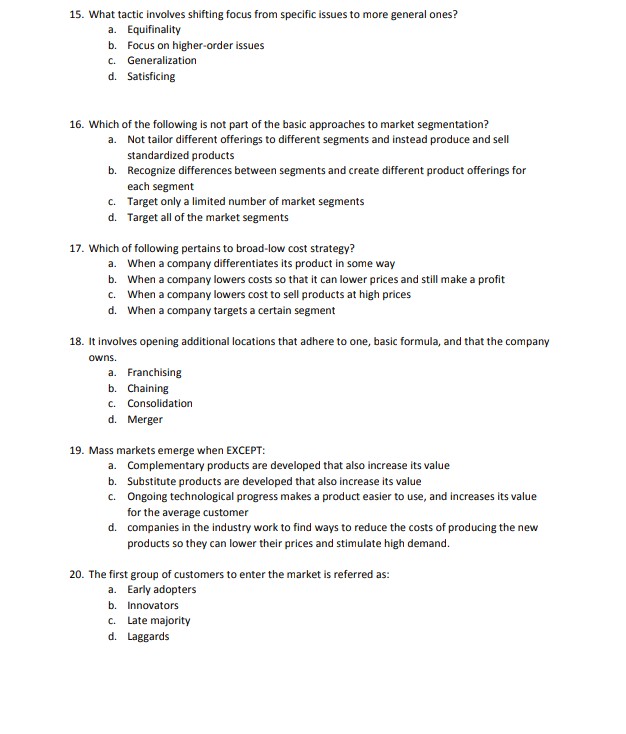
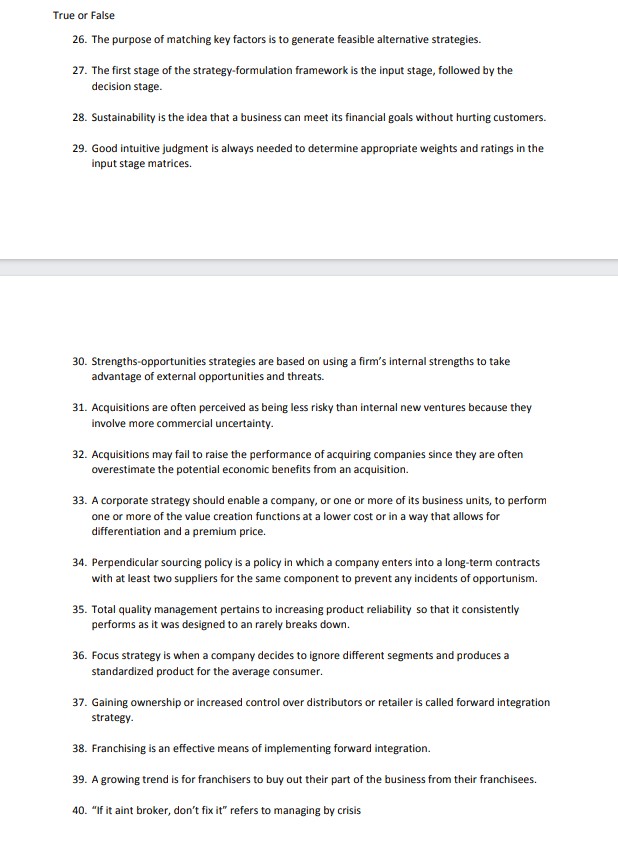
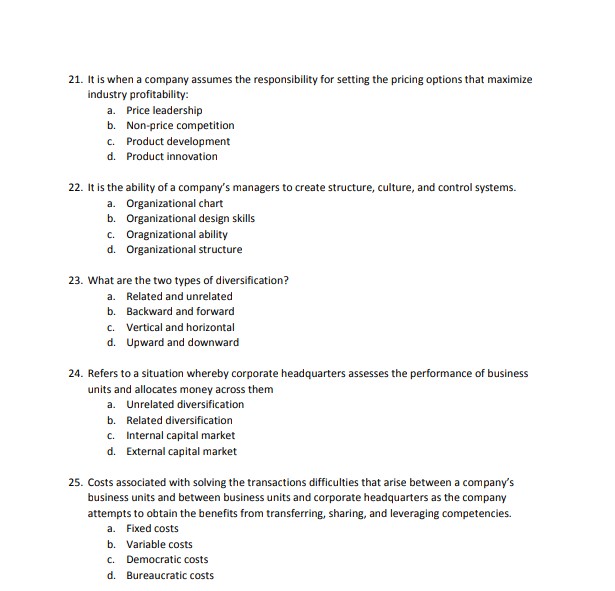
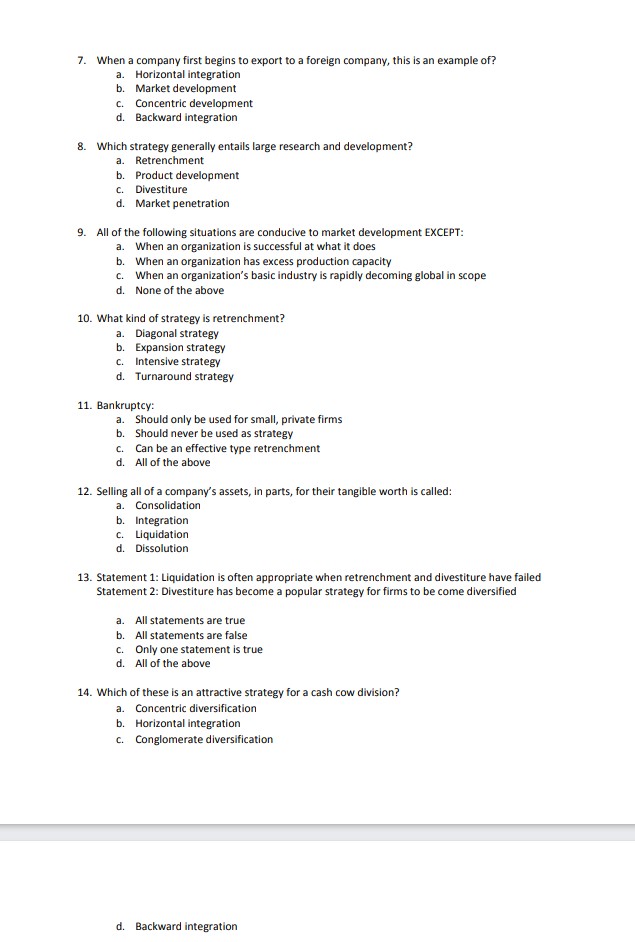
MCQ 1. Long term objectives are needed at which level(s) in an organization? a. Corporate b. Divisional C. Functional d. All of the above 2. Which strategy should an organization use when its products are currently in the declining stage of the product's life cycle? a. Retrenchment b. Unrelated diversification C. Related diversification d. Backward integration 3. Forward integration and backward integration are sometimes collectively referred to as: a. Vertical integration b. Hierarchical integration C. Stuck-in-the middle d. Horizontal integration 4. Websites that sell products directly to consumers are examples of which type of strategy? a. Forward integration b. Conglomerate diversification Product development d. Backward integration 5. Which of these strategies is effective when the number of suppliers is small and the number of competitors is large? a. Backward integration b. Forward integration C. Horizontal integration d. Diagonal integration 6. Backward integration is effective in all of these cases EXCEPT: . When present suppliers have high profit margins b. When an organization needs to acquire a needed resource quickly When the advantages of stable prices are not particulary important d. When an organization competes in an industry that is growing rapidly15. What tactic involves shifting focus from specific issues to more general ones? a. Equifinality b. Focus on higher-order issues c. Generalization d. Satisficing 16. Which of the following is not part of the basic approaches to market segmentation? a. Not tailor different offerings to different segments and instead produce and sell standardized products Recognize differences between segments and create different product offerings for each segment C. Target only a limited number of market segments d. Target all of the market segments 17. Which of following pertains to broad-low cost strategy? a. When a company differentiates its product in some way b. When a company lowers costs so that it can lower prices and still make a profit c. When a company lowers cost to sell products at high prices d. When a company targets a certain segment 18. It involves opening additional locations that adhere to one, basic formula, and that the company owns. a. Franchising b. Chaining c. Consolidation d. Merger 19. Mass markets emerge when EXCEPT: a. Complementary products are developed that also increase its value b. Substitute products are developed that also increase its value C. Ongoing technological progress makes a product easier to use, and increases its value for the average customer d. companies in the industry work to find ways to reduce the costs of producing the new products so they can lower their prices and stimulate high demand. 20. The first group of customers to enter the market is referred as: a. Early adopters b. Innovators C. Late majority d. LaggardsTrue or False 26. The purpose of matching key factors is to generate feasible alternative strategies. 27. The first stage of the strategy-formulation framework is the input stage, followed by the decision stage. 28. Sustainability is the idea that a business can meet its financial goals without hurting customers. 29. Good intuitive judgment is always needed to determine appropriate weights and ratings in the input stage matrices. 30. Strengths-opportunities strategies are based on using a firm's internal strengths to take advantage of external opportunities and threats. 31. Acquisitions are often perceived as being less risky than internal new ventures because they involve more commercial uncertainty. 32. Acquisitions may fail to raise the performance of acquiring companies since they are often overestimate the potential economic benefits from an acquisition. 33. A corporate strategy should enable a company, or one or more of its business units, to perform one or more of the value creation functions at a lower cost or in a way that allows for differentiation and a premium price. 34. Perpendicular sourcing policy is a policy in which a company enters into a long-term contracts with at least two suppliers for the same component to prevent any incidents of opportunism. 35. Total quality management pertains to increasing product reliability so that it consistently performs as it was designed to an rarely breaks down. 36. Focus strategy is when a company decides to ignore different segments and produces a standardized product for the average consumer. 37. Gaining ownership or increased control over distributors or retailer is called forward integration strategy- 38. Franchising is an effective means of implementing forward integration. 39. A growing trend is for franchisers to buy out their part of the business from their franchisees. 40. "if it aint broker, don't fix it" refers to managing by crisis21. It is when a company assumes the responsibility for setting the pricing options that maximize industry profitability: a. Price leadership b. Non-price competition C. Product development d. Product innovation 22. It is the ability of a company's managers to create structure, culture, and control systems. a. Organizational chart b. Organizational design skills c. Oragnizational ability d. Organizational structure 23. What are the two types of diversification? a. Related and unrelated b. Backward and forward c. Vertical and horizontal d. Upward and downward 24. Refers to a situation whereby corporate headquarters assesses the performance of business units and allocates money across them a. Unrelated diversification b. Related diversification c. Internal capital market d. External capital market 25. Costs associated with solving the transactions difficulties that arise between a company's business units and between business units and corporate headquarters as the company attempts to obtain the benefits from transferring, sharing, and leveraging competencies. a. Fixed costs b. Variable costs c. Democratic costs d. Bureaucratic costs7. When a company first begins to export to a foreign company, this is an example of? a. Horizontal integration b. Market development C. Concentric development d. Backward integration 8. Which strategy generally entails large research and development? a. Retrenchment b. Product development C. Divestiture d. Market penetration 9. All of the following situations are conducive to market development EXCEPT: a. When an organization is successful at what it does b. When an organization has excess production capacity C. When an organization's basic industry is rapidly decoming global in scope d. None of the above 10. What kind of strategy is retrenchment? a. Diagonal strategy b. Expansion strategy C. Intensive strategy d. Turnaround strategy 11. Bankruptcy: a. Should only be used for small, private firms b. Should never be used as strategy c. Can be an effective type retrenchment d. All of the above 12. Selling all of a company's assets, in parts, for their tangible worth is called: Consolidation b. Integration C. Liquidation d. Dissolution 13. Statement 1: Liquidation is often appropriate when retrenchment and divestiture have failed Statement 2: Divestiture has become a popular strategy for firms to be come diversified a. All statements are true b. All statements are false C. Only one statement is true d. All of the above 14. Which of these is an attractive strategy for a cash cow division? Concentric diversification b. Horizontal integration Conglomerate diversification d. Backward integration
Step by Step Solution
There are 3 Steps involved in it

Get step-by-step solutions from verified subject matter experts