



Question: 13. [410 Points] DETAILS SERPSET9 13.P.065. MY NOTES ASK YOUR TEACHER PRACTICE ANOTHER As an astronaut, you observe a small planet to be spherical. After
![13. [410 Points] DETAILS SERPSET9 13.P.065. MY NOTES ASK YOUR TEACHER](https://s3.amazonaws.com/si.experts.images/answers/2024/07/6688589671007_606668858963ea6b.jpg)
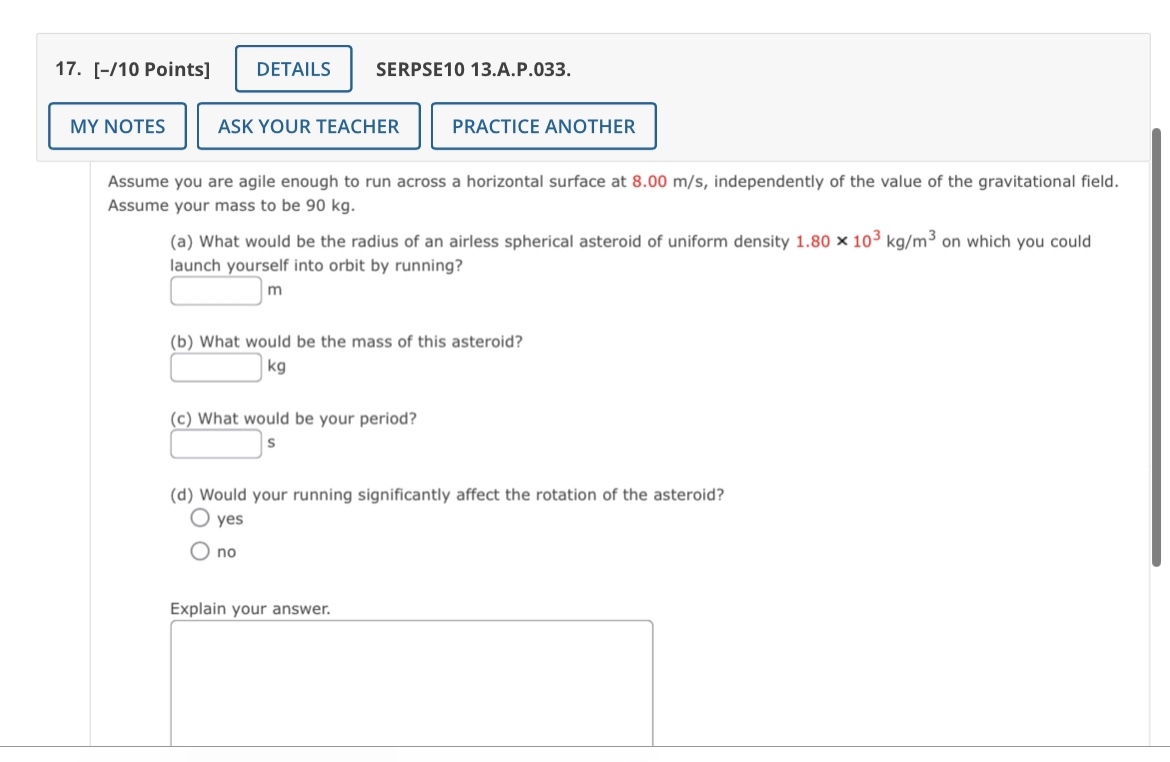
13. [410 Points] DETAILS SERPSET9 13.P.065. MY NOTES ASK YOUR TEACHER PRACTICE ANOTHER As an astronaut, you observe a small planet to be spherical. After landing on the planet, you set off. walking always straight ahead, and find yourself returning to your spacecraft from the opposite side after completlng a lap of 24.6 km. You hold a hammer and a falcon feather at a height of 1.32 m, release them, and observe that they fall together to the surface in 29.7 5. Determine the mass of the planet. [ W! kg 17. [-110 Points] DETAILS SERPSE1U 13.A.P.033. MY NOTES ASK YOUR TEACHER PRACTICE ANOTHER Assume you are agile enough to run across a horizontal surface at 8.00 m/s, independently of the value of the gravitational field. Assume your mass to be 90 kg. (a) What would be the radius of an airless spherical asteroid of uniform density 1.80 X 10³ kg/m3 on which you could launch yourself into orbit by running? F j m k {b} What would be the mass of this asteroid? 1kg (c) What would be your period? .r' W . i 5 L J (G) would vaur running significantly affect the rotation of the asteroid? 0 yes 0 no Explain your
Step by Step Solution
There are 3 Steps involved in it

Get step-by-step solutions from verified subject matter experts