







Question: 13. Criteria for a estimating a proportion involve A. situations which only have a two possible outcomes B. situations which can only have one true
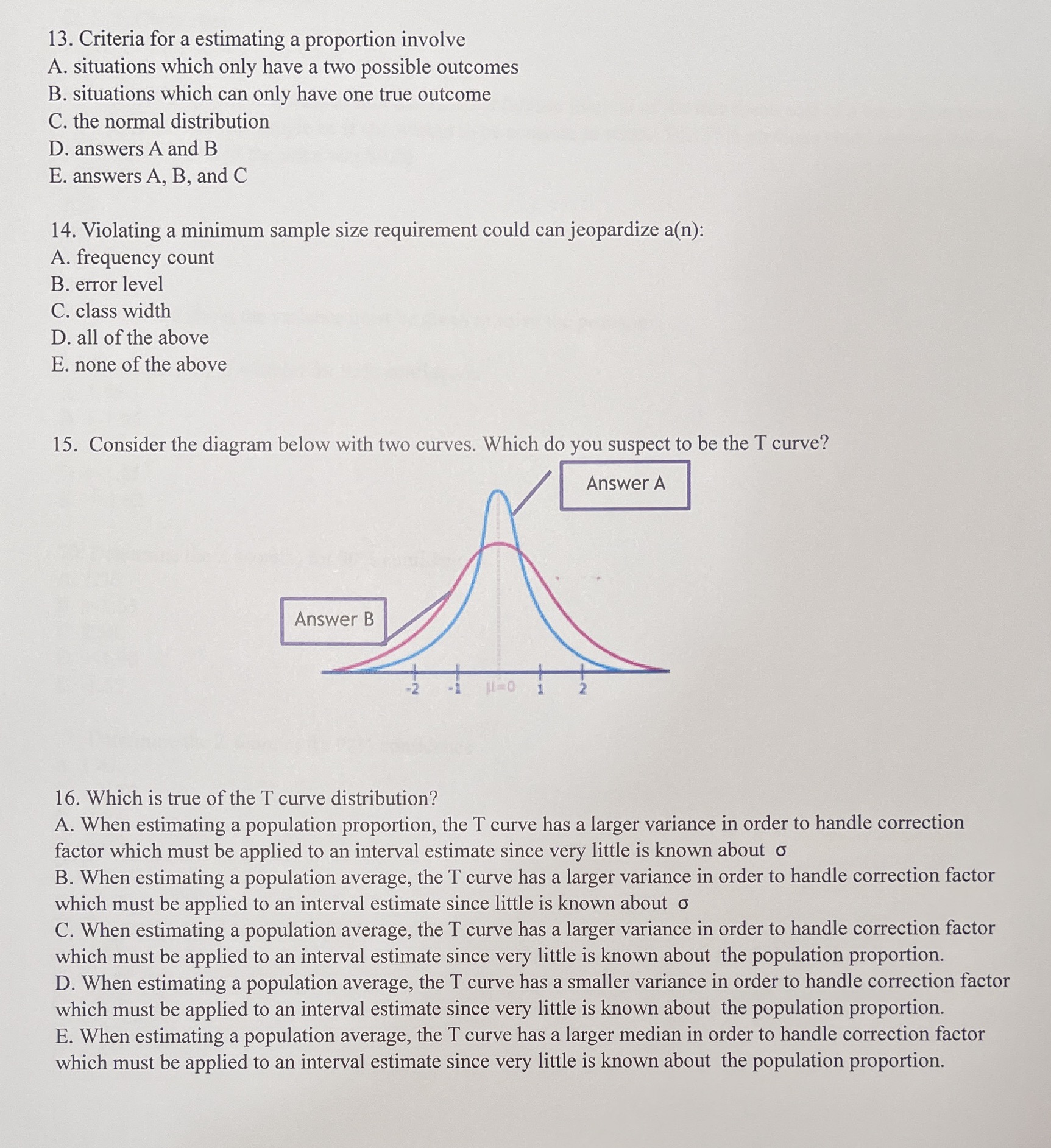
13. Criteria for a estimating a proportion involve A. situations which only have a two possible outcomes B. situations which can only have one true outcome C. the normal distribution D. answers A and B E. answers A, B, and C 14. Violating a minimum sample size requirement could can jeopardize a(n): A. frequency count B. error level C. class width D. all of the above E. none of the above 15. Consider the diagram below with two curves. Which do you suspect to be the T curve? Answer A Answer B 16. Which is true of the T curve distribution? A. When estimating a population proportion, the T curve has a larger variance in order to handle correction factor which must be applied to an interval estimate since very little is known about o B. When estimating a population average, the T curve has a larger variance in order to handle correction factor which must be applied to an interval estimate since little is known about o C. When estimating a population average, the T curve has a larger variance in order to handle correction factor which must be applied to an interval estimate since very little is known about the population proportion. D. When estimating a population average, the T curve has a smaller variance in order to handle correction factor which must be applied to an interval estimate since very little is known about the population proportion. E. When estimating a population average, the T curve has a larger median in order to handle correction factor which must be applied to an interval estimate since very little is known about the population proportion
Step by Step Solution
There are 3 Steps involved in it

Get step-by-step solutions from verified subject matter experts
 Study Help