





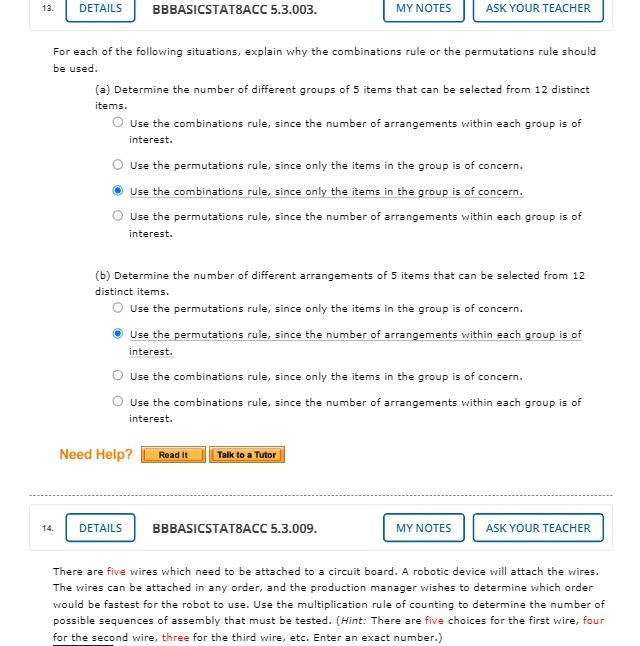
Question: 13. DETAILS BBBASICSTATBACC 5.3.003. MY NOTES ASK YOUR TEACHER For each of the following situations, explain why the combinations rule or the permutations rule should
13. DETAILS BBBASICSTATBACC 5.3.003. MY NOTES ASK
13. DETAILS BBBASICSTATBACC 5.3.003. MY NOTES ASK YOUR TEACHER For each of the following situations, explain why the combinations rule or the permutations rule should be used (=) Determine the number of different groups of 5 items that can be selected from 12 distinct items. Use the combinations rule, since the number of arrangements within each group is of interest. Use the permutations rule, since only the items in the group is of concern. Use the combinations rule, since only the items in the group is of concern. O Use the permutations rule, since the number of arrangements within each group is of interest. (b) Determine the number of different arrangements of 5 items that can be selected from 12 distinct items. O Use the permutations rule, since only the items in the group is of concern. O Use the permutations rule, since the number of arrangements within each group is of interest. O Use the combinations rule, since only the items in the group is of concern. O Use the combinations rule, since the number of arrangements within each group is of interest. Need Help? Read It Talk to a Tutor 14 DETAILS BBBASICSTATBACC 5.3.009. MY NOTES ASK YOUR TEACHER There are five wires which need to be attached to a circuit board. A robotic device will attach the wires. The wires can be attached in any order, and the production manager wishes to determine which order would be fastest for the robot to use. Use the multiplication rule of counting to determine the number of possible sequences of assembly that must be tested. (Hint: There are five choices for the first wire, four for the second wire, three for the third wire, etc. Enter an exact number.)

Step by Step Solution

There are 3 Steps involved in it

1 Expert Approved Answer
Step: 1 Unlock blur-text-image

Question Has Been Solved by an Expert!

Get step-by-step solutions from verified subject matter experts

Step: 2 Unlock
Step: 3 Unlock

Students Have Also Explored These Related Mathematics Questions!