







Question: 13. Enzyme 1 (Km1 = 38 mg/L, Vm1' = 1.3 x 10⁻⁵ mg/(cm*s)) and Enzyme 2 (Km2 = 105 mg/L, Vm2' = 2.4 x
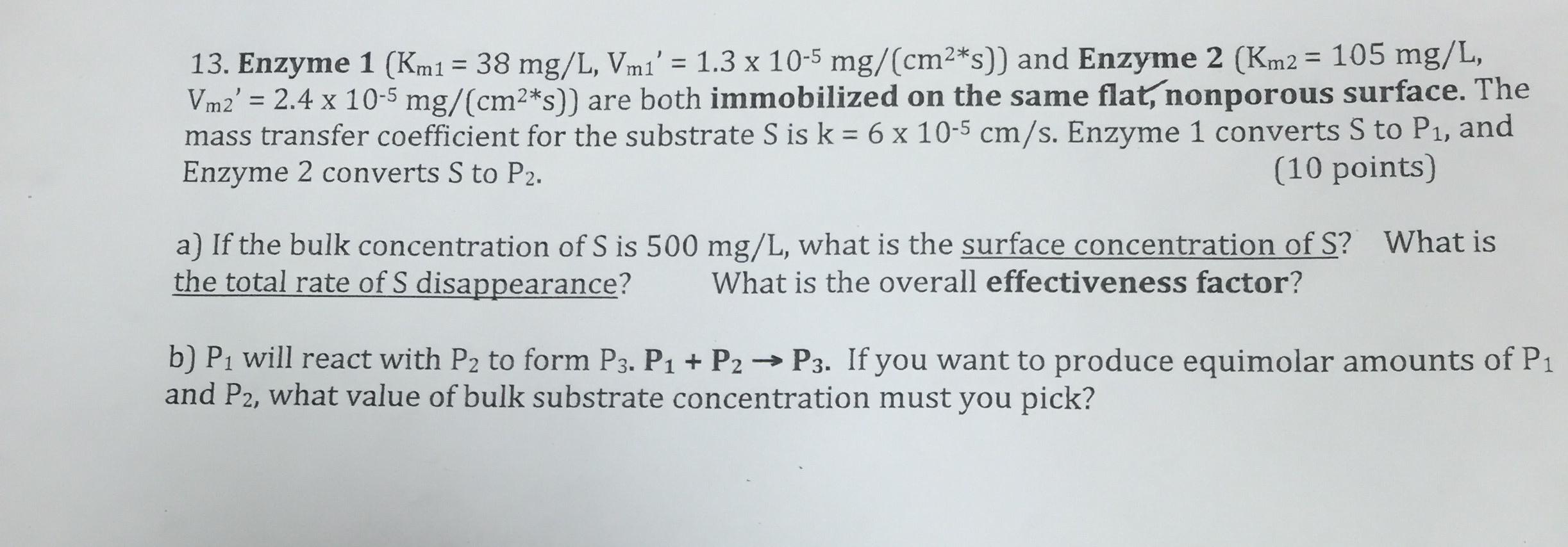
13. Enzyme 1 (Km1 = 38 mg/L, Vm1' = 1.3 x 10⁻⁵ mg/(cm*s)) and Enzyme 2 (Km2 = 105 mg/L, Vm2' = 2.4 x 10⁻⁵ mg/(cm2*s)) are both immobilized on the same flat, nonporous surface. The mass transfer coefficient for the substrate S is k = 6 x 10⁻⁵ cm/s. Enzyme 1 converts S to P1, and Enzyme 2 converts S to P2. (10 points) a) If the bulk concentration of S is 500 mg/L, what is the surface concentration of S? What is the total rate of S disappearance? What is the overall effectiveness factor? b) P1 will react with P2 to form P3. P1 + P2 P3. If you want to produce equimolar amounts of P1 and P2, what value of bulk substrate concentration must you pick?
Step by Step Solution
There are 3 Steps involved in it

Get step-by-step solutions from verified subject matter experts
 Study Help