







Question: 13. Given a relation R(A, B, c, D) with the functional dependencies F-(ABC-D, D--C], what is the highest normal form the relation is in? a)
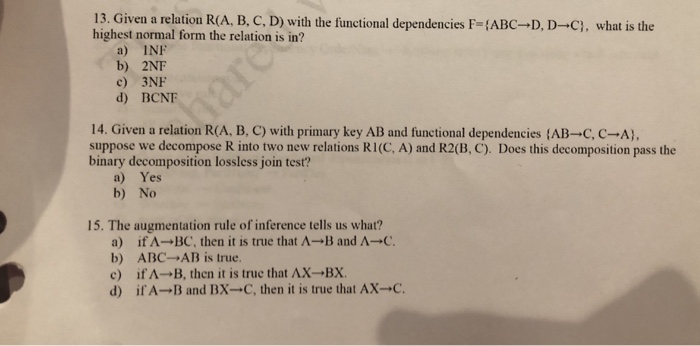
13. Given a relation R(A, B, c, D) with the functional dependencies F-(ABC-D, D--C], what is the highest normal form the relation is in? a) INF b) 2NF c) 3NF d) BCNF 14. Given a relation R(A, B, C) with primary key AB and functional dependencies {AB-C, C AL suppose we decompose R into two new relations RI (?, A) and R2(B, C). Does this decomposition pass the binary decomposition lossless join test? a)Yes b) No 15. The augmentation rule of inference tells us what? a) ?fA--BC, then it is true that A?B and ??C. b) ABC-AB is true. c) ifA--B, then it is true that AX?BX d) ?fA?B and IX?C, then it is true that AX?C
Step by Step Solution
There are 3 Steps involved in it
1 Expert Approved Answer
Step: 1 Unlock

Question Has Been Solved by an Expert!
Get step-by-step solutions from verified subject matter experts
Step: 2 Unlock
Step: 3 Unlock
 Study Help