







Question: (13 points) Consider three processes P1, P2, and P3, all ready to run at time = 0. Each process has two CPU bursts, separated by
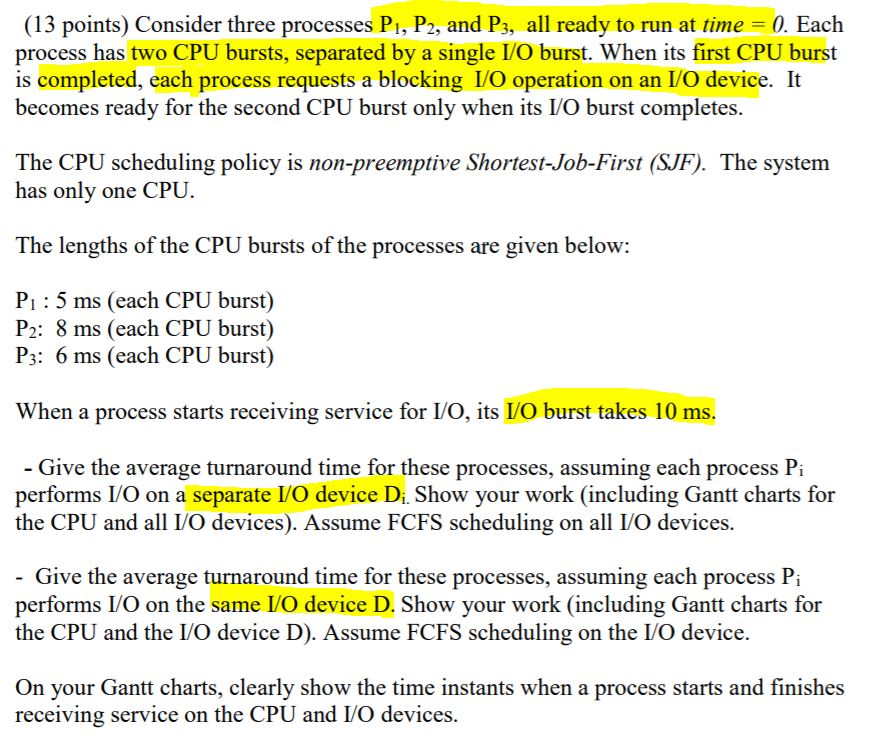
(13 points) Consider three processes P1, P2, and P3, all ready to run at time = 0. Each process has two CPU bursts, separated by a single I/O burst. When its first CPU burst is completed, each process requests a blocking I/O operation on an I/O device. It becomes ready for the second CPU burst only when its I/O burst completes. The CPU scheduling policy is non-preemptive Shortest-Job-First (SJF). The system has only one CPU. The lengths of the CPU bursts of the processes are given below: P1: 5 ms (each CPU burst) P2: 8 ms (each CPU burst) P3: 6 ms (each CPU burst) When a process starts receiving service for I/O, its I/O burst takes 10 ms. - Give the average turnaround time for these processes, assuming each process Pi performs I/O on a separate I/O device D. Show your work (including Gantt charts for the CPU and all I/O devices). Assume FCFS scheduling on all I/O devices. - Give the average turnaround time for these processes, assuming each process Pi performs I/O on the same I/O device D. Show your work (including Gantt charts for the CPU and the I/O device D). Assume FCFS scheduling on the I/O device. On your Gantt charts, clearly show the time instants when a process starts and finishes receiving service on the CPU and I/O devices
Step by Step Solution
There are 3 Steps involved in it

Get step-by-step solutions from verified subject matter experts
 Study Help