







Question: 13. Testing for Unit Root in Time Series 131. Following an appropriate model selection procedure, conduct Dickey Fuller (DF) andfor augmented Dickey-Fuller (ADP) ttype tests
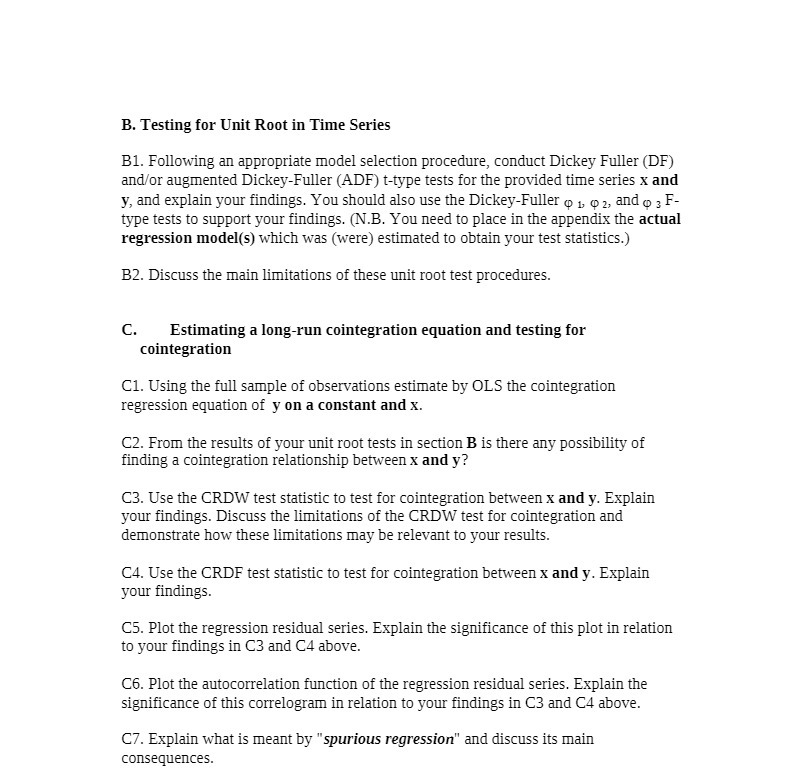
13. Testing for Unit Root in Time Series 131. Following an appropriate model selection procedure, conduct Dickey Fuller (DF) andfor augmented Dickey-Fuller (ADP) ttype tests for the provided time series 1: and y, and explain your ndings. You should also use the DickeyFuller q, 1; {p 2, and q; 3 E type tests to support your ndings. (NB. You need to place in the appendix the actual regression model{s) which was {were} estimated to obtain your test statistics.) 132. Discuss the main Limitations of these unit root test procedures. C. Estimating a longrun cointegration equation and testing for cointegraon C1. Using the full sample of observations esmate by OILS the cointegration regression equation of y on a constant and x. C2. From the results of your unit root tests in secon I3 is there any possibility of finding a cointegration relationship between x and y? C3. Use the CRDW test statistic to test for cointegraon between x and y. Explain your findings. Discuss the limitations of the CRDW test for cointegraon and demonstrate how these limitations may be relevant to your results. C4. Use the CRDF test statistic to test for cointegraon between x and y. Explain your findings. C5. Plot the regression residual series. Explain the significance of this plot in relation to your ndings in C3 and C4 above. C5. Plot the autocorrelation function of the regression residual series. Explain the signicance of this correlogram in relation to your ndings in C3 and C4 above. CF. Explain what is meant by "spurious regression" and discuss its main consequences
Step by Step Solution
There are 3 Steps involved in it

Get step-by-step solutions from verified subject matter experts
 Study Help