







Question: 13. This problem concerns the inventory stocking policies for type O negative blood at a particular hospital. Although some blood types are compatible with others,
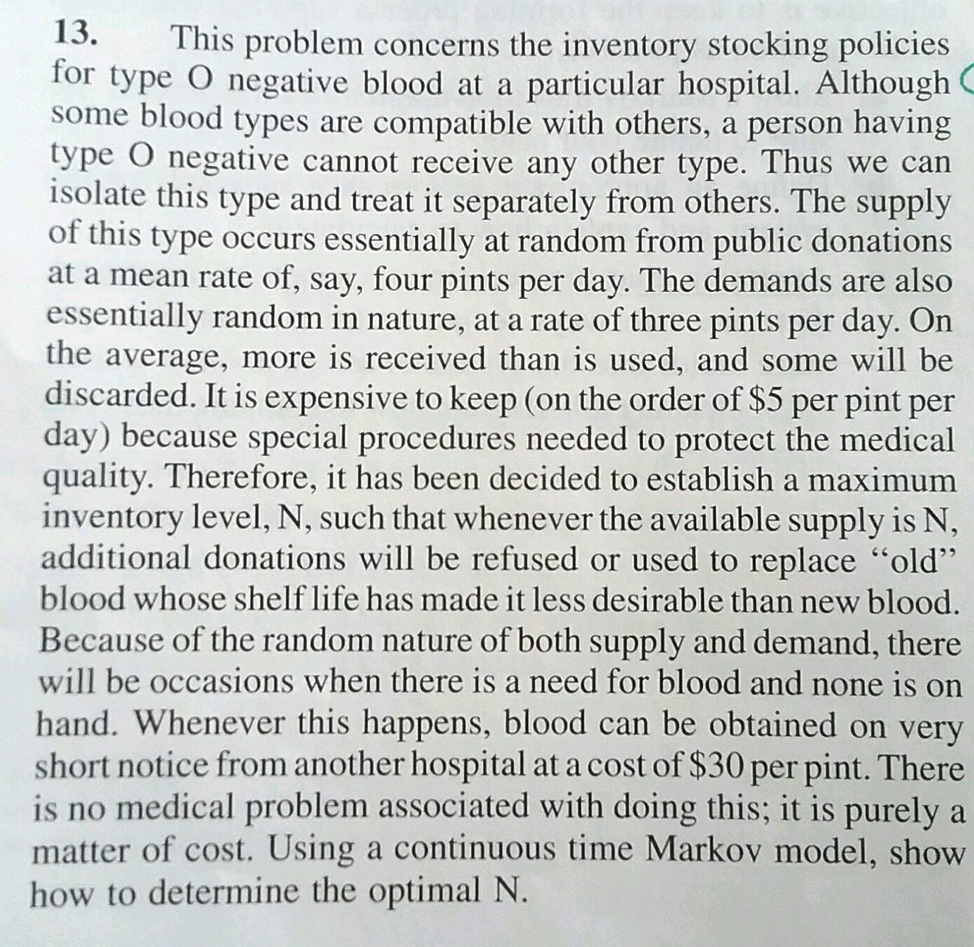
13. This problem concerns the inventory stocking policies for type O negative blood at a particular hospital. Although some blood types are compatible with others, a person having type O negative cannot receive any other type. Thus we can isolate this type and treat it separately from others. The supply of this type occurs essentially at random from public donations at a mean rate of, say, four pints per day. The demands are also essentially random in nature, at a rate of three pints per day. On the average, more is received than is used, and some will be discarded. It is expensive to keep (on the order of $5 per pint per day) because special procedures needed to protect the medical quality. Therefore, it has been decided to establish a maximum inventory level, N, such that whenever the available supply is N additional donations will be refused or used to replace "old" blood whose shelf life has made it less desirable than new blood. Because of the random nature of both supply and demand, there will be occasions when there is a need for blood and none is on hand. Whenever this happens, blood can be obtained on very short notice from another hospital at a cost of $30 per pint. There is no medical problem associated with doing this; it is purely a matter of cost. Using a continuous time Markov model, show how to determine the optimal N
Step by Step Solution
There are 3 Steps involved in it

Get step-by-step solutions from verified subject matter experts
 Study Help