Question: 13.2 MACHINE-LEARNING TECHNIQUES Machine learning techniques enable computers to acquire knowledge (i.e., learn) from data that reflects the historical happenings. They overcome deficiencies of manual
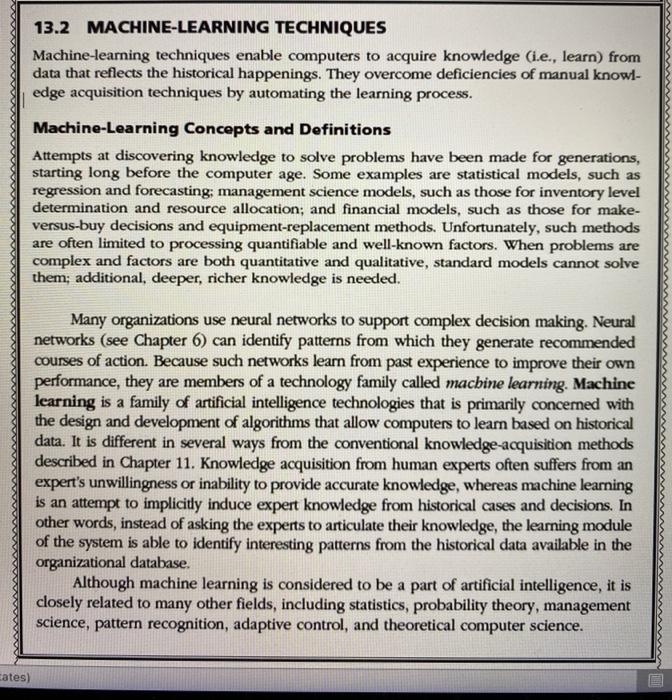
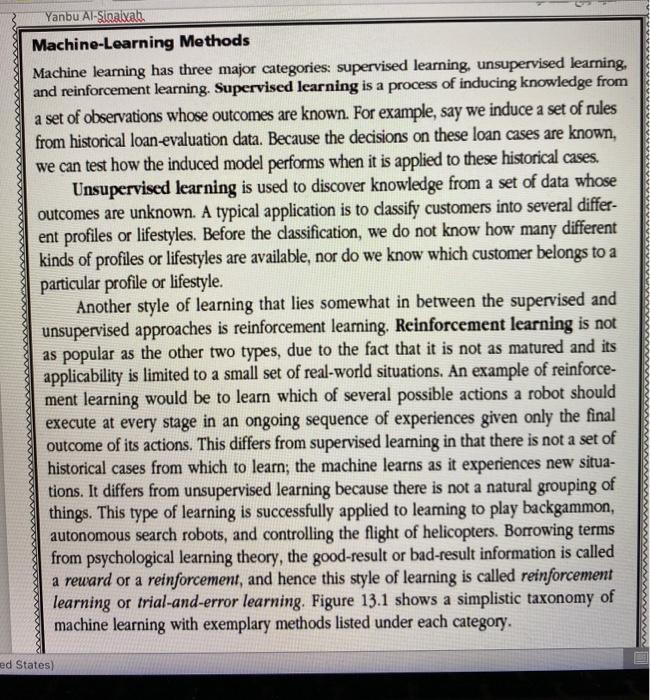
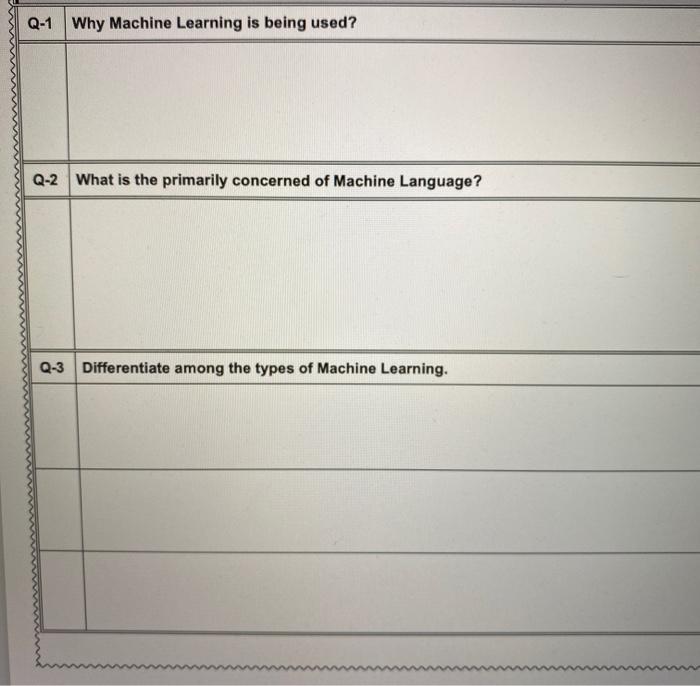
13.2 MACHINE-LEARNING TECHNIQUES Machine learning techniques enable computers to acquire knowledge (i.e., learn) from data that reflects the historical happenings. They overcome deficiencies of manual knowl- edge acquisition techniques by automating the learning process. Machine-Learning Concepts and Definitions Attempts at discovering knowledge to solve problems have been made for generations, starting long before the computer age. Some examples are statistical models, such as regression and forecasting; management science models, such as those for inventory level determination and resource allocation; and financial models, such as those for make- versus-buy decisions and equipment-replacement methods. Unfortunately, such methods are often limited to processing quantifiable and well-known factors. When problems are complex and factors are both quantitative and qualitative, standard models cannot solve them; additional, deeper, richer knowledge is needed. Many organizations use neural networks to support complex decision making. Neural networks (see Chapter 6) can identify patterns from which they generate recommended courses of action. Because such networks learn from past experience to improve their own performance, they are members of a technology family called machine learning Machine learning is a family of artificial intelligence technologies that is primarily concerned with the design and development of algorithms that allow computers to learn based on historical data. It is different in several ways from the conventional knowledge acquisition methods described in Chapter 11. Knowledge acquisition from human experts often suffers from an expert's unwillingness or inability to provide accurate knowledge, whereas machine learning is an attempt to implicitly induce expert knowledge from historical cases and decisions. In other words, instead of asking the experts to articulate their knowledge, the learning module of the system is able to identify interesting patterns from the historical data available in the organizational database. Although machine learning is considered to be a part of artificial intelligence, it is closely related to many other fields, including statistics, probability theory, management science, pattern recognition, adaptive control, and theoretical computer science. Eates) Yanbu Al-Sinalxah Machine Learning Methods Machine learning has three major categories: supervised learning, unsupervised learning, and reinforcement learning. Supervised learning is a process of inducing knowledge from a set of observations whose outcomes are known. For example, say we induce a set of rules from historical loan-evaluation data. Because the decisions on these loan cases are known, we can test how the induced model performs when it is applied to these historical cases. Unsupervised learning is used to discover knowledge from a set of data whose outcomes are unknown. A typical application is to dassify customers into several differ- ent profiles or lifestyles. Before the dassification, we do not know how many different kinds of profiles or lifestyles are available, nor do we know which customer belongs to a particular profile or lifestyle. Another style of learning that lies somewhat in between the supervised and unsupervised approaches is reinforcement learning. Reinforcement learning is not as popular as the other two types, due to the fact that it is not as matured and its applicability is limited to a small set of real-world situations. An example of reinforce- ment learning would be to learn which of several possible actions a robot should execute at every stage in an ongoing sequence of experiences given only the final outcome of its actions. This differs from supervised learning in that there is not a set of historical cases from which to learn; the machine learns as it experiences new situa- tions. It differs from unsupervised learning because there is not a natural grouping of things. This type of learning is successfully applied to leaming to play backgammon, autonomous search robots, and controlling the flight of helicopters. Borrowing terms from psychological learning theory, the good-result or bad-result information is called a reward or a reinforcement, and hence this style of learning is called reinforcement learning or trial-and-error learning. Figure 13.1 shows a simplistic taxonomy of machine learning with exemplary methods listed under each category. ed States) Q-1 Why Machine Learning is being used? Q-2 What is the primarily concerned of Machine Language? Q-3 Differentiate among the types of Machine Learning









 Study Help