



Question: *13.24. (Effect of Leverage with Floating Rate Debt) Consider the case of (riskless from a default perspective) variable or floating rate debt. Show that the
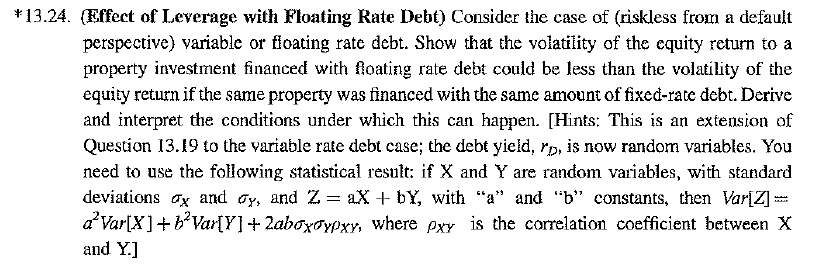
*13.24. (Effect of Leverage with Floating Rate Debt) Consider the case of (riskless from a default perspective) variable or floating rate debt. Show that the volatility of the cquity return to a property investment financed with floating rate debt could be less than the volatility of the equity return if the same property was financed with the same amount of fixed-rate debt. Derive and interpret the conditions under which this can happen. [Hints: This is an extension of Question 13.19 to the variable rate debt case; the debt yield, rp, is now random variables. You need to use the following statistical result: if X and Y are random variables, with standard deviations Oy and Oy, and Z = ax + by, with "a" and "b" constants, then Var[Z] - a Var[X]+BVar[Y] + 2abox yaxy, where Pxy is the correlation coefficient between X and Y.] *13.24. (Effect of Leverage with Floating Rate Debt) Consider the case of (riskless from a default perspective) variable or floating rate debt. Show that the volatility of the cquity return to a property investment financed with floating rate debt could be less than the volatility of the equity return if the same property was financed with the same amount of fixed-rate debt. Derive and interpret the conditions under which this can happen. [Hints: This is an extension of Question 13.19 to the variable rate debt case; the debt yield, rp, is now random variables. You need to use the following statistical result: if X and Y are random variables, with standard deviations Oy and Oy, and Z = ax + by, with "a" and "b" constants, then Var[Z] - a Var[X]+BVar[Y] + 2abox yaxy, where Pxy is the correlation coefficient between X and Y.]
Step by Step Solution
There are 3 Steps involved in it

Get step-by-step solutions from verified subject matter experts