







Question: 134 (b) (c) (d) (e) (f) Chap. 3 The simplex method The first row in the present tableau indicates that the problem is infeasible. The
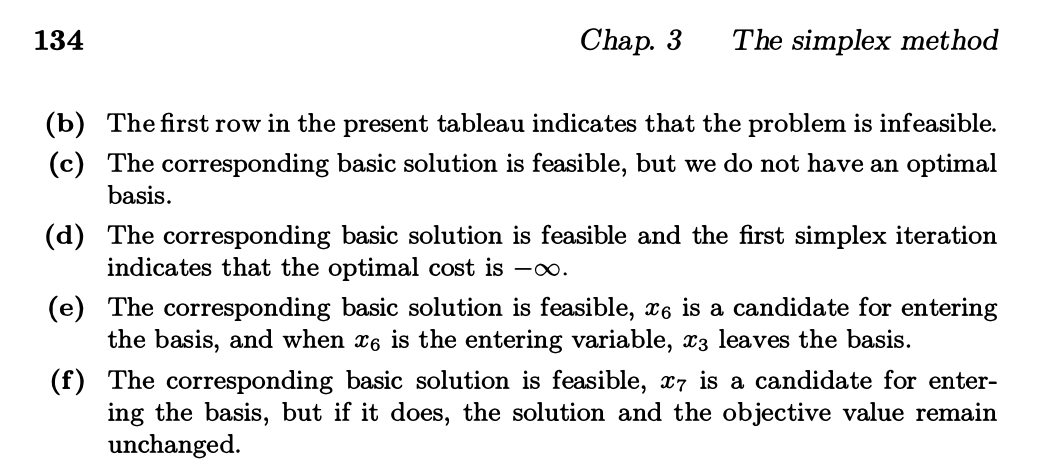
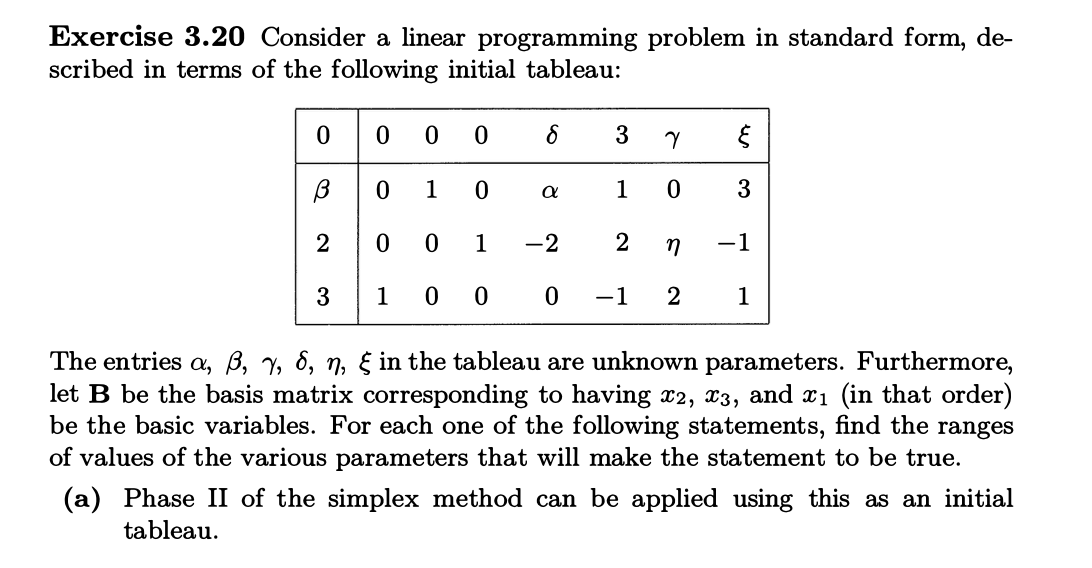
134 (b) (c) (d) (e) (f) Chap. 3 The simplex method The first row in the present tableau indicates that the problem is infeasible. The corresponding basic solution is feasible, but we do not have an optimal basis. The corresponding basic solution is feasible and the first simplex iteration indicates that the optimal cost is oo. The corresponding basic solution is feasible, is a candidate for entering the basis, and when zg is the entering variable, 3 leaves the basis. The corresponding basic solution is feasible, 7 is a candidate for enter- ing the basis, but if it does, the solution and the objective value remain unchanged. Exercise 3.20 Consider a linear programming problem in standard form, de- scribed in terms of the following initial tableau: The entries o, B, v, 6, n, in the tableau are unknown parameters. Furthermore, let B be the basis matrix corresponding to having z2, 3, and 1 (in that order) be the basic variables. For each one of the following statements, find the ranges of values of the various parameters that will make the statement to be true. (a) Phase II of the simplex method can be applied using this as an initial tableau
Step by Step Solution
There are 3 Steps involved in it

Get step-by-step solutions from verified subject matter experts
 Study Help