







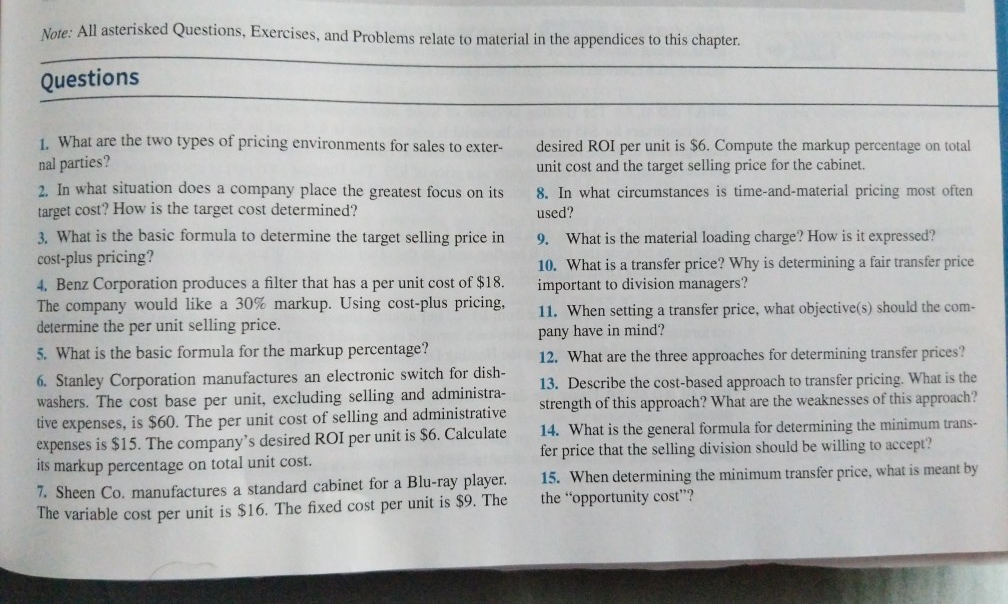
Question: 1,3,5 then 9 through 16 Note: All asterisked Questions, Exercises, and Problems relate to material in the appendices to this chapter. Questions 1. What are
1,3,5 then 9 through 16
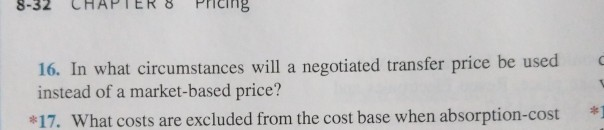
Note: All asterisked Questions, Exercises, and Problems relate to material in the appendices to this chapter. Questions 1. What are the two types of pricing environments for sales to exter- nal parties? 2. In what situation does a company place the greatest focus on its target cost? How is the target cost determined? 3. What is the basic formula to determine the target selling price in cost-plus pricing? 4. Benz Corporation produces a filter that has a per unit cost of $18. The company would like a 30% markup. Using cost-plus pricing, determine the per unit selling price. 5. What is the basic formula for the markup percentage? 6. Stanley Corporation manufactures an electronic switch for dish- washers. The cost base per unit, excluding selling and administra- tive expenses, is $60. The per unit cost of selling and administrative expenses is $15. The company's desired ROI per unit is $6. Calculate its markup percentage on total unit cost. 7. Sheen Co. manufactures a standard cabinet for a Blu-ray player. The variable cost per unit is $16. The fixed cost per unit is $9. The desired ROI per unit is $6. Compute the markup percentage on total unit cost and the target selling price for the cabinet. 8. In what circumstances is time-and-material pricing most often used? 9. What is the material loading charge? How is it expressed? 10. What is a transfer price? Why is determining a fair transfer price important to division managers? 11. When setting a transfer price, what objective(s) should the com- pany have in mind? 12. What are the three approaches for determining transfer prices? 13. Describe the cost-based approach to transfer pricing. What is the strength of this approach? What are the weaknesses of this approach? 14. What is the general formula for determining the minimum trans- fer price that the selling division should be willing to accept? 15. When determining the minimum transfer price, what is meant by the opportunity cost"? 332 CHAPIRO PICI 16. In what circumstances will a negotiated transfer price be used instead of a market-based price? *17. What costs are excluded from the cost base when absorption-cost *
Step by Step Solution
There are 3 Steps involved in it

Get step-by-step solutions from verified subject matter experts
 Study Help