







Question: 1.4 De Morgan's theorem in programming Jamie is making a robot vacuum cleaner. The robot has three sensors to detect if the robot is located
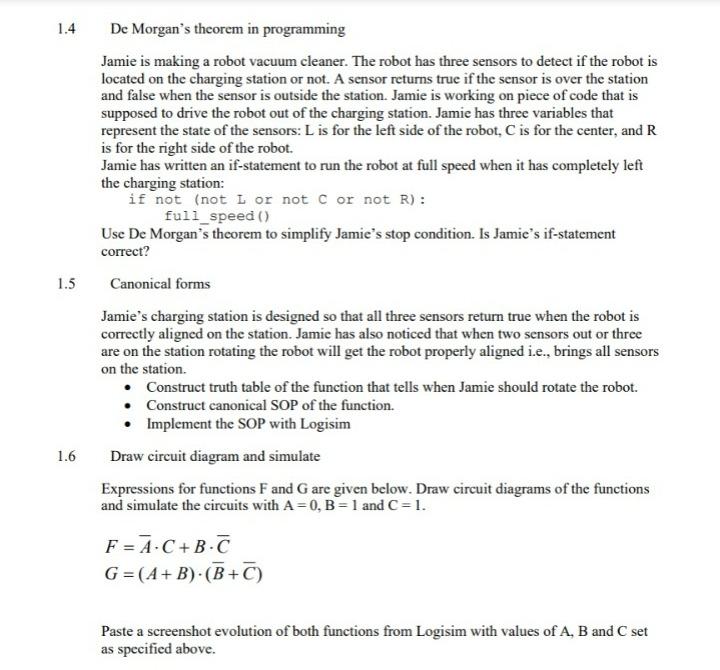
1.4 De Morgan's theorem in programming Jamie is making a robot vacuum cleaner. The robot has three sensors to detect if the robot is located on the charging station or not. A sensor returns true if the sensor is over the station and false when the sensor is outside the station. Jamie is working on piece of code that is supposed to drive the robot out of the charging station. Jamie has three variables that represent the state of the sensors: L is for the left side of the robot, C is for the center, and R is for the right side of the robot. Jamie has written an if-statement to run the robot at full speed when it has completely left the charging station: if not (not L or not C or not R): full_speed() Use De Morgan's theorem to simplify Jamie's stop condition. Is Jamie's if-statement correct? 1.5 Canonical forms Jamie's charging station is designed so that all three sensors return true when the robot is correctly aligned on the station. Jamic has also noticed that when two sensors out or three are on the station rotating the robot will get the robot properly aligned i.e., brings all sensors on the station. - Construct truth table of the function that tells when Jamie should rotate the robot. - Construct canonical SOP of the function. - Implement the SOP with Logisim 1.6 Draw circuit diagram and simulate Expressions for functions F and G are given below. Draw circuit diagrams of the functions and simulate the circuits with A=0,B=1 and C=1. F=AC+BCG=(A+B)(B+C) Paste a screenshot evolution of both functions from Logisim with values of A,B and C set as specified above
Step by Step Solution
There are 3 Steps involved in it

Get step-by-step solutions from verified subject matter experts
 Study Help