







Question: 14. Froen the standard reduction potential values given below, which of the following statements is trae far the following reaction? 2Fe3+(aq)+2Br(aq)Br2(O)+2Ee2+(aq)Br2(D)+2e2Br(aq)Fe3+(aq)+eFe2+(aq)Ev=+1.09VE=+0.77V a. The stasdard cell
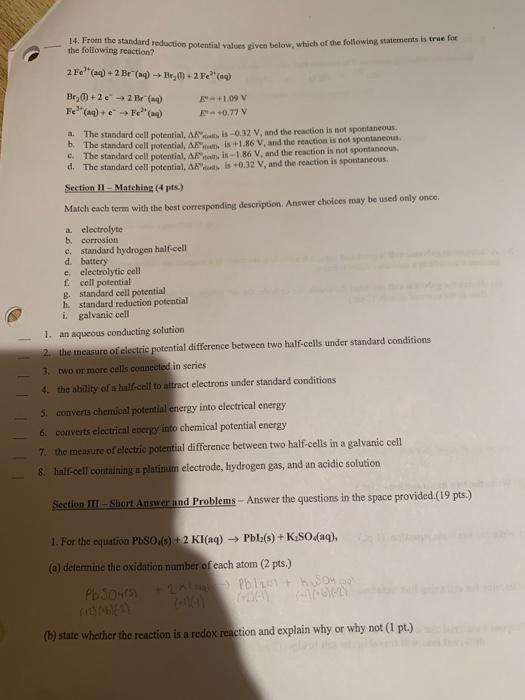
14. Froen the standard reduction potential values given below, which of the following statements is trae far the following reaction? 2Fe3+(aq)+2Br(aq)Br2(O)+2Ee2+(aq)Br2(D)+2e2Br(aq)Fe3+(aq)+eFe2+(aq)Ev=+1.09VE=+0.77V a. The stasdard cell potential, FWinathis0.32V, and the resction is not spontaneous. b. The standard cell potential, EYhaile is +1.86V, and the reaction is not spoetaneoua. c. The standard cell potential, Ar: Ytathe is 1.86V, and the reaction is not spontaneous. d. The standard cell potential, EV reobll Section II-Matching (4 pts.) Match each term with the best corresponding description. Answer choices may be used only once. a. electrolyte b. corrosion. c. standard hydrogen half-cell d. battery c. electrolytic cell f. cell potential g. standard cell potential h. standard roduetion potential i. galvanic cell 1. an aqueous conducting solution 2. the measure of electric potential difference between two half-cells under standard conditions 3. two or more oells conatcted in series 4. the ability of a hinffecll io atract electrons under standard conditions 5. converts chemical potential energy into clectrical energy 6. converts electrieal evcrigy into chemical potential energy 7. the mearure of electre potential difference between two half-cells in a galvanio cell 8. half-cell continining it platimum electrode, hydrogen gas, and in acidio solution Section IT - Short Amsyer and Problems - Answer the questions in the space provided.(19 pts.) 1. For tho equation PbSO4(s)+2KI(aq)PbI2(s)+K2SO4(aq)4 (a) defemine the oxidation number of each atom (2 pts.) (b) state whether the reaction is a redox reaction and explain why or why not ( 1 pt.)
Step by Step Solution
There are 3 Steps involved in it

Get step-by-step solutions from verified subject matter experts
 Study Help