







Question: (14%) Problem 2: Consider the three resistors R1 = 21 9, R2 = 48 Q, and R 3 = 83 Q in the conguration shown
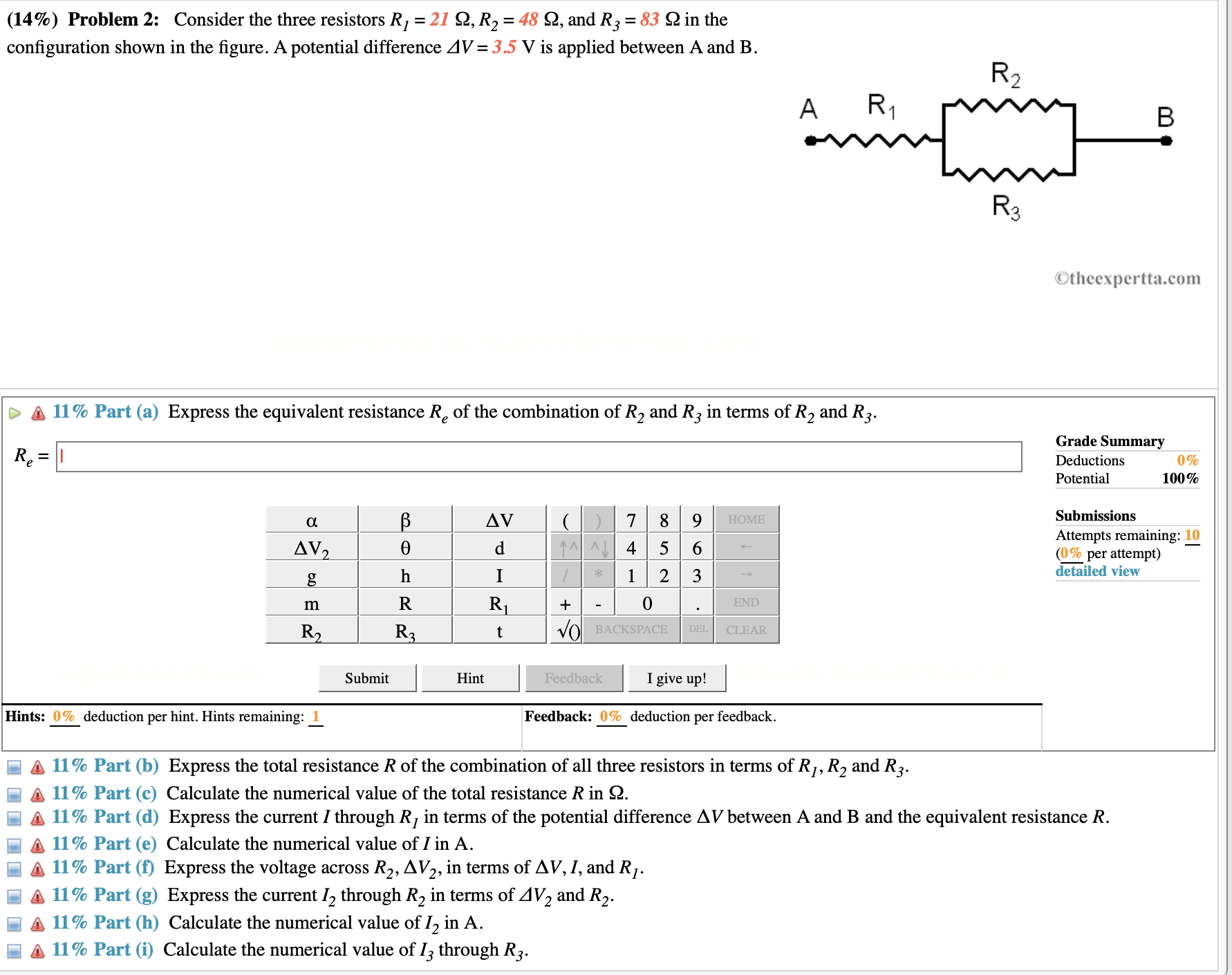
(14%) Problem 2: Consider the three resistors R1 = 21 9, R2 = 48 Q, and R 3 = 83 Q in the conguration shown in the gure. A potential difference AV: 3.5 V is applied between A and B. D a 11% Part (a) Express the equivalent resistance R e of the combination of R2 and R 3 in terms of R 2 and R 3. Re = I a [3 AV ( ) 7 8 9 HOME AV2 e d v A; 4 5 6 e g h I I * 1 2 3 a m R R] + ' 0 . END R2 R3 t J0 BACKSPACE DBL arm Submit Hint Feedback I give up! Hints: 0% deduction pet hint. Hints remaining: i Feedback: 0% deduction pet feedback. E 3 11% Part (b) Express the total resistance R of the combination of all three resistors in terms of R1 , R2 and R3. E A 11% Part (c) Calculate the numerical value of the total resistance R in Q. Uthccxpcrttarnm Grade Summary Deductions 0 % Potential 100% Submissions Attempts remaining: Q (g per attempt) detailed view E A 11% Part (d) Express the current I through R1 in terms of the potential difference AV between A and B and the equivalent resistance R. E a 11% Part (e) Calculate the numerical value of I in A. E 11% Part (D Express the voltage across R2, AVZ, in terms of AV, I, and R1. 8 11% Part (g) Express the current 12 through R2 in terms ofAV2 and R2. A 11% Part (h) Calculate the numerical value of 12 in A. 3 11% Part (i) Calculate the numerical value of I 3 through R 3
Step by Step Solution
There are 3 Steps involved in it

Get step-by-step solutions from verified subject matter experts
 Study Help