







Question: 14. This problem studies the steady state system related to a reaction-diffusion system modeling a flocculation process in an un-stirred chemostat, where the isolated or
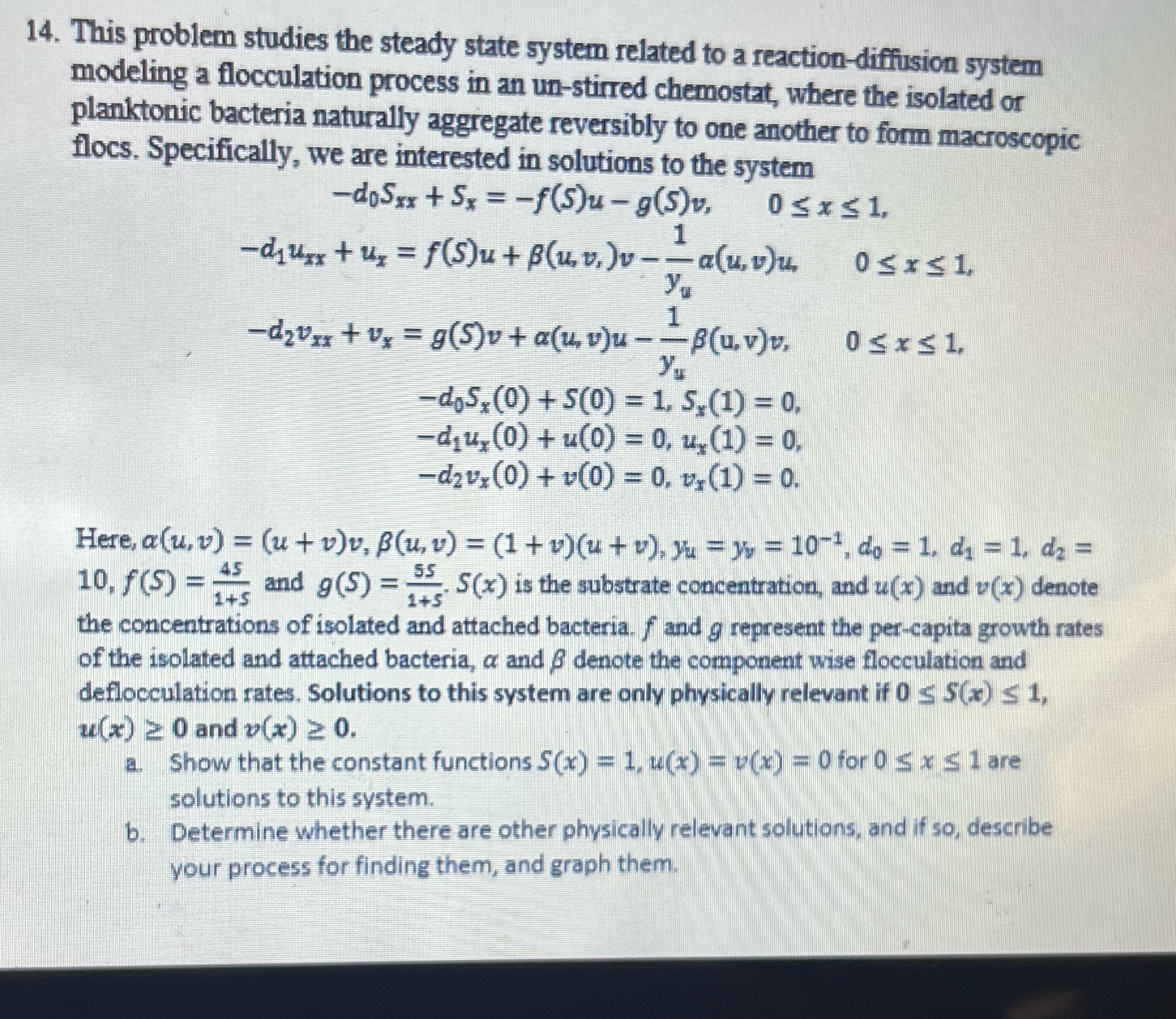
14. This problem studies the steady state system related to a reaction-diffusion system modeling a flocculation process in an un-stirred chemostat, where the isolated or planktonic bacteria naturally aggregate reversible to one another to form macroscopic flocs. Specifically, we are interested in solutions to the system -doSxx + Sx =-f(S)u- g(5)v. Osx51, -djurx + u, = f(S)u+ B(u.v.)v--a(u.v)u. 0sxs1, yu -davis + v, = g(S)v + a(u, v)u - -B(u.v)v, Osxs1, yu -doS, (0) + 5(0) = 1. 5,(1) = 0, -dju, (0) + u(0) = 0, u, (1) = 0, -divx(0) + v(0) = 0, v.(1) = 0. Here, a (u, v) = (u + v)v, B(u, v) = (1 + v)(u + v), j = > = 10"), do = 1, dj = 1, dz = 10. f (S) = = and g(S) = S(x) is the substrate concentration, and u(x) and v(x) denote the concentrations of isolated and attached bacteria. f and g represent the per-capita growth rates of the isolated and attached bacteria, a and 8 denote the component wise flocculation and deflocculation rates. Solutions to this system are only physically relevant if 0 s S(x) $ 1, u(x) 2 0 and v(x) 2 0. a. Show that the constant functions S(x) = 1, u(x) = v(x) = 0 for 0 s x $ 1 are solutions to this system. b. Determine whether there are other physically relevant solutions, and if so, describe your process for finding them, and graph them
Step by Step Solution
There are 3 Steps involved in it

Get step-by-step solutions from verified subject matter experts
 Study Help