







Question: 14. Why is benchmarking challenging? a. It can be difficult to find an equivalent firm (based on business size, types of businesses, etc.) on which
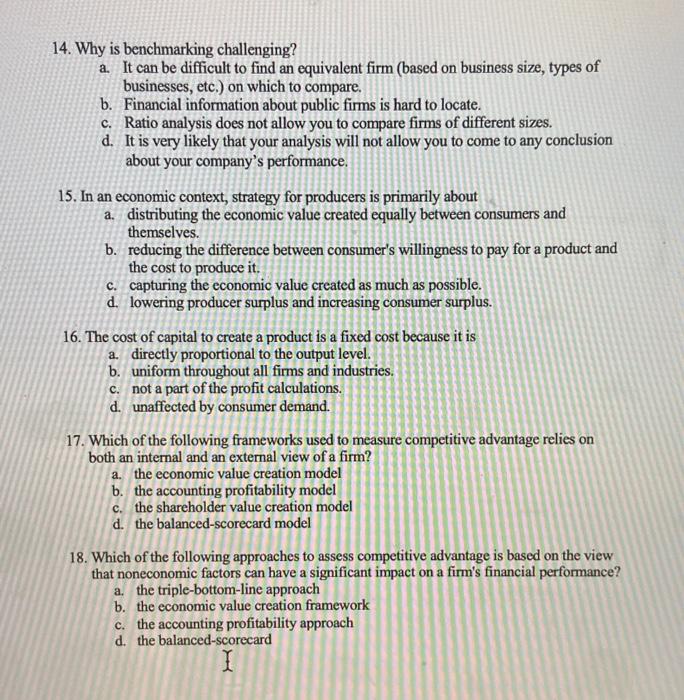
14. Why is benchmarking challenging? a. It can be difficult to find an equivalent firm (based on business size, types of businesses, etc.) on which to compare. b. Financial information about public firms is hard to locate. c. Ratio analysis does not allow you to compare firms of different sizes. d. It is very likely that your analysis will not allow you to come to any conclusion about your company's performance. 15. In an economic context, strategy for producers is primarily about a. distributing the economic value created equally between consumers and themselves. b. reducing the difference between consumer's willingness to pay for a product and the cost to produce it. c. capturing the economic value created as much as possible. d. lowering producer surplus and increasing consumer surplus. 16. The cost of capital to create a product is a fixed cost because it is a. directly proportional to the output level. b. uniform throughout all firms and industries. c. not a part of the profit calculations. d. unaffected by consumer demand. 17. Which of the following frameworks used to measure competitive advantage relies on both an internal and an external view of a firm? a. the economic value creation model b. the accounting profitability model c. the shareholder value creation model d. the balanced-scorecard model 18. Which of the following approaches to assess competitive advantage is based on the view that noneconomic factors can have a significant impact on a firm's financial performance? a. the triple-bottom-line approach b. the economic value creation framework c. the accounting profitability approach d. the balanced-scorecard
Step by Step Solution
There are 3 Steps involved in it

Get step-by-step solutions from verified subject matter experts
 Study Help