







Question: 14.2 For the disk I/O and CPU data in Example 14.1, find a linear formula to predict the number of disk I/O's given the CPU
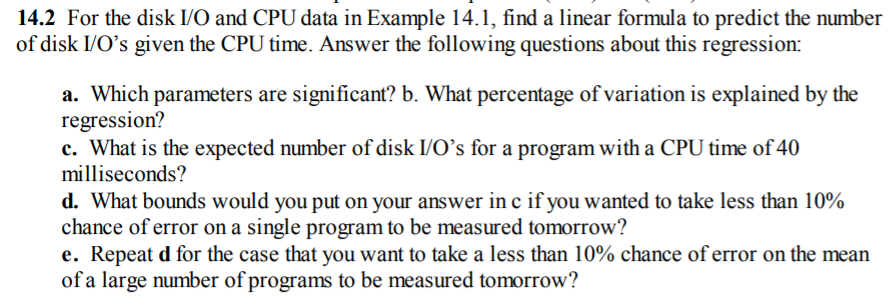

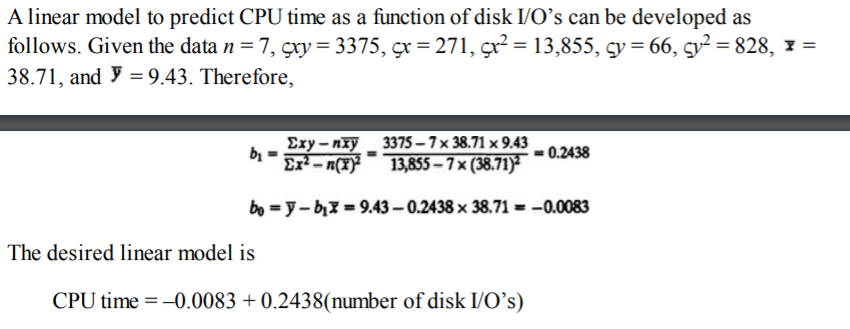
14.2 For the disk I/O and CPU data in Example 14.1, find a linear formula to predict the number of disk I/O's given the CPU time. Answer the following questions about this regression: a. Which parameters are significant? b. What percentage of variation is explained by the regression? c. What is the expected number of disk I/O's for a program with a CPU time of 40 milliseconds? d. What bounds would you put on your answer in c if you wanted to take less than 10% chance of error on a single program to be measured tomorrow? e. Repeat d for the case that you want to take a less than 10% chance of error on the mean of a large number of programs to be measured tomorrow? Example 14.1 The number of disk I/O's and processor times of seven programs were measured as {(14, 2), (16, 5), (27, 7 (42,9), (39, 10), (50, 13), (83, 20)}. A linear model to predict CPU time as a function of disk I/O's can be developed as follows. Given the data n = 7, sxy = 3375, sx = 271, x2 = 13,855, sy = 66, $y2 = 828, 3 = 38.71, and 5 = 9.43. Therefore, 3375 - 7 x 38.71 x 9.43 -0.2438 b-272-n(3) - 13,855 7x (38.71) boy -b17 = 9.43 -0.2438 x 38.71 = -0.0083 The desired linear model is CPU time = -0.0083 + 0.2438(number of disk I/O's)
Step by Step Solution
There are 3 Steps involved in it

Get step-by-step solutions from verified subject matter experts
 Study Help