



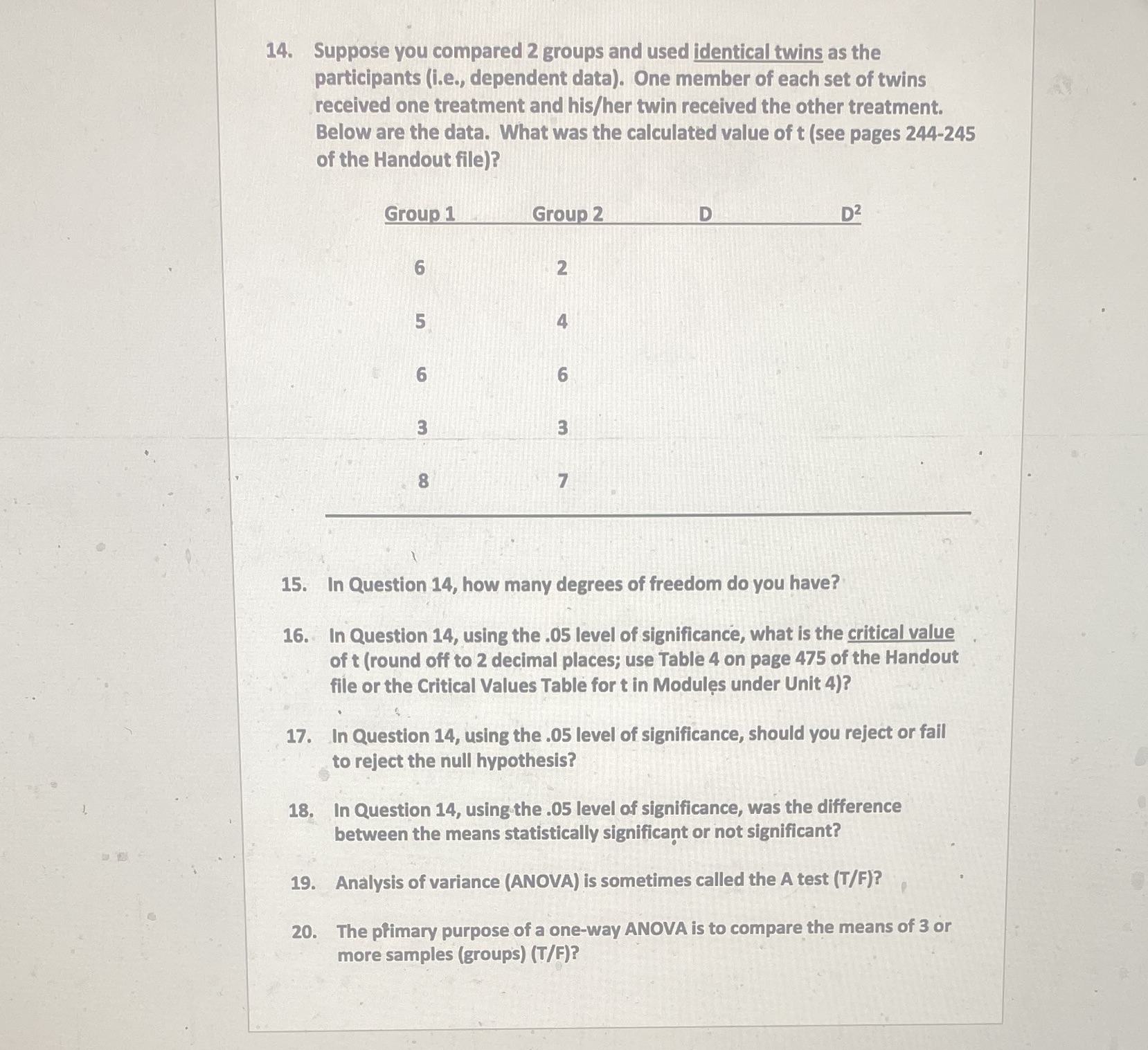
Question: 14-20 14. Suppose you compared 2 groups and used identical twins as the participants (i.e., dependent data). One member of each set of twins received
14-20
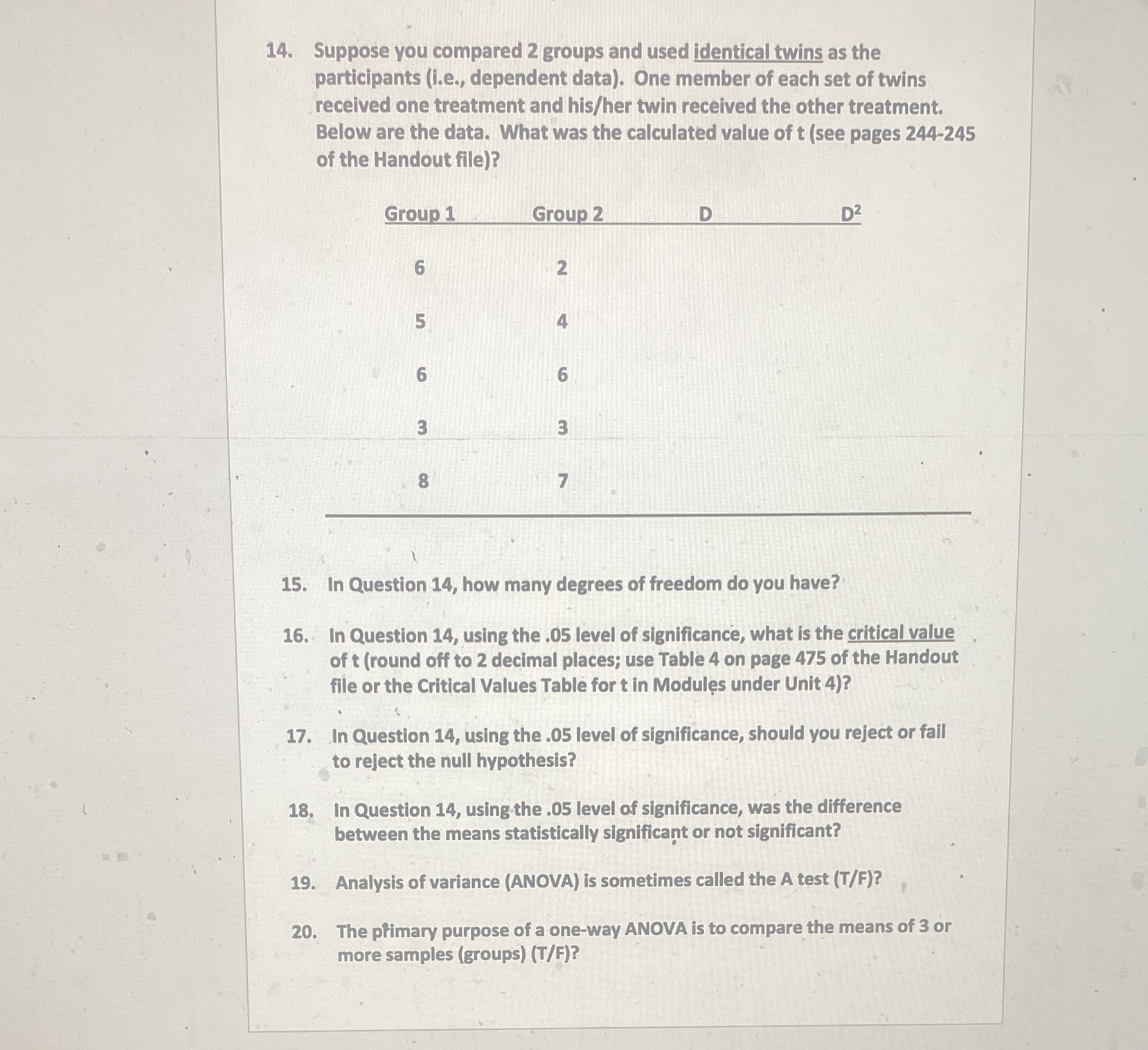
14. Suppose you compared 2 groups and used identical twins as the participants (i.e., dependent data). One member of each set of twins received one treatment and his/her twin received the other treatment. Below are the data. What was the calculated value of t (see pages 244-245 of the Handout file)? Group 1 Group 2 D D2 N 5 P W w 15. In Question 14, how many degrees of freedom do you have? 16. In Question 14, using the .05 level of significance, what is the critical value of t (round off to 2 decimal places; use Table 4 on page 475 of the Handout file or the Critical Values Table for t in Modules under Unit 4)? 17. In Question 14, using the .05 level of significance, should you reject or fail to reject the null hypothesis? 18. In Question 14, using the .05 level of significance, was the difference between the means statistically significant or not significant? 19. Analysis of variance (ANOVA) is sometimes called the A test (T/F)? 20. The primary purpose of a one-way ANOVA is to compare the means of 3 or more samples (groups) (T/F)
Step by Step Solution
There are 3 Steps involved in it

Get step-by-step solutions from verified subject matter experts