







Question: 1.5 FTEs O2.0 FTEs OCannot tell from the data given When most of us talk about bureaucracy, we do so in negative terms. That is,
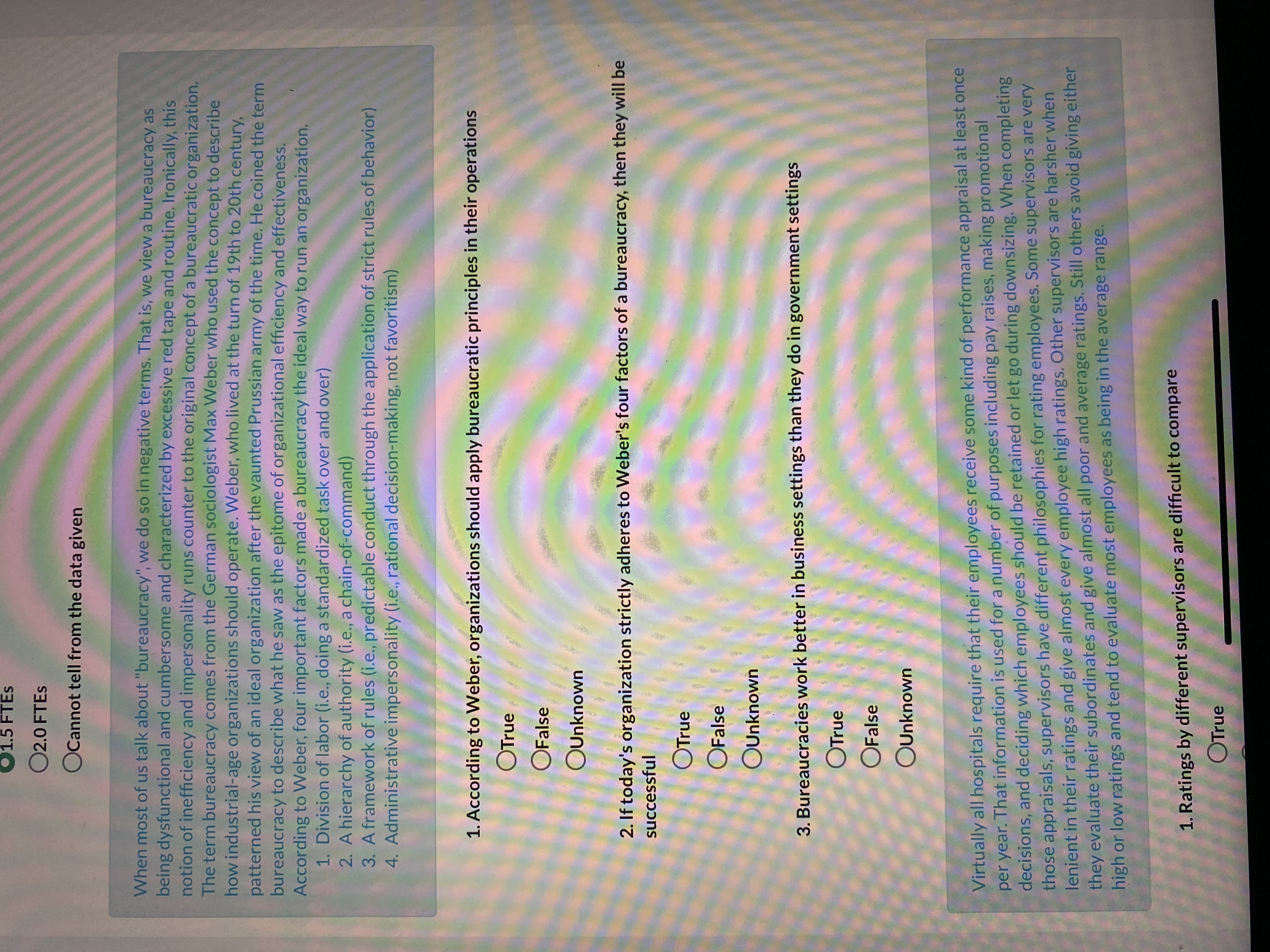
1.5 FTEs O2.0 FTEs OCannot tell from the data given When most of us talk about "bureaucracy", we do so in negative terms. That is, we view a bureaucracy as being dysfunctional and cumbersome and characterized by excessive red tape and routine. Ironically, this notion of inefficiency and impersonality runs counter to the original concept of a bureaucratic organization. The term bureaucracy comes from the German sociologist Max Weber who used the concept to describe how industrial-age organizations should operate. Weber, who lived at the turn of 19th to 20th century, patterned his view of an ideal organization after the vaunted Prussian army of the time. He coined the term bureaucracy to describe what he saw as the epitome of organizational efficiency and effectiveness. According to Weber, four important factors made a bureaucracy the ideal way to run an organization. 1. Division of labor (i.e., doing a standardized task over and over) 2. A hierarchy of authority (i.e., a chain-of-command) 3. A framework of rules (i.e., predictable conduct through the application of strict rules of behavior) 4. Administrative impersonality (i.e., rational decision-making, not favoritism) 1. According to Weber, organizations should apply bureaucratic principles in their operations OTrue OFalse OUnknown 2. If today's organization strictly adheres to Weber's four factors of a bureaucracy, then they will be successful OTrue OFalse OUnknown 3. Bureaucracies work better in business settings than they do in government settings OTrue OFalse OUnknown Virtually all hospitals require that their employees receive some kind of performance appraisal at least once per year. That information is used for a number of purposes including pay raises, making promotional decisions, and deciding which employees should be retained or let go during downsizing. When completing those appraisals, supervisors have different philosophies for rating employees. Some supervisors are very lenient in their ratings and give almost every employee high ratings. Other supervisors are harsher when they evaluate their subordinates and give almost all poor and average ratings. Still others avoid giving either high or low ratings and tend to evaluate most employees as being in the average range. 1. Ratings by different supervisors are difficult to compare OTrue
Step by Step Solution
There are 3 Steps involved in it

Get step-by-step solutions from verified subject matter experts
 Study Help