







Question: 15. If the null hypothesis is H0 : p = 111 {where p is the probability of sioeerreetsl, attribute the probabilities derived as type |
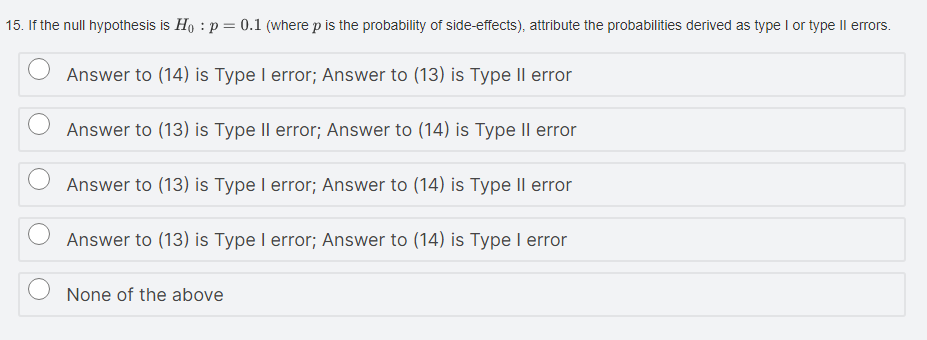

15. If the null hypothesis is H0 : p = 111 {where p is the probability of sioeerreetsl, attribute the probabilities derived as type | or type II errors. 0 Answer to (14] is Type I error; Answer to [13) is Type II error 0 Answer to (13] is Type II error; Answer to (14}I is Type II error 0 Answer to (13] is Type I error; Answer to {14) is Type II error 0 Answer to (13] is Type I error; Answer to {14) is Type I error 0 None of the above A pharmaceutical company claims that a new drug (A) cures a disease with only 10% of patients suffering nausea as a side-effect. Medical researchers are concerned about the probability of side-effects and propose a study of the case histories of 400 patients. Their recommendation to their employers will be to use an alternative, more expensive, drug (B) if 13% or more patients are found to have suffered side-effects. {Remember, if the probability of an event is p, the standard error of a sample proportion drawn from n observations is p (1 - p) / vn}
Step by Step Solution
There are 3 Steps involved in it

Get step-by-step solutions from verified subject matter experts
 Study Help