



Question: (15 points) Consider the following situation. It is a made up, but you should be able to imagine that it is a useful model to
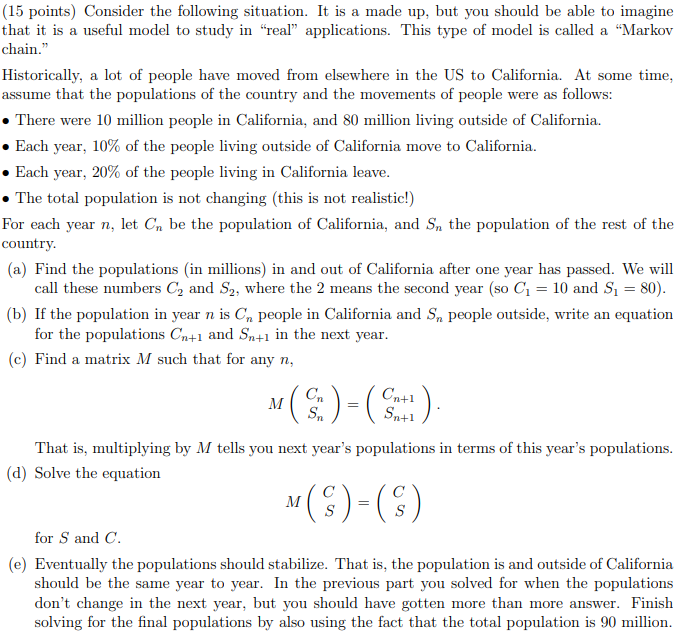
(15 points) Consider the following situation. It is a made up, but you should be able to imagine that it is a useful model to study in "real" applications. This type of model is called a "Markov chain." Historically, a lot of people have moved from elsewhere in the US to California. At some time, assume that the populations of the country and the movements of people were as follows: There were 10 million people in California, and 80 million living outside of California. Each year, 10% of the people living outside of California move to California. Each year, 20% of the people living in California leave. The total population is not changing (this is not realistic!) For each year n, let Cn be the population of California, and Sn the population of the rest of the country. (a) Find the populations (in millions) in and out of California after one year has passed. We will call these numbers C, and S2, where the 2 means the second year (so G = 10 and S1 = 80). (b) If the population in year n is n people in California and Sn people outside, write an equation for the populations Cn+1 and Sn+1 in the next year. (c) Find a matrix M such that for any n, Cn+1 M M (S) =( Sn+1 :). That is, multiplying by M tells you next year's populations in terms of this year's populations. (d) Solve the equation M S S for S and C. (e) Eventually the populations should stabilize. That is, the population is and outside of California should be the same year to year. In the previous part you solved for when the populations don't change in the next year, but you should have gotten more than more answer. Finish solving for the final populations by also using the fact that the total population is 90 million. (15 points) Consider the following situation. It is a made up, but you should be able to imagine that it is a useful model to study in "real" applications. This type of model is called a "Markov chain." Historically, a lot of people have moved from elsewhere in the US to California. At some time, assume that the populations of the country and the movements of people were as follows: There were 10 million people in California, and 80 million living outside of California. Each year, 10% of the people living outside of California move to California. Each year, 20% of the people living in California leave. The total population is not changing (this is not realistic!) For each year n, let Cn be the population of California, and Sn the population of the rest of the country. (a) Find the populations (in millions) in and out of California after one year has passed. We will call these numbers C, and S2, where the 2 means the second year (so G = 10 and S1 = 80). (b) If the population in year n is n people in California and Sn people outside, write an equation for the populations Cn+1 and Sn+1 in the next year. (c) Find a matrix M such that for any n, Cn+1 M M (S) =( Sn+1 :). That is, multiplying by M tells you next year's populations in terms of this year's populations. (d) Solve the equation M S S for S and C. (e) Eventually the populations should stabilize. That is, the population is and outside of California should be the same year to year. In the previous part you solved for when the populations don't change in the next year, but you should have gotten more than more answer. Finish solving for the final populations by also using the fact that the total population is 90 million
Step by Step Solution
There are 3 Steps involved in it

Get step-by-step solutions from verified subject matter experts