





Question: (15 points) In the Dart programming language (https://dart.dev/), a function has a list of formal parameters (though the parameter list may be empty), and the
 (15 points) In the Dart programming language (https://dart.dev/), a function has

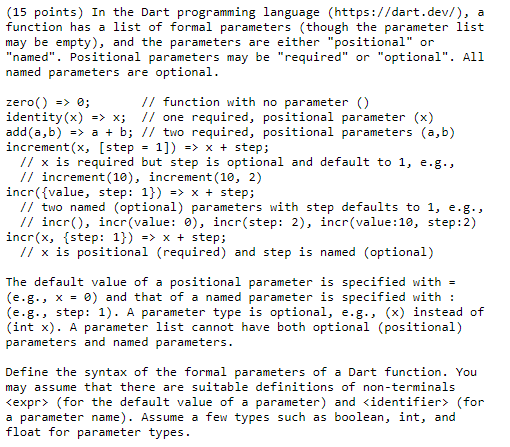
(15 points) In the Dart programming language (https://dart.dev/), a function has a list of formal parameters (though the parameter list may be empty), and the parameters are either "positional" or "named". Positional parameters may be "required" or "optional". All named parameters are optional. zero() => 0; // function with no parameter () identity(x) => X; // one required, positional parameter (x) add(a,b) => a + b; // two required, positional parameters (a,b) increment(X, (step 1]) => x + step: 1/ x is required but step is optional and default to 1, e.g., // increment(10), increment (10, 2) incr({value, step: 1}) => x + step; // two named (optional) parameters with step defaults to 1, e.g., // incr(), incr(value: %), incr(step: 2), incr(value:10, step:2) incr(x, {step: 1)) => x + step: 11 x is positional (required) and step is named (optional) The default value of a positional parameter is specified with = (e.g., X = ) and that of a named parameter is specified with : (e.g., step: 1). A parameter type is optional, e.g., (x) instead of (int x). A parameter list cannot have both optional (positional) parameters and named parameters. Define the syntax of the formal parameters of a Dart function. You may assume that there are suitable definitions of non-terminals (for the default value of a parameter) and (for a parameter name). Assume a few types such as boolean, int, and float for parameter types. (15 points) In the Dart programming language (https://dart.dev/), a function has a list of formal parameters (though the parameter list may be empty), and the parameters are either "positional" or "named". Positional parameters may be "required" or "optional". All named parameters are optional. zero() => 0; // function with no parameter () identity(x) => X; // one required, positional parameter (x) add(a,b) => a + b; // two required, positional parameters (a,b) increment(X, (step 1]) => x + step: 1/ x is required but step is optional and default to 1, e.g., // increment(10), increment (10, 2) incr({value, step: 1}) => x + step; // two named (optional) parameters with step defaults to 1, e.g., // incr(), incr(value: %), incr(step: 2), incr(value:10, step:2) incr(x, {step: 1)) => x + step: 11 x is positional (required) and step is named (optional) The default value of a positional parameter is specified with = (e.g., X = ) and that of a named parameter is specified with : (e.g., step: 1). A parameter type is optional, e.g., (x) instead of (int x). A parameter list cannot have both optional (positional) parameters and named parameters. Define the syntax of the formal parameters of a Dart function. You may assume that there are suitable definitions of non-terminals (for the default value of a parameter) and (for a parameter name). Assume a few types such as boolean, int, and float for parameter types

Step by Step Solution

There are 3 Steps involved in it

1 Expert Approved Answer
Step: 1 Unlock blur-text-image
Question Has Been Solved by an Expert!

Get step-by-step solutions from verified subject matter experts

Step: 2 Unlock
Step: 3 Unlock

Students Have Also Explored These Related Databases Questions!