







Question: (15 points) Let y,; and y,; represent potential grades with and without receiving tutoring services, respectively. Denote the treatment dummy as D;, which equals 1
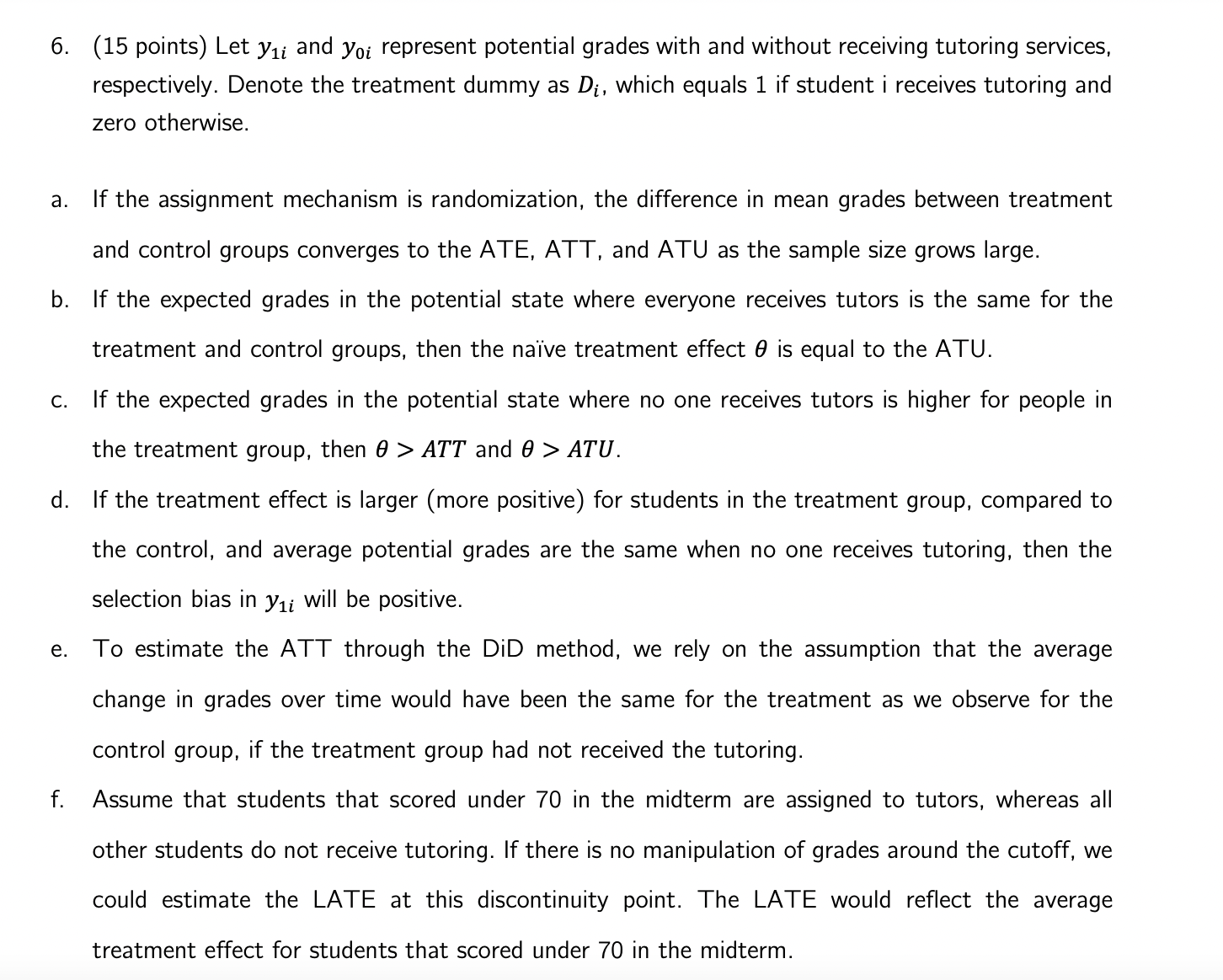
(15 points) Let y,; and y,; represent potential grades with and without receiving tutoring services, respectively. Denote the treatment dummy as D;, which equals 1 if student i receives tutoring and zero otherwise. If the assignment mechanism is randomization, the difference in mean grades between treatment and control groups converges to the ATE, ATT, and ATU as the sample size grows large. If the expected grades in the potential state where everyone receives tutors is the same for the treatment and control groups, then the naive treatment effect 8 is equal to the ATU. If the expected grades in the potential state where no one receives tutors is higher for people in the treatment group, then 8 > ATT and 6 > ATU. If the treatment effect is larger (more positive) for students in the treatment group, compared to the control, and average potential grades are the same when no one receives tutoring, then the selection bias in yy; will be positive. To estimate the ATT through the DiD method, we rely on the assumption that the average change in grades over time would have been the same for the treatment as we observe for the control group, if the treatment group had not received the tutoring. Assume that students that scored under 70 in the midterm are assigned to tutors, whereas all other students do not receive tutoring. If there is no manipulation of grades around the cutoff, we could estimate the LATE at this discontinuity point. The LATE would reflect the average treatment effect for students that scored under 70 in the midterm
Step by Step Solution
There are 3 Steps involved in it

Get step-by-step solutions from verified subject matter experts
 Study Help